Georgia S4L1.d
The Standard
- S4L1
- Obtain, evaluate, and communicate information about the roles of organisms and the flow of energy within an ecosystem.
Use printed and digital data to develop a model illustrating and describing changes to the flow of energy in an ecosystem when plants or animals become scarce, extinct or over-abundant.
Georgia Standards of Excellence for Science · Obtain, evaluate, and communicate information about the roles of organisms and the flow of energy within an ecosystem.
Teacher's field guide
What This Standard Means
What Students Need to Do
- Students use information from articles, charts, and online data to build or revise a food web model. They explain how a population change affects energy available to other organisms.
What Mastery Looks Like
- Students draw energy arrows in the correct direction and use data to support predicted changes. They trace effects through several organisms, including less obvious indirect effects.
Common Misconceptions
- Students may point arrows toward the organism being eaten rather than toward the energy receiver. They may assume one population change affects only its direct predator or prey, or confuse scarcity with extinction.
How to Assess It
- Give students a food web and a data table showing a sharp drop in grass. Ask them to revise the model and explain two likely population changes.
Lesson moves
Ways to Teach It
Build a yarn food web with organism cards, then remove one species card and relabel which energy pathways shrink or disappear.
Show a population graph and ask, "Which organism changed first, and how did that change affect two others?"
Play Food Web Forecast: teams draw a change card, revise a diagram, and earn points for each evidence-based prediction.
Use local deer and plant population data to model how too many deer can change food available for other animals.
Free download
Printable S4L1.d Worksheet
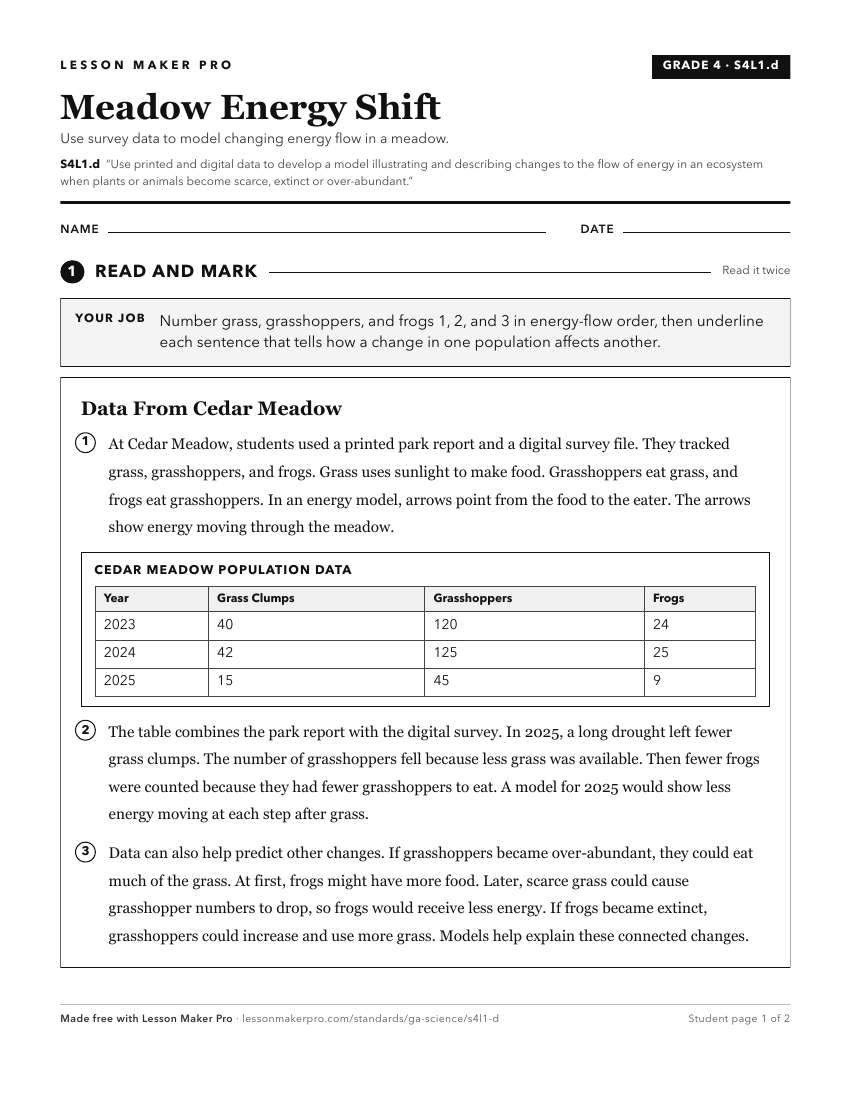
A ready-to-print activity worksheet aligned to S4L1.d, with an answer key for the teacher on its own page. No account needed.
PDF, US Letter, prints cleanly in black and white.
Download the worksheetKeep exploring
Related Standards
- S4L1.c
Design a scenario to demonstrate the effect of a change on an ecosystem.
- S4L1.b
Develop simple models to illustrate the flow of energy through a food web/food chain beginning with sunlight and including producers, consumers, and decomposers...
- S5E1.b
Develop simple interactive models to collect data that illustrate how changes in surface features are/were caused by constructive and/or destructive processes.
- S7L4.b
Develop a model to describe the cycling of matter and the flow of energy among biotic and abiotic components of an ecosystem.
Turn this exact standard into a lesson
Grade, subject, topic, and the complete standard are prefilled. Create one free, no account needed.
Also for this standard:Make a WorksheetMake a QuizMake a Sub Lesson