Georgia S4E3.b
The Standard
- S4E3
- Obtain, evaluate, and communicate information to demonstrate the water cycle.
Develop models to illustrate multiple pathways water may take during the water cycle (evaporation, condensation, and precipitation).
Georgia Standards of Excellence for Science · Obtain, evaluate, and communicate information to demonstrate the water cycle.
Teacher's field guide
What This Standard Means
What Students Need to Do
- Students build models showing how water moves between Earth’s surface and the atmosphere. They use arrows and labels to show more than one possible route through evaporation, condensation, and precipitation.
What Mastery Looks Like
- A student creates a clear model with correctly placed arrows and process labels. They can trace two different routes and explain what changes the water at each step.
Common Misconceptions
- Students may think the water cycle always follows one fixed circle. They may treat clouds as water vapor, confuse condensation with precipitation, or think precipitation means only rain.
How to Assess It
- Exit ticket: Draw two different paths one water drop could take through the water cycle. Label evaporation, condensation, and precipitation, and show movement with arrows.
Lesson moves
Ways to Teach It
Give pairs water location cards and blue counters; students move each counter along two different routes, adding labeled arrows for each process.
Ask, “Can one water drop follow more than one route?” Students sketch two routes and explain where evaporation, condensation, and precipitation occur.
Play Water Drop Pathways: students draw location cards, choose a possible next stop, and name the process that moves the water.
Use a local weather forecast to trace how rainwater from a school puddle could later become cloud water and fall elsewhere.
Free download
Printable S4E3.b Worksheet
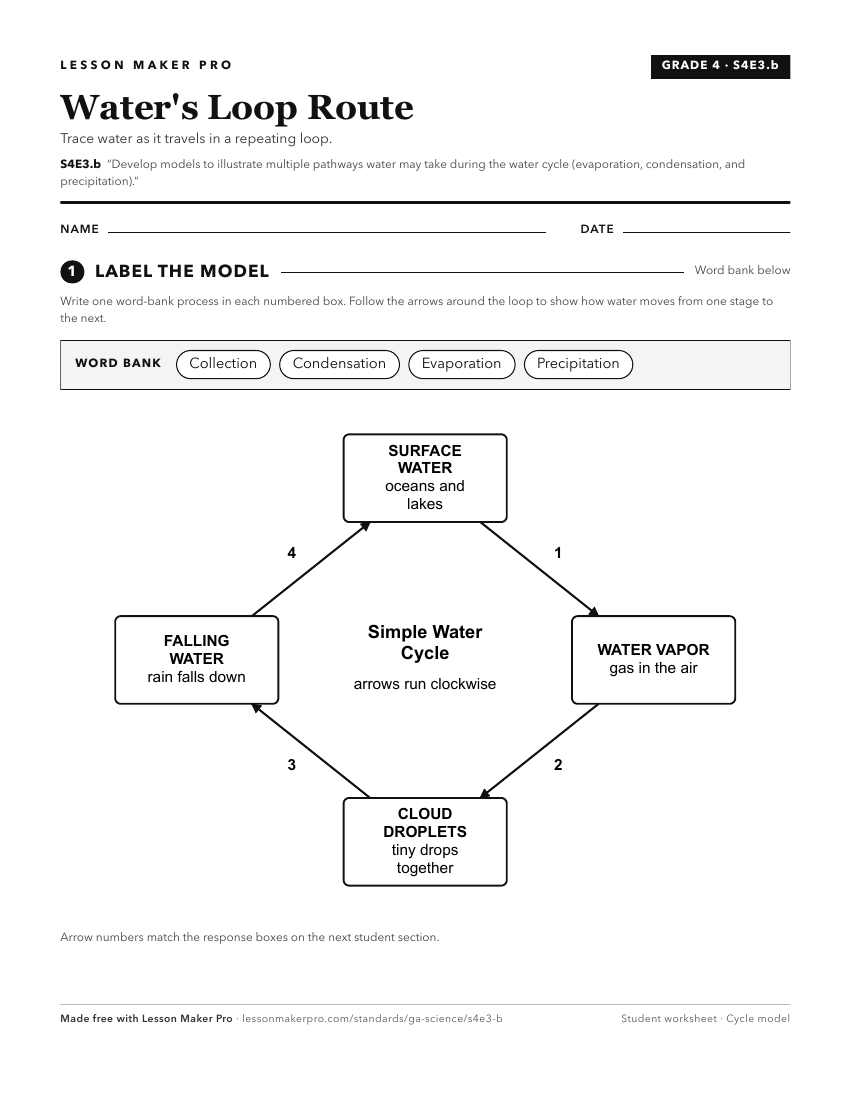
A ready-to-print activity worksheet aligned to S4E3.b, with an answer key for the teacher on its own page. No account needed.
PDF, US Letter, prints cleanly in black and white.
Download the worksheetKeep exploring
Related Standards
- S4L1.b
Develop simple models to illustrate the flow of energy through a food web/food chain beginning with sunlight and including producers, consumers, and decomposers...
- S5E1.b
Develop simple interactive models to collect data that illustrate how changes in surface features are/were caused by constructive and/or destructive processes.
- S4E3
Obtain, evaluate, and communicate information to demonstrate the water cycle.
- S6E3.b
Plan and carry out an investigation to illustrate the role of the sun's energy in atmospheric conditions that lead to the cycling of water.
Turn this exact standard into a lesson
Grade, subject, topic, and the complete standard are prefilled. Create one free, no account needed.
Also for this standard:Make a WorksheetMake a QuizMake a Sub Lesson