Georgia 7.PAR.4.3
The Standard
Determine whether two quantities presented in authentic problems are in a proportional relationship.
Georgia's K-12 Mathematics Standards · Recognize proportional relationships in relevant, mathematical problems; represent, solve, and explain these relationships with tables, graphs, and equations.
Teacher's field guide
What This Standard Means
What Students Need to Do
- Students compare paired quantities from a real situation. They check whether the ratio between the quantities stays constant across all pairs. They use the context and a representation to justify a yes or no decision.
What Mastery Looks Like
- A student can classify a relationship from a story, table, graph, or equation. They find a constant unit rate or identify a pair that breaks the pattern. They connect proportional relationships to graphs through the origin and equations in the form y = kx.
Common Misconceptions
- Students may treat any straight-line pattern as proportional, even when the graph does not pass through the origin. They may compare differences instead of ratios or switch the order of a ratio. Some decide from one pair instead of checking several pairs.
How to Assess It
- Use this exit ticket: “A taxi charges $4 plus $2 per mile. Is the total cost proportional to miles traveled? Show two ordered pairs and explain.”
Lesson moves
Ways to Teach It
Use measuring spoons to mix one spoon of colored water with three spoons of clear water, then record several scaled batches.
Write whether $15 per hour plus a $10 travel fee gives proportional pay, using two input-output pairs as evidence.
Run a card sort with scenario, table, graph, and equation cards; students label each proportional or not and match equivalent representations.
Use a grocery ad to compare costs for one, two, and three identical items, then test whether a coupon changes proportionality.
Free download
Printable 7.PAR.4.3 Worksheet
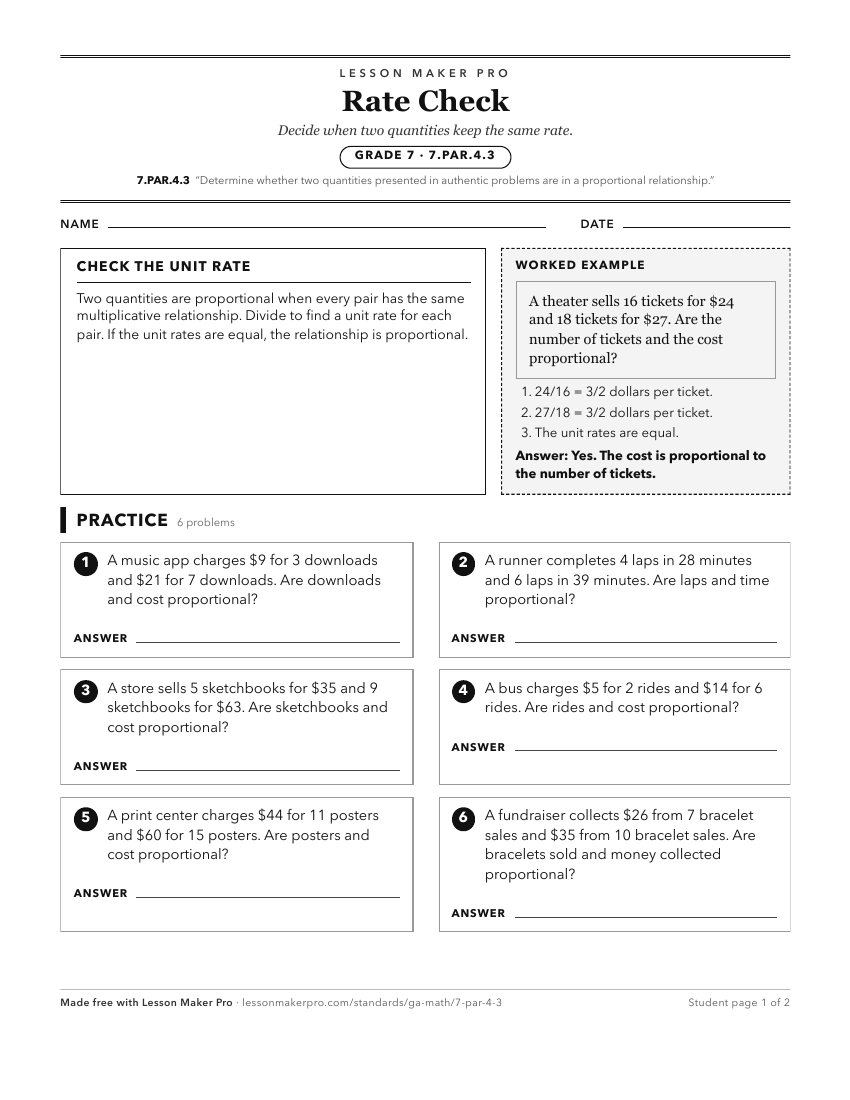
A ready-to-print activity worksheet aligned to 7.PAR.4.3, with an answer key for the teacher on its own page. No account needed.
PDF, US Letter, prints cleanly in black and white.
Download the worksheetKeep exploring
Related Standards
- 7.PAR.4.9
Use proportional relationships to solve multi-step ratio and percent problems presented in applicable situations.
- 7.PAR.4
Recognize proportional relationships in relevant, mathematical problems; represent, solve, and explain these relationships with tables, graphs, and equations.
- 7.PAR.4.8
Graph proportional relationships, interpreting the unit rate as the slope of the graph. Compare two different proportional relationships represented in differen...
- 7.PAR.4.4
Identify, represent, and use proportional relationships.
Turn this exact standard into a lesson
Grade, subject, topic, and the complete standard are prefilled. Create one free, no account needed.
Also for this standard:Make a WorksheetMake a QuizMake a Sub Lesson