Georgia 5.MDR.7.4
The Standard
Convert among units within relative sizes of measurement units within the customary measurement system.
Georgia's K-12 Mathematics Standards · Solve problems involving customary measurements, metric measurements, and time and analyze graphical displays of data to answer relevant questions.
Teacher's field guide
What This Standard Means
What Students Need to Do
- Students use known unit relationships for length, weight, and capacity. They convert a measurement to a larger or smaller customary unit and explain why the number changes.
What Mastery Looks Like
- A student selects the correct unit relationship, decides whether to multiply or divide, and labels the result. The student can write 50 inches as 4 feet 2 inches and explain the steps.
Common Misconceptions
- Students may treat customary units as powers of ten, such as saying 1 foot equals 10 inches. They may multiply in both directions, choose the wrong conversion factor, or confuse ounces with fluid ounces.
How to Assess It
- Exit ticket: A 5-yard ribbon is cut into 2-foot pieces. How many full pieces can be cut, and how much ribbon remains? Show the conversion.
Lesson moves
Ways to Teach It
Give pairs rulers, measuring cups, and labeled containers, then have them measure objects and record each amount in two customary units.
Ask, "Why does 3 feet become 36 inches, while 36 inches becomes 3 feet?" Students explain the operation choice.
Play conversion match: students pair cards such as 4 quarts and 1 gallon, then justify each match using a conversion fact.
Plan a class picnic by converting drink amounts among cups, pints, quarts, and gallons to decide what containers to buy.
Free download
Printable 5.MDR.7.4 Worksheet
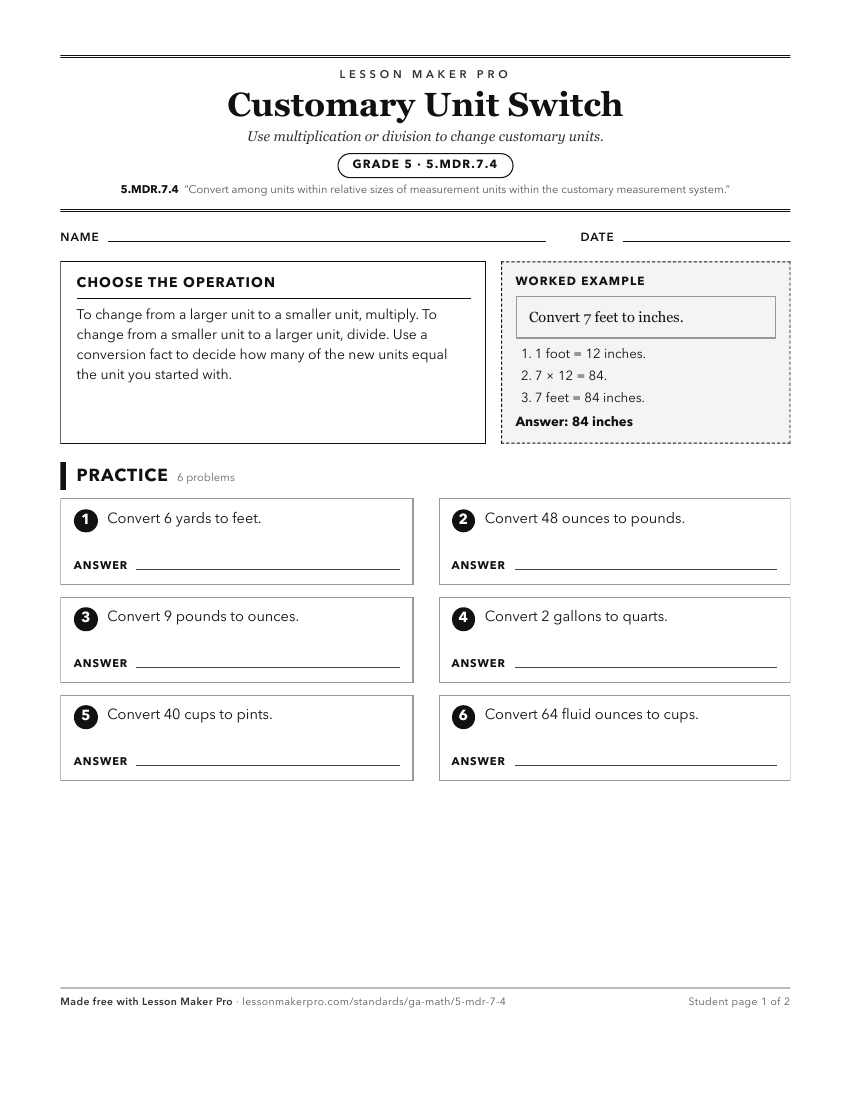
A ready-to-print activity worksheet aligned to 5.MDR.7.4, with an answer key for the teacher on its own page. No account needed.
PDF, US Letter, prints cleanly in black and white.
Download the worksheetKeep exploring
Related Standards
- 7.GSR.5.1
Measure angles in whole nonstandard units.
- 5.MDR.7.3
Convert among units within the metric system and then apply these conversions to solve multistep, practical problems.
- 3.MDR.5.5
Estimate and measure liquid volumes, lengths and masses of objects using customary units. Solve problems involving mass, length, and volume given in the same un...
- 6.NR.4.7
Use ratios to convert within measurement systems (customary and metric) to solve authentic problems that exist in everyday life.
Turn this exact standard into a lesson
Grade, subject, topic, and the complete standard are prefilled. Create one free, no account needed.
Also for this standard:Make a WorksheetMake a QuizMake a Sub Lesson