Georgia 7.P.AC.2.c
The Standard
Make decisions about sentence structure and syntax in order to accommodate and influence the audience and achieve a specific purpose. (I/C)
Georgia's K-12 English Language Arts Standards · Practices (P) · Author’s Craft
Teacher's field guide
What This Standard Means
What Students Need to Do
- Students choose sentence lengths, sentence types, and word order to fit a particular reader and goal. They revise syntax to control clarity, pace, tone, and emphasis.
What Mastery Looks Like
- Students can write the same idea in different ways for different readers or effects. They can explain how sentence length, type, or word order shapes tone, pace, clarity, or emphasis.
Common Misconceptions
- Students may think longer sentences always sound more mature. They may vary punctuation without changing sentence structure, or treat every fragment as an error even when it creates intentional emphasis.
How to Assess It
- Exit ticket: Rewrite “The storm reached the town” once to create suspense and once to give clear information. Label each audience and explain one syntax choice.
Lesson moves
Ways to Teach It
Cut a short paragraph into sentence strips, then rearrange and combine them to create urgency, calm, or suspense.
Compare two versions of the same message and discuss which syntax better fits a principal, friend, or younger student.
Play Syntax Switch: draw an audience and purpose card, then rewrite one sentence to match both.
Rewrite a school event announcement for students and families, changing sentence structure to suit each group.
Free download
Printable 7.P.AC.2.c Worksheet
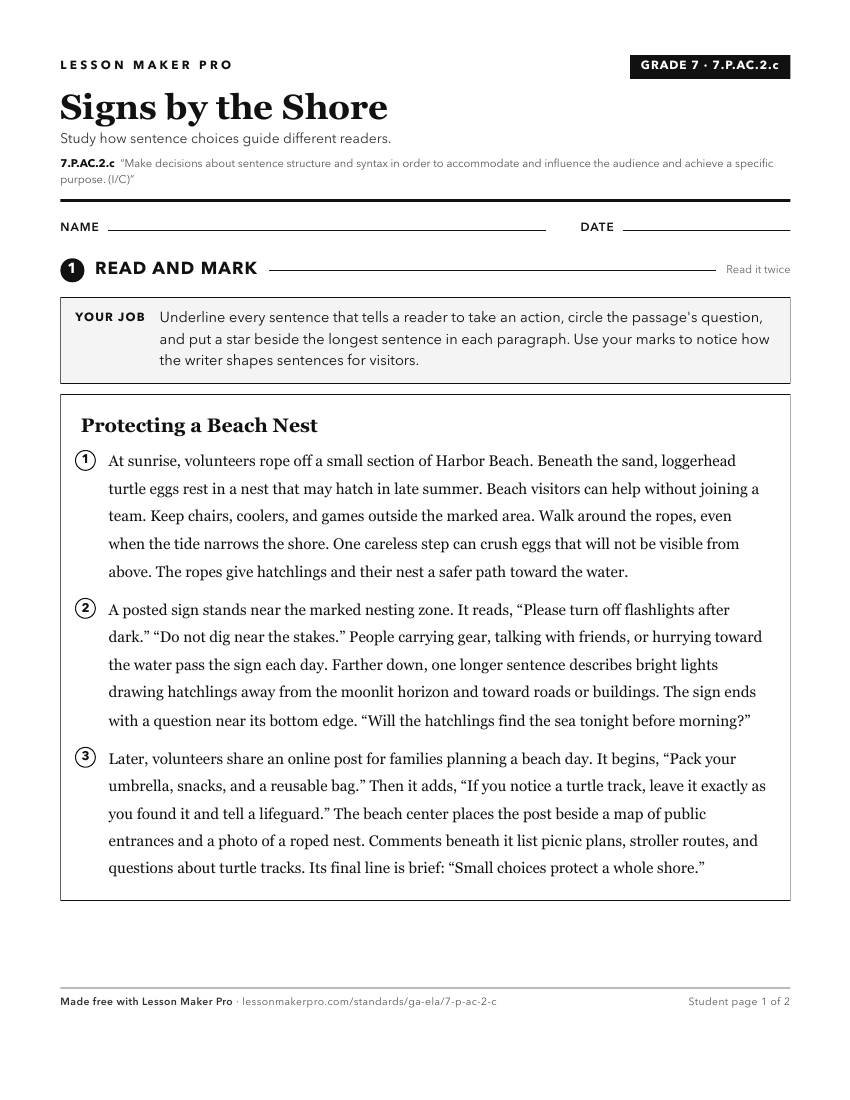
A ready-to-print activity worksheet aligned to 7.P.AC.2.c, with an answer key for the teacher on its own page. No account needed.
PDF, US Letter, prints cleanly in black and white.
Download the worksheetKeep exploring
Related Standards
Turn this exact standard into a lesson
Grade, subject, topic, and the complete standard are prefilled. Create one free, no account needed.
Also for this standard:Make a WorksheetMake a QuizMake a Sub Lesson