Georgia 4.L.V.3.c
The Standard
Distinguish shades of meaning among closely related adverbs (e.g., quickly, swiftly, rapidly). (I)
Georgia's K-12 English Language Arts Standards · Language (L) · Vocabulary
Teacher's field guide
What This Standard Means
What Students Need to Do
- Students compare adverbs that describe similar actions and explain small differences in speed, intensity, or manner. They choose the word that best fits a sentence’s context and tone.
What Mastery Looks Like
- Students can arrange similar adverbs from least to most intense and explain their choices. They can select an adverb that matches the action, setting, and tone of a sentence.
Common Misconceptions
- Students may treat similar adverbs as interchangeable, even when one suggests more speed, force, or emotion. They may rank words by length or familiarity instead of using context clues.
How to Assess It
- Give this exit ticket: “During the fire drill, students moved rapidly, briskly, or frantically while staying calm and orderly.” Circle the best choice and explain why.
Lesson moves
Ways to Teach It
Give pairs word cards such as softly, quietly, and silently; students place them on a meaning continuum and defend each position.
Ask, “How does replacing ‘walked slowly’ with ‘walked sluggishly’ change the picture?” Students write two sentences explaining the difference.
Play adverb charades: one student performs an action calmly, cautiously, or nervously, while teammates identify the best word and explain why.
Compare weather alerts using steadily, heavily, or violently, then discuss how each adverb might change a family’s plans.
Free download
Printable 4.L.V.3.c Worksheet
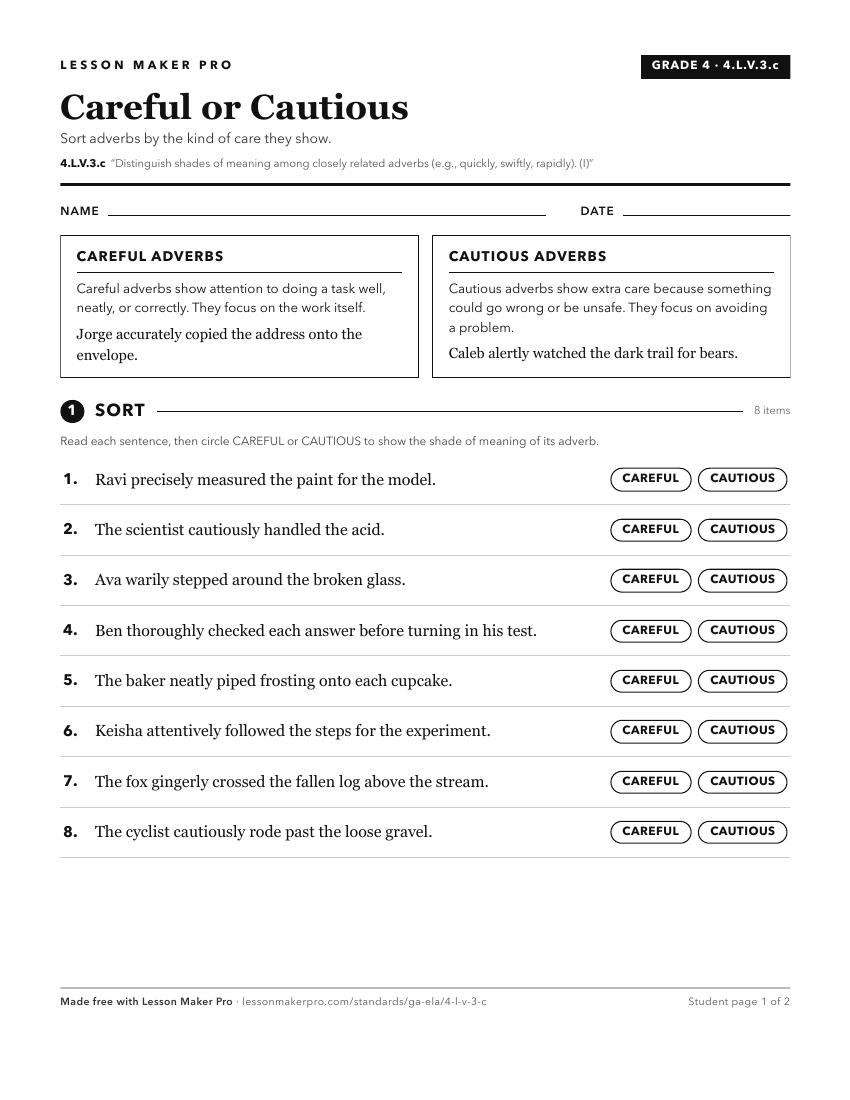
A ready-to-print activity worksheet aligned to 4.L.V.3.c, with an answer key for the teacher on its own page. No account needed.
PDF, US Letter, prints cleanly in black and white.
Download the worksheetKeep exploring
Related Standards
- 1.L.V.3.c
Distinguish shades of meaning among verbs that describe the same general action (e.g., walk, march, strut, prance). (I)
- 2.L.V.3.c
Distinguish shades of meaning among verbs that differ in manner (e.g., look, peek, glance, stare, glare, scowl) and adjectives that differ in intensity (e.g., l...
- 3.L.V.3.c
Distinguish shades of meaning among closely related verbs (e.g., toss, throw, hurl) and closely related adjectives (e.g., thin, slender, skinny, scrawny). (I)
- 5.L.V.3.c
Distinguish shades of meaning among related words, including verbs, adjectives, and/or adverbs, to clarify intended meaning. (I)
Turn this exact standard into a lesson
Grade, subject, topic, and the complete standard are prefilled. Create one free, no account needed.
Also for this standard:Make a WorksheetMake a QuizMake a Sub Lesson