Georgia 1.L.V.3.c
The Standard
Distinguish shades of meaning among verbs that describe the same general action (e.g., walk, march, strut, prance). (I)
Georgia's K-12 English Language Arts Standards · Language (L) · Vocabulary
Teacher's field guide
What This Standard Means
What Students Need to Do
- Students compare verbs that name similar actions. They explain small differences in speed, force, mood, or manner and choose the best verb for a context.
What Mastery Looks Like
- Students can compare related action words and explain how each movement looks or feels. They choose a verb that matches a picture, sentence, or intended mood.
Common Misconceptions
- Students may treat similar action words as exact synonyms. They may focus only on speed and miss clues about force, mood, direction, or purpose.
How to Assess It
- Give students the sentence, “The children ___ into the library,” with stomped, tiptoed, and marched as choices. Ask them to choose one word and draw how the movement looks.
Lesson moves
Ways to Teach It
Give pairs cards labeled stroll, stomp, and tiptoe; students act out each verb while classmates identify it and explain the movement clue.
Show two movement pictures and ask, “Which verb fits each picture, and what detail helped you decide?”
Play verb charades with cards such as glance, stare, peek, and gaze, awarding a point for naming and explaining the acted word.
During a hallway walk, have students notice whether classmates shuffle, march, hurry, or tiptoe, then describe how each movement differs.
Free download
Printable 1.L.V.3.c Worksheet
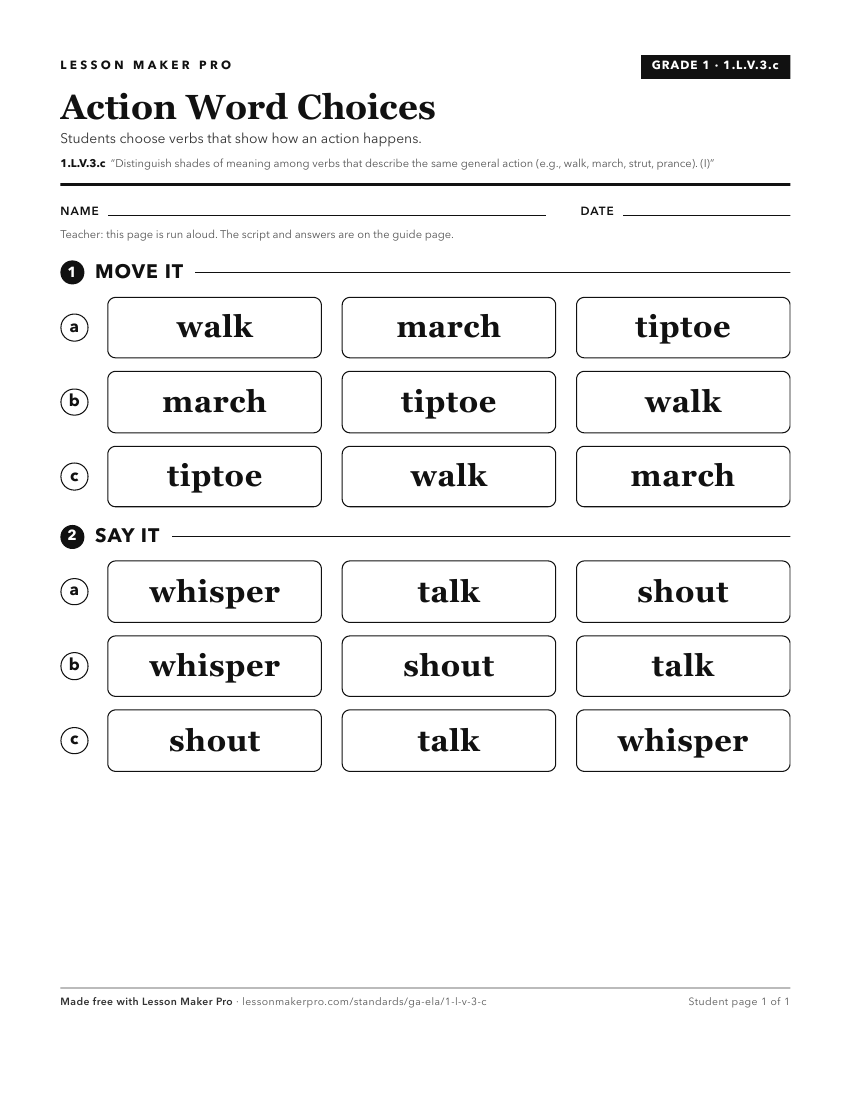
A ready-to-print activity worksheet aligned to 1.L.V.3.c, with an answer key for the teacher on its own page. No account needed.
PDF, US Letter, prints cleanly in black and white.
Download the worksheetKeep exploring
Related Standards
- 2.L.V.3.c
Distinguish shades of meaning among verbs that differ in manner (e.g., look, peek, glance, stare, glare, scowl) and adjectives that differ in intensity (e.g., l...
- 3.L.V.3.c
Distinguish shades of meaning among closely related verbs (e.g., toss, throw, hurl) and closely related adjectives (e.g., thin, slender, skinny, scrawny). (I)
- 5.L.V.3.c
Distinguish shades of meaning among related words, including verbs, adjectives, and/or adverbs, to clarify intended meaning. (I)
- 4.L.V.3.c
Distinguish shades of meaning among closely related adverbs (e.g., quickly, swiftly, rapidly). (I)
Turn this exact standard into a lesson
Grade, subject, topic, and the complete standard are prefilled. Create one free, no account needed.
Also for this standard:Make a WorksheetMake a QuizMake a Sub Lesson