Georgia 3.L.GC.1.36
The Standard
Mechanics: Use commas to indicate direct address and to set off the words yes and no. (Introduce)
Georgia's K-12 English Language Arts Standards · Language (L) · Grammar Conventions
Teacher's field guide
What This Standard Means
What Students Need to Do
- Students place commas around a name or title when speaking directly to someone. They also separate an opening yes or no from the rest of a sentence.
What Mastery Looks Like
- Students correctly punctuate direct address at the beginning, middle, or end of a sentence. They can explain why a subject name does not need the same comma.
Common Misconceptions
- Students may place a comma after every name, even when the name is the subject. They may also omit the comma after an opening yes or no.
How to Assess It
- Give this exit ticket: Add only the needed commas to “No I did not call,” “Lena please sit down,” and “Lena sat down.”
Lesson moves
Ways to Teach It
Give pairs sentence strips and comma cards, then have them place commas in sentences that address a named person.
Ask students to compare “Maya opened the door” and “Maya, open the door,” then explain what the comma changes.
Play a punctuation relay where teams add commas to sentences containing direct address, yes, or no.
Have students write three polite classroom requests to classmates and two answers beginning with yes or no.
Free download
Printable 3.L.GC.1.36 Worksheet
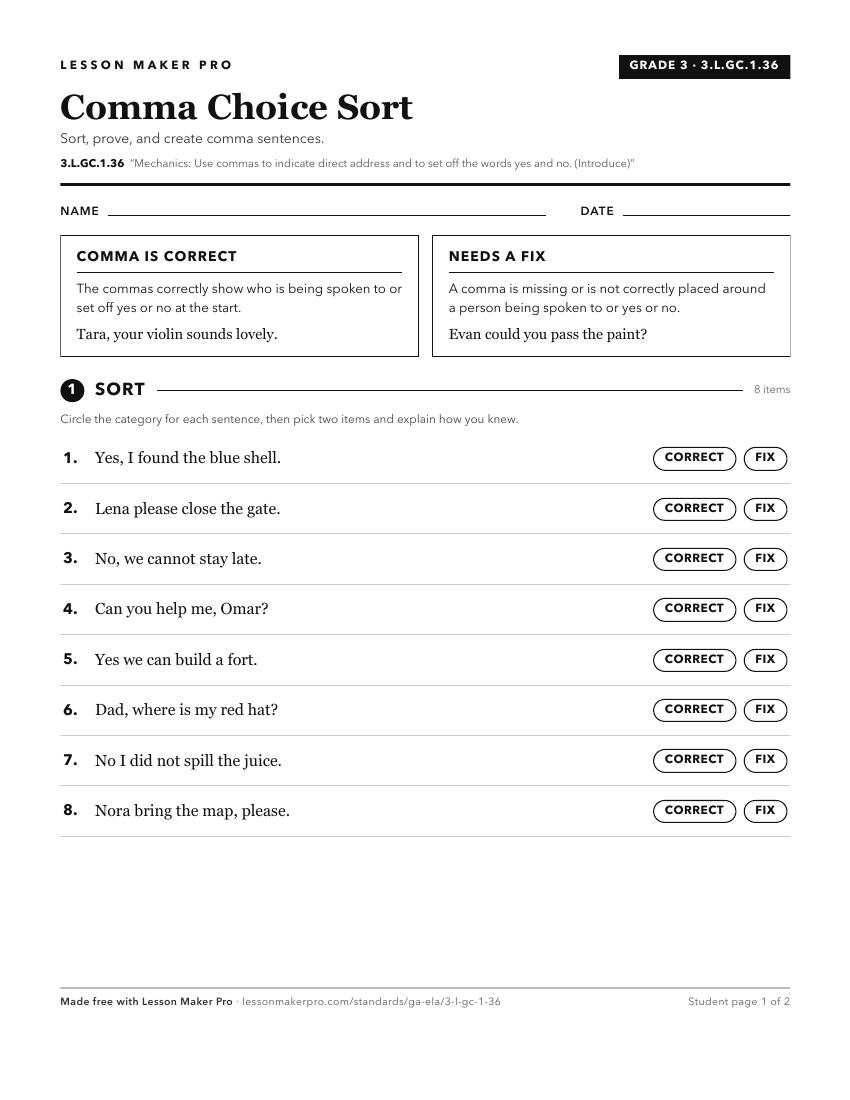
A ready-to-print activity worksheet aligned to 3.L.GC.1.36, with an answer key for the teacher on its own page. No account needed.
PDF, US Letter, prints cleanly in black and white.
Download the worksheetKeep exploring
Related Standards
- 6.L.GC.1.49
Mechanics: Use commas, parentheses, and dashes to set off nonessential words, phrases, or clauses. (Introduce)
- 4.L.GC.1.36
Mechanics: Use commas to indicate direct address and to set off the words yes and no. (Master)
- 1.L.GC.1.17
Mechanics: Use commas to separate items in a series and to format dates, addresses, salutations, and closings. (Introduce)
- 3.L.GC.1.40
Mechanics: Use commas after introductory phrases or clauses. (Introduce)
Turn this exact standard into a lesson
Grade, subject, topic, and the complete standard are prefilled. Create one free, no account needed.
Also for this standard:Make a WorksheetMake a QuizMake a Sub Lesson