Georgia 12.T.T.3.b
The Standard
Evaluate and critique the use of rhetorical language in a variety of texts. (I)
Georgia's K-12 English Language Arts Standards · Texts (T) · Techniques
Teacher's field guide
What This Standard Means
What Students Need to Do
- Students identify loaded words, repetition, rhetorical questions, figurative language, and other deliberate language choices across speeches, essays, advertisements, and public messages. They judge how well those choices serve the writer's purpose and audience, using specific evidence.
What Mastery Looks Like
- Students accurately name specific language choices and explain how each shapes tone, credibility, emotion, or reasoning. They support a clear judgment about effectiveness with quoted words and details about audience and purpose.
Common Misconceptions
- Students may name a device without explaining its effect. They may treat emotional language as proof or assume any rhetorical device improves an argument. Some judge a text by whether they agree with its claim rather than how well the language works.
How to Assess It
- Give students a short editorial paragraph with loaded language and a rhetorical question. Ask them to identify one choice, explain its effect, and judge whether it suits the audience.
Lesson moves
Ways to Teach It
Give pairs two printed versions of one claim, then have them highlight loaded words and physically rank each version by audience impact.
Discuss the prompt: When does emotional language strengthen an argument, and when does it weaken the writer's credibility?
Run a card match with rhetorical devices, short examples, and effects, then require teams to defend or challenge each completed set.
Compare the language in a campaign email and a company apology, noting how each text tries to influence its intended audience.
Free download
Printable 12.T.T.3.b Worksheet
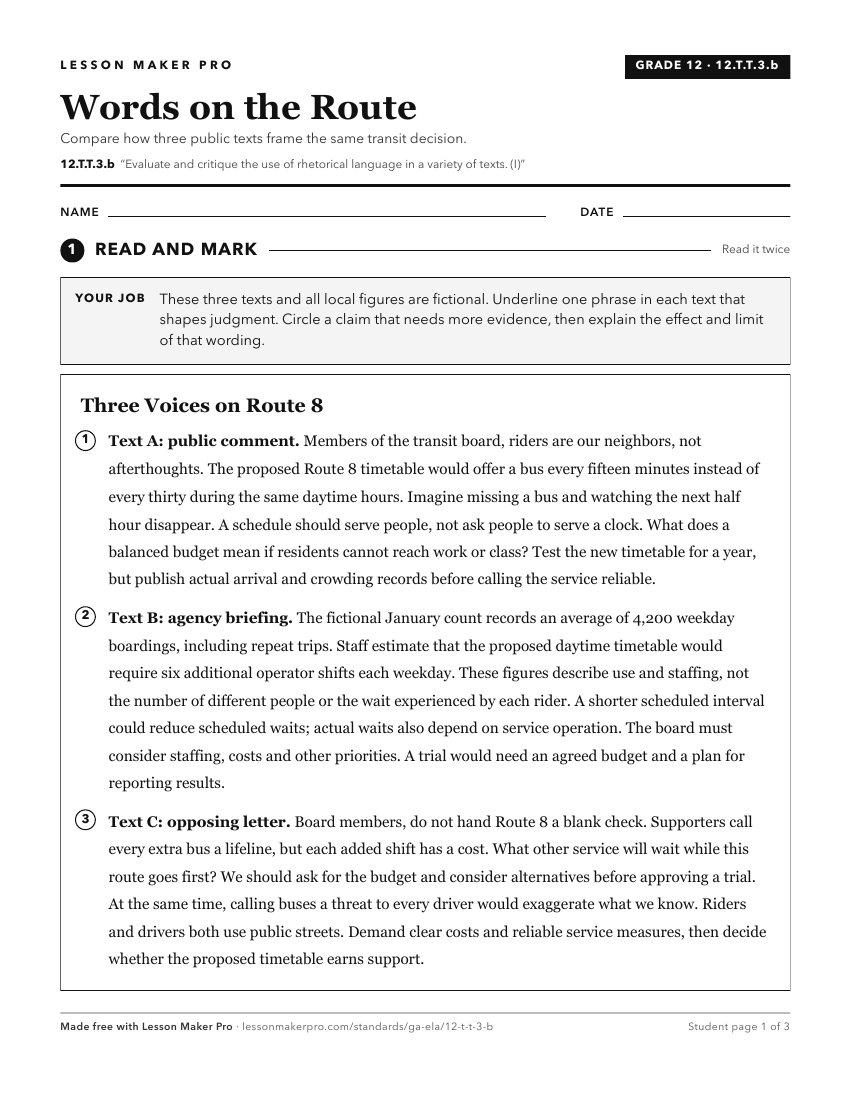
A ready-to-print activity worksheet aligned to 12.T.T.3.b, with an answer key for the teacher on its own page. No account needed.
PDF, US Letter, prints cleanly in black and white.
Download the worksheetKeep exploring
Related Standards
- 10.T.T.3.b
Analyze the use of rhetorical appeals; identify fallacies in a text. (I)
- 10.T.SS.2.a
Analyze how the use of figurative, connotative, and/or rhetorical language contributes to the development of meaning, tone, or mood in a wide variety of texts. ...
- 9.T.T.3.b
Recognize and analyze the use of rhetorical appeals (ethos, logos, and pathos) in a variety of texts. (I)
- 9.T.SS.2.a
Analyze how the use of figurative, connotative, and/or rhetorical language contributes to the development of meaning, tone, or mood in a wide variety of texts. ...
Turn this exact standard into a lesson
Grade, subject, topic, and the complete standard are prefilled. Create one free, no account needed.
Also for this standard:Make a WorksheetMake a QuizMake a Sub Lesson