Georgia 11.P.AC.2.c
The Standard
Make decisions about sentence structure and syntax in order to accommodate and influence the audience and achieve a specific purpose. (I/C)
Georgia's K-12 English Language Arts Standards · Practices (P) · Author’s Craft
Teacher's field guide
What This Standard Means
What Students Need to Do
- Students choose sentence length, clause order, repetition, and sentence type to fit a specific audience and purpose. They revise syntax to control clarity, tone, pace, and emphasis.
What Mastery Looks Like
- Students can write the same message for two audiences using noticeably different syntax. They can explain how sentence length, clause order, or repetition shapes tone, pace, and emphasis.
Common Misconceptions
- Students may think longer sentences always sound more sophisticated or that sentence variety means changing lengths at random. They may confuse intentional fragments with accidental fragments and run-ons.
How to Assess It
- Exit ticket: Rewrite “The school day should begin later” for parents and then for classmates. Explain one syntax choice in each version.
Lesson moves
Ways to Teach It
Give groups sentence strips with movable clauses, then have them reorder each sentence to emphasize a different idea.
Ask students to write one request to a principal and one to a friend, then explain their sentence choices.
Play Syntax Switch: students draw audience and purpose cards, then revise a sentence within two minutes and compare results.
Compare sentence patterns in a job application email and a group chat, then revise one message for the other setting.
Free download
Printable 11.P.AC.2.c Worksheet
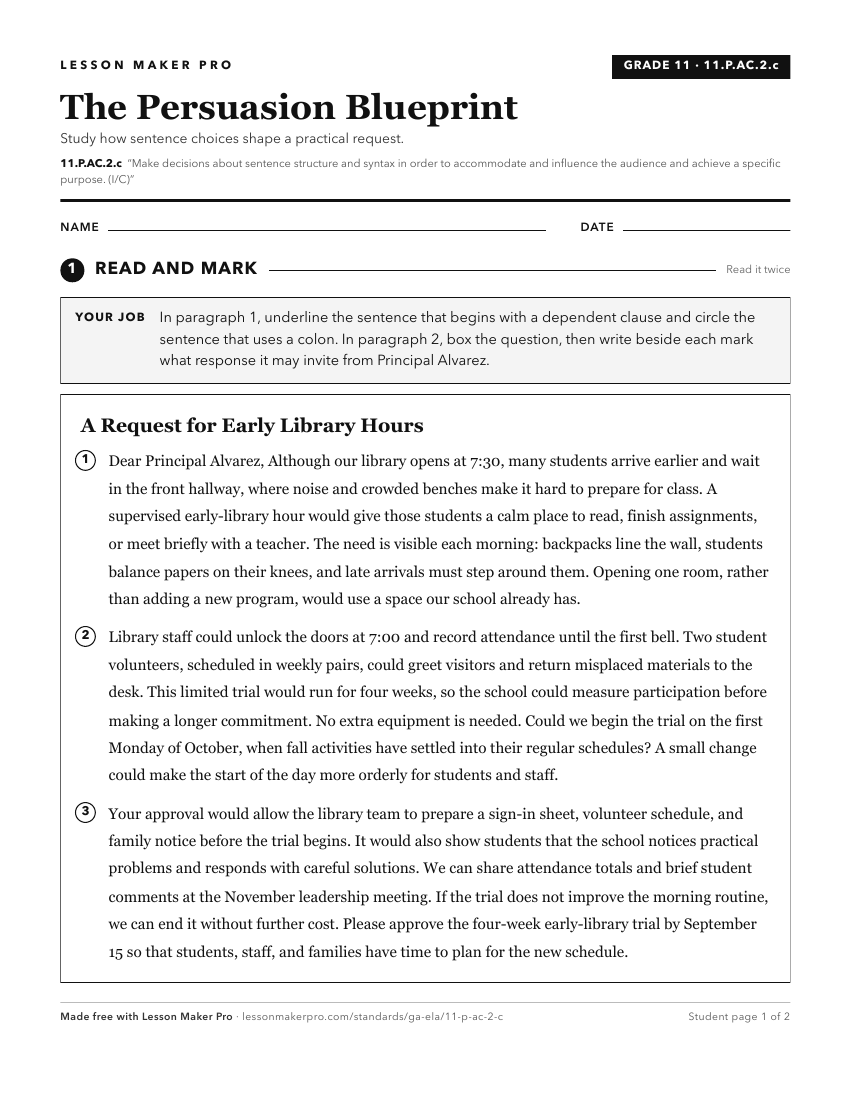
A ready-to-print activity worksheet aligned to 11.P.AC.2.c, with an answer key for the teacher on its own page. No account needed.
PDF, US Letter, prints cleanly in black and white.
Download the worksheetKeep exploring
Related Standards
Turn this exact standard into a lesson
Grade, subject, topic, and the complete standard are prefilled. Create one free, no account needed.
Also for this standard:Make a WorksheetMake a QuizMake a Sub Lesson