Georgia 1.T.C.1.b
The Standard
Identify different modes of communication: print, digital, auditory, and visual. (I)
Georgia's K-12 English Language Arts Standards · Texts (T) · Context
Teacher's field guide
What This Standard Means
What Students Need to Do
- Students recognize whether a message comes through paper, a screen, sound, or images. They use visible or heard clues to explain their choice.
What Mastery Looks Like
- Students correctly label examples as print, digital, auditory, or visual. They point to evidence, such as paper, a screen, spoken words, or pictures.
Common Misconceptions
- Students may call anything with words print, even when the words appear on a screen. They may also confuse visual messages with digital messages or miss that one text can use several forms.
How to Assess It
- Show a book page, website screenshot, voice recording, and wordless sign. Ask students to name how each message is shared and point to one clue.
Lesson moves
Ways to Teach It
Set up four sorting mats, then have students place books, screenshots, audio clips, and picture cards on the matching mat.
Ask, "How could you share lunch rules without speaking?" and have students draw or write one possible message.
Play Communication Corners by showing an example while students move to the room corner labeled print, digital, auditory, or visual.
Examine a cereal box, school announcement, traffic sign, and weather app, then identify how each sends information.
Free download
Printable 1.T.C.1.b Worksheet
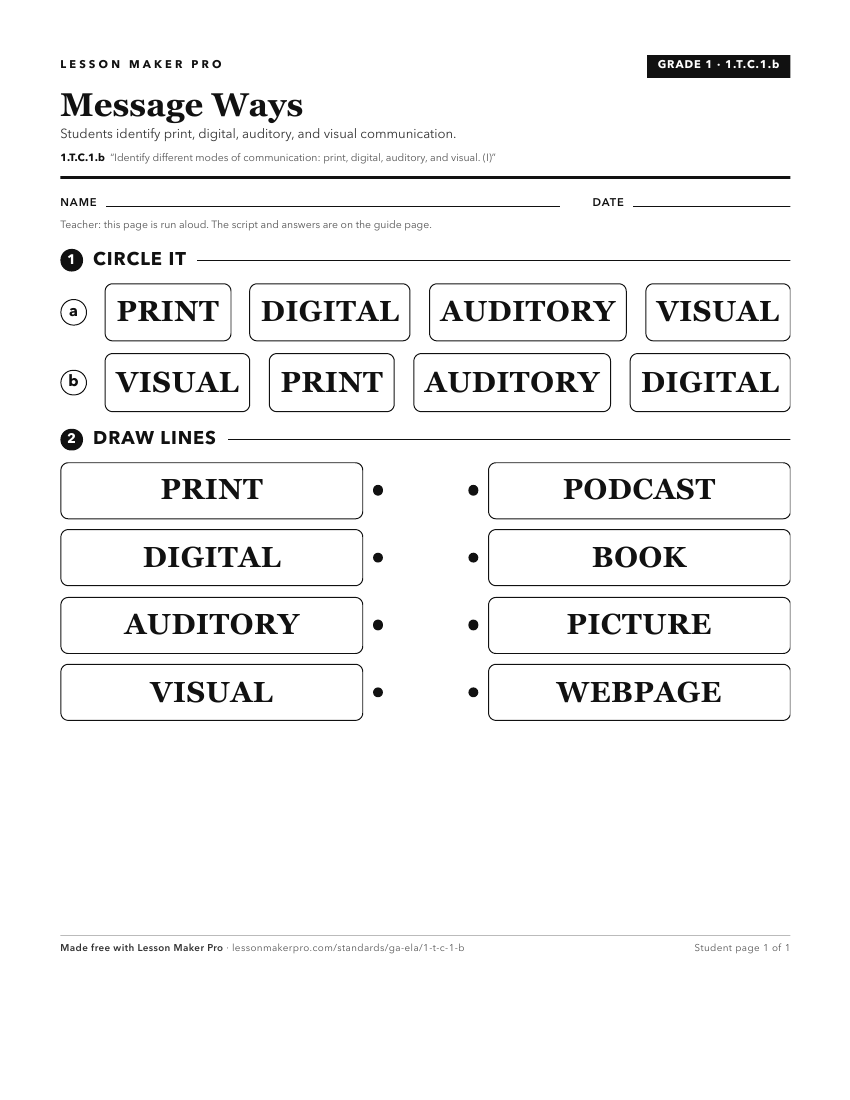
A ready-to-print activity worksheet aligned to 1.T.C.1.b, with an answer key for the teacher on its own page. No account needed.
PDF, US Letter, prints cleanly in black and white.
Download the worksheetKeep exploring
Related Standards
- 1.T.RA.2.b
Explore various sources of information, including print, digital, and personal communication. (I)
- K.T.C.1.b
With adult support, identify different modes of communication: print, digital, auditory, and visual. (I)
- 2.T.C.1.b
Recognize different modes of communication: print, digital, auditory, spoken, visual, and multimodal. (I)
- 3.T.C.1.b
Determine common text features of print, digital, auditory, spoken, and visual modes and describe how they contribute to the overall purpose and effect. (I)
Turn this exact standard into a lesson
Grade, subject, topic, and the complete standard are prefilled. Create one free, no account needed.
Also for this standard:Make a WorksheetMake a QuizMake a Sub Lesson