Florida SS.8.A.4.9
The Standard
- SS.8.A.4
- Demonstrate an understanding of the domestic and international causes, course, and consequences of westward expansion.
Analyze the causes, course, and consequences of the Second Great Awakening on social reform movements.
Florida Next Generation Sunshine State Standards for Social Studies
Teacher's field guide
What This Standard Means
What Students Need to Do
- Students trace why religious revivals grew in the early 1800s and how camp meetings and traveling preachers spread them. They connect revival beliefs to abolition, temperance, women’s rights, public education, and prison or asylum reform.
What Mastery Looks Like
- Students can explain a clear chain from revival belief to reform action to social result. They support the chain with named people, events, movements, or primary source evidence.
Common Misconceptions
- Students may confuse the First and Second Great Awakenings or treat the later movement as only a religious event. They may assume every revival leader supported every reform, especially abolition and women’s rights.
How to Assess It
- Exit ticket: In four sentences, explain one cause of the revivals, one way they spread, and one reform they influenced, using two named details.
Lesson moves
Ways to Teach It
Students arrange source cards about camp meetings, Charles Finney, abolition, temperance, and women’s rights into a cause, course, and consequence chain.
Ask students to write: Did revival religion change society directly, or through the actions of reformers? Defend your answer with two examples.
Teams sort event cards into causes, course, or consequences, then challenge one placement made by another team using historical evidence.
Students compare a current public service campaign with a temperance or abolition broadside, focusing on message, audience, and persuasion methods.
Free download
Printable SS.8.A.4.9 Worksheet
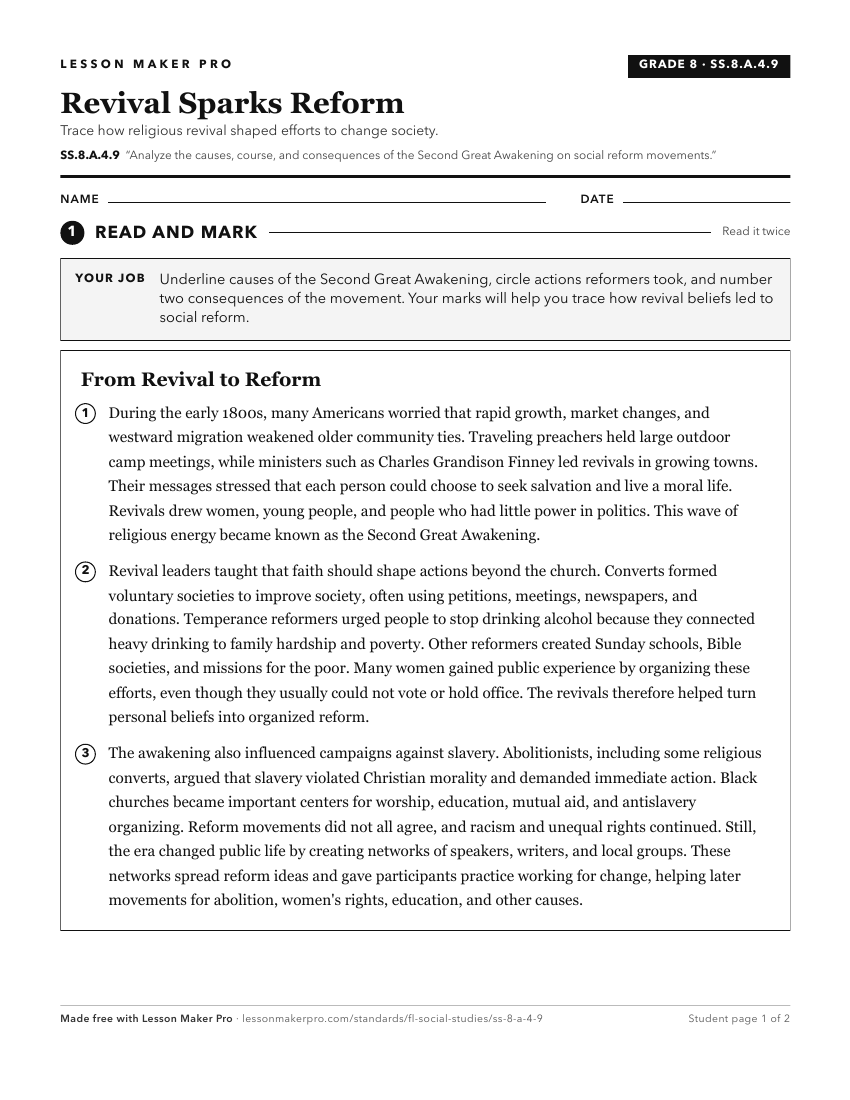
A ready-to-print activity worksheet aligned to SS.8.A.4.9, with an answer key for the teacher on its own page. No account needed.
PDF, US Letter, prints cleanly in black and white.
Download the worksheetKeep exploring
Related Standards
- SS.8.A.4.14
Examine the causes, course, and consequences of the women's suffrage movement (e.g., 1848 Seneca Falls Convention, Declaration of Sentiments).
- SS.8.A.4.15
Examine the causes, course, and consequences of literature movements (e.g., Transcendentalism) significant to this era of American history.
- SS.8.A.3.6
Examine the causes, course, and consequences of the American Revolution.
- SS.5.AA.1.3
Examine key figures and events in abolitionist movements.
Turn this exact standard into a lesson
Grade, subject, topic, and the complete standard are prefilled. Create one free, no account needed.
Also for this standard:Make a WorksheetMake a QuizMake a Sub Lesson