Florida SS.8.A.4.12
The Standard
- SS.8.A.4
- Demonstrate an understanding of the domestic and international causes, course, and consequences of westward expansion.
Examine the effects of the 1804 Haitian Revolution on the United States acquisition of the Louisiana Territory.
Florida Next Generation Sunshine State Standards for Social Studies
Teacher's field guide
What This Standard Means
What Students Need to Do
- Students trace how Haitian resistance and French losses weakened Napoleon’s plan for a Caribbean empire. They connect that defeat to France’s decision to sell Louisiana in 1803. They use dates and evidence to explain that Haitian independence came in 1804, after the sale.
What Mastery Looks Like
- A student can build a clear chain from the revolt in Saint-Domingue to the Louisiana Purchase. They can explain that French military losses, disease, war with Britain, and Napoleon’s need for money also shaped the sale.
Common Misconceptions
- Students often say the United States bought Louisiana after Haiti gained independence, but the purchase was signed in 1803. They may treat Haiti as the only cause or think Haiti transferred Louisiana directly to the United States.
How to Assess It
- On an exit ticket, write a three-link cause and effect chain using Saint-Domingue, Napoleon, and Louisiana Purchase. Add one sentence explaining the 1803 and 1804 dates.
Lesson moves
Ways to Teach It
Give pairs five event cards dated 1791 to 1804, then have them arrange the cards and connect causes with yarn.
Ask students to write: How did events in Saint-Domingue change Napoleon’s plans for Louisiana?
Run a matching race with cause and effect cards for Haitian resistance, French losses, Caribbean plans, and the Louisiana sale.
Mark New Orleans and Mississippi River trade routes on a modern map, then explain why control of Louisiana mattered to American farmers.
Free download
Printable SS.8.A.4.12 Worksheet
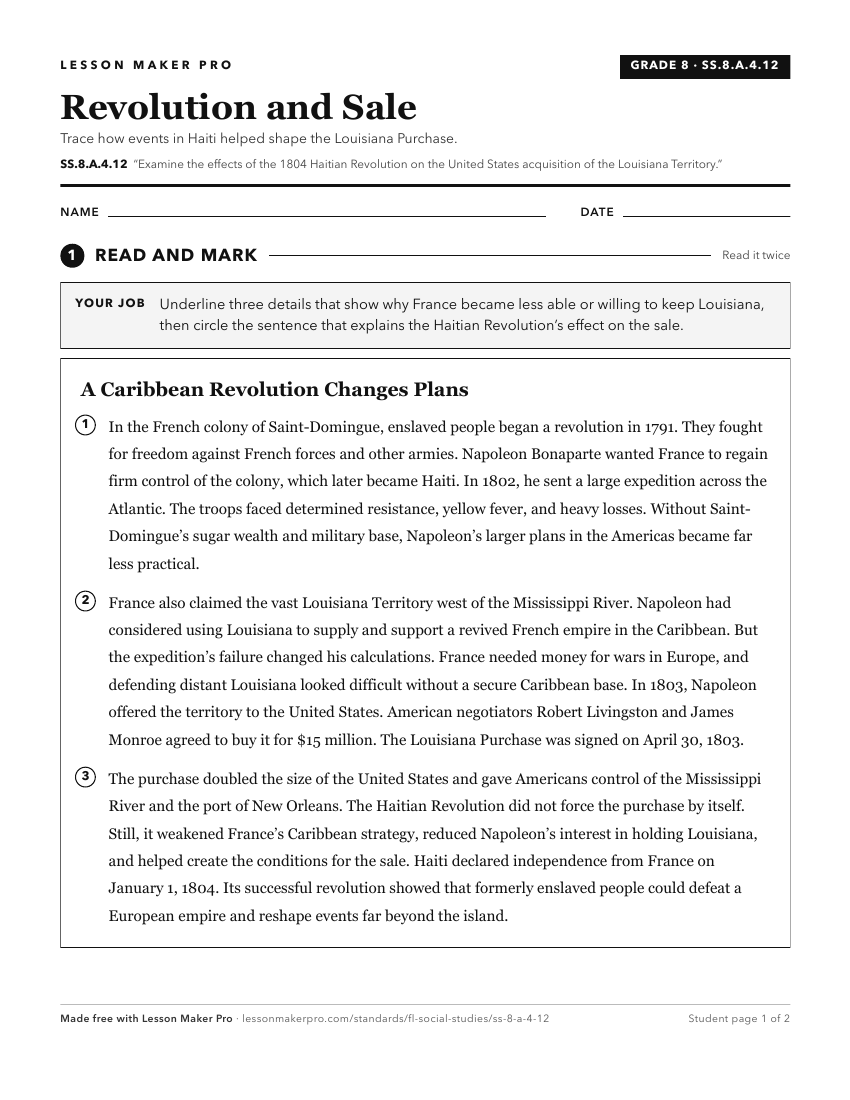
A ready-to-print activity worksheet aligned to SS.8.A.4.12, with an answer key for the teacher on its own page. No account needed.
PDF, US Letter, prints cleanly in black and white.
Download the worksheetKeep exploring
Related Standards
- SS.5.A.6.1
Describe the causes and effects of the Louisiana Purchase.
- SS.5.A.6.5
Identify the causes and effects of the War of 1812.
- SS.8.A.2.6
Examine the causes, course, and consequences of the French and Indian War.
- SS.8.A.4.1
Examine the causes, course, and consequences of United States westward expansion and its growing diplomatic assertiveness (i.e., War of 1812, Convention of 1818...
Turn this exact standard into a lesson
Grade, subject, topic, and the complete standard are prefilled. Create one free, no account needed.
Also for this standard:Make a WorksheetMake a QuizMake a Sub Lesson