Florida SC.7.L.16.3
The Standard
Compare and contrast the general processes of sexual reproduction requiring meiosis and asexual reproduction requiring mitosis.
Florida Next Generation Sunshine State Standards for Science
Teacher's field guide
What This Standard Means
What Students Need to Do
- Students trace how meiosis makes sex cells with half the usual chromosome number, then connect fertilization to genetic variation. They explain how mitosis supports reproduction from one parent and produces genetically similar offspring.
What Mastery Looks Like
- Students can complete a comparison chart for parent number, cell division, sex cells, fertilization, and genetic similarity. They can identify each process from a scenario and justify the choice with evidence.
Common Misconceptions
- Students may think meiosis directly produces an offspring rather than sex cells. They may also think asexual offspring are always exact copies, ignoring mutations, or that mitosis only supports growth and repair.
How to Assess It
- Give students two scenarios, a strawberry plant growing a runner and a frog producing eggs and sperm. Ask them to name the cell division involved and explain one difference in the offspring.
Lesson moves
Ways to Teach It
Use colored chromosome cards to model mitosis and meiosis, then compare cell number, chromosome count, and genetic variation.
Write a response to this prompt: Why are offspring from seeds usually more varied than offspring from plant cuttings?
Sort process cards into sexual, asexual, or both, then earn a point by defending each placement with one accurate reason.
Compare how gardeners use seeds and stem cuttings, focusing on why each method produces different levels of variation.
Free download
Printable SC.7.L.16.3 Worksheet
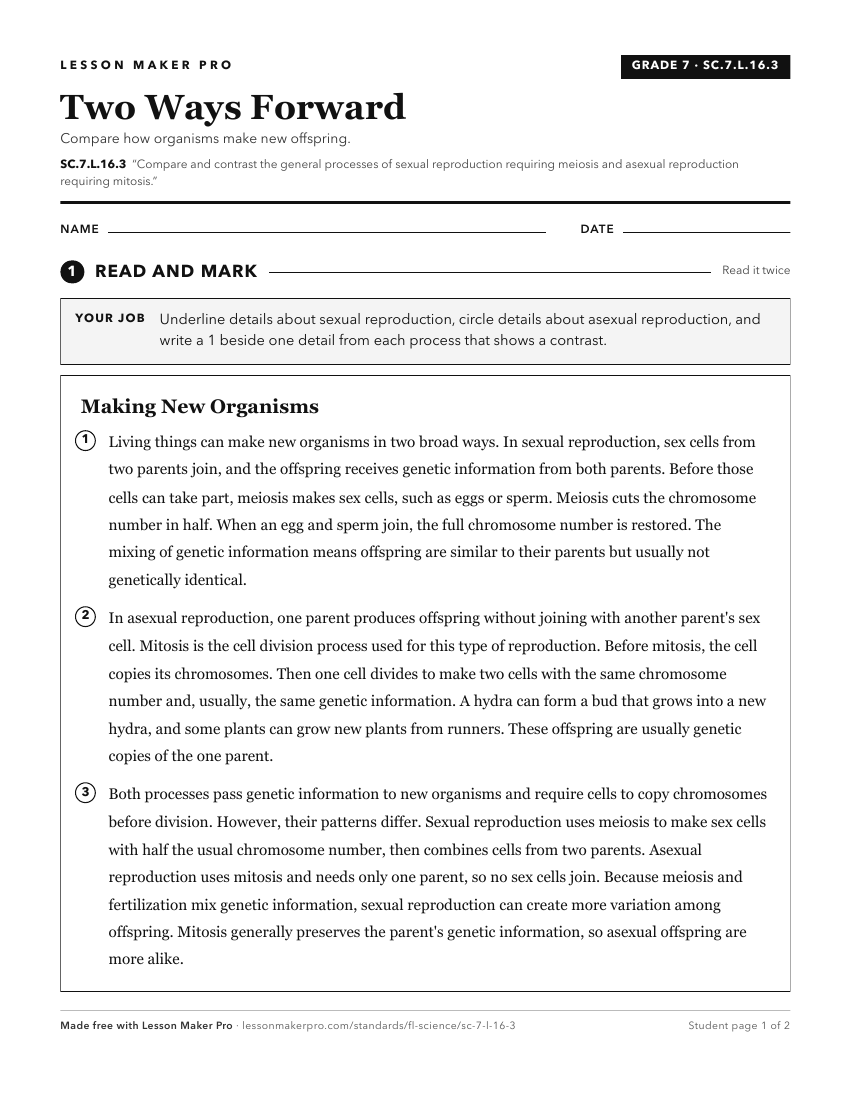
A ready-to-print activity worksheet aligned to SC.7.L.16.3, with an answer key for the teacher on its own page. No account needed.
PDF, US Letter, prints cleanly in black and white.
Download the worksheetKeep exploring
Related Standards
- SC.4.L.16.4
Compare and contrast the major stages in the life cycles of Florida plants and animals, such as those that undergo incomplete and complete metamorphosis, and fl...
- SC.4.L.16.1
Identify processes of sexual reproduction in flowering plants, including pollination, fertilization (seed production), seed dispersal, and germination.
- SC.6.L.14.3
Recognize and explore how cells of all organisms undergo similar processes to maintain homeostasis, including extracting energy from food, getting rid of waste,...
- SC.7.N.1.2
Differentiate replication (by others) from repetition (multiple trials).
Turn this exact standard into a lesson
Grade, subject, topic, and the complete standard are prefilled. Create one free, no account needed.
Also for this standard:Make a WorksheetMake a QuizMake a Sub Lesson