Florida SC.7.L.16.2
The Standard
Determine the probabilities for genotype and phenotype combinations using Punnett Squares and pedigrees.
Florida Next Generation Sunshine State Standards for Science
Teacher's field guide
What This Standard Means
What Students Need to Do
- Students use parent alleles to complete Punnett squares and report genotype and phenotype probabilities. They read pedigrees to infer likely genotypes and inheritance patterns.
What Mastery Looks Like
- Given a monohybrid cross, a student fills every box correctly and states results as ratios, fractions, or percentages. The student uses affected and unaffected relatives to justify unknown genotypes in a pedigree.
Common Misconceptions
- Students may confuse genotype letters with visible traits. They may think dominant means common or stronger. They may also expect every small group of offspring to match the predicted ratio exactly.
How to Assess It
- Exit ticket: Cross Bb × bb, with B dominant, and report all genotype and phenotype percentages. Then label the genotypes of two unaffected parents and their affected child for a recessive trait.
Lesson moves
Ways to Teach It
Give pairs allele cards and a four-box mat, then have them model Bb × Bb and tally predicted offspring.
Ask students to explain why two parents showing a dominant trait can have a child showing the recessive trait.
Play Pedigree Detective: teams label unknown genotypes on four family cards and earn a point for each evidence-based justification.
Have students advise a pea breeder which parent cross gives the best chance of recessive flowers, using a Punnett square.
Free download
Printable SC.7.L.16.2 Worksheet
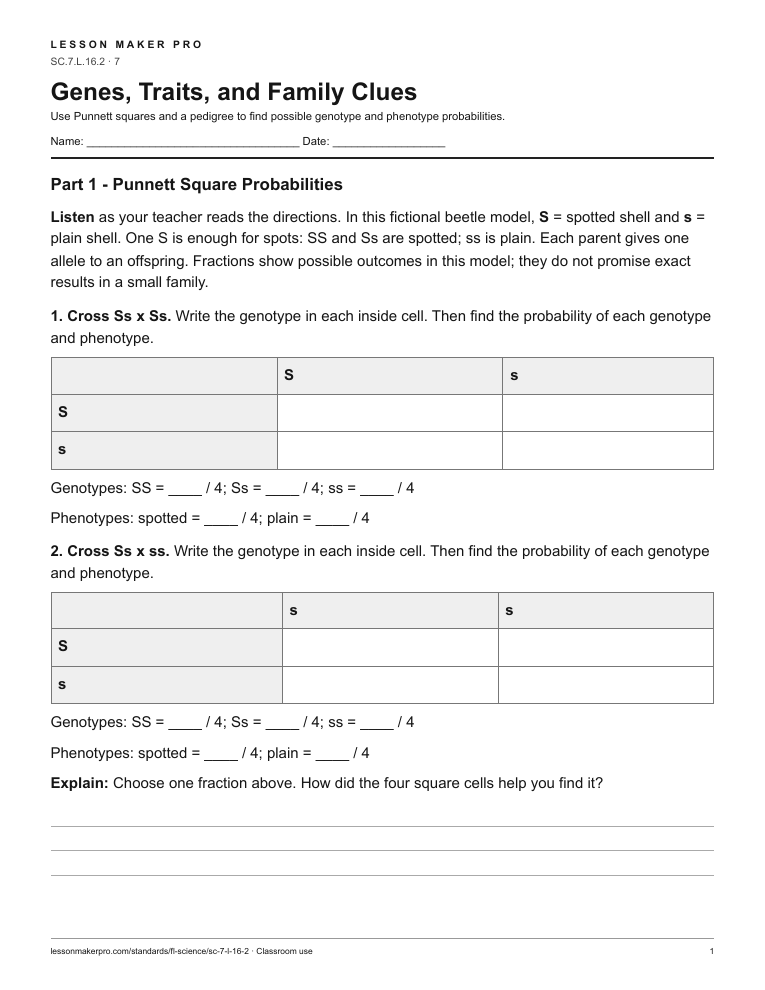
A ready-to-print activity worksheet aligned to SC.7.L.16.2, with an answer key for the teacher on its own page. No account needed.
PDF, US Letter, prints cleanly in black and white.
Download the worksheetKeep exploring
Related Standards
- SC.7.L.16.1
Understand and explain that every organism requires a set of instructions that specifies its traits, that this hereditary information (DNA) contains genes locat...
- SC.4.L.16.3
Recognize that animal behaviors may be shaped by heredity and learning.
- SC.4.L.16.1
Identify processes of sexual reproduction in flowering plants, including pollination, fertilization (seed production), seed dispersal, and germination.
- SC.1.L.16.1
Make observations that plants and animals closely resemble their parents, but variations exist among individuals within a population.
Turn this exact standard into a lesson
Grade, subject, topic, and the complete standard are prefilled. Create one free, no account needed.
Also for this standard:Make a WorksheetMake a QuizMake a Sub Lesson