Florida SC.6.P.11.1
The Standard
Explore the Law of Conservation of Energy by differentiating between potential and kinetic energy. Identify situations where kinetic energy is transformed into potential energy and vice versa.
Florida Next Generation Sunshine State Standards for Science
Teacher's field guide
What This Standard Means
What Students Need to Do
- Students identify potential energy from an object's position and kinetic energy from its motion. They track how energy changes between these forms. They explain that energy is transferred or transformed, not lost.
What Mastery Looks Like
- Students can label energy changes on a roller coaster, pendulum, or tossed ball. They correctly predict where potential energy and kinetic energy are greatest. They explain each change using position and motion.
Common Misconceptions
- Students may think a motionless object has no energy or that potential energy means energy that might not exist. They may think kinetic energy disappears when an object stops. They may also say friction destroys energy instead of changing it to thermal energy.
How to Assess It
- Draw a ball at the bottom, middle, and top of its upward path. Ask students to label the dominant energy form at each point and explain the changes.
Lesson moves
Ways to Teach It
Release a marble from different ramp heights, then measure how far it pushes a paper cup across the floor.
Have students explain where energy changes form during one complete swing of a playground swing.
Give pairs picture cards of moving and raised objects, then race to sort and justify each energy type.
Analyze a skateboarder on a half-pipe and mark where potential and kinetic energy are greatest.
Free download
Printable SC.6.P.11.1 Worksheet
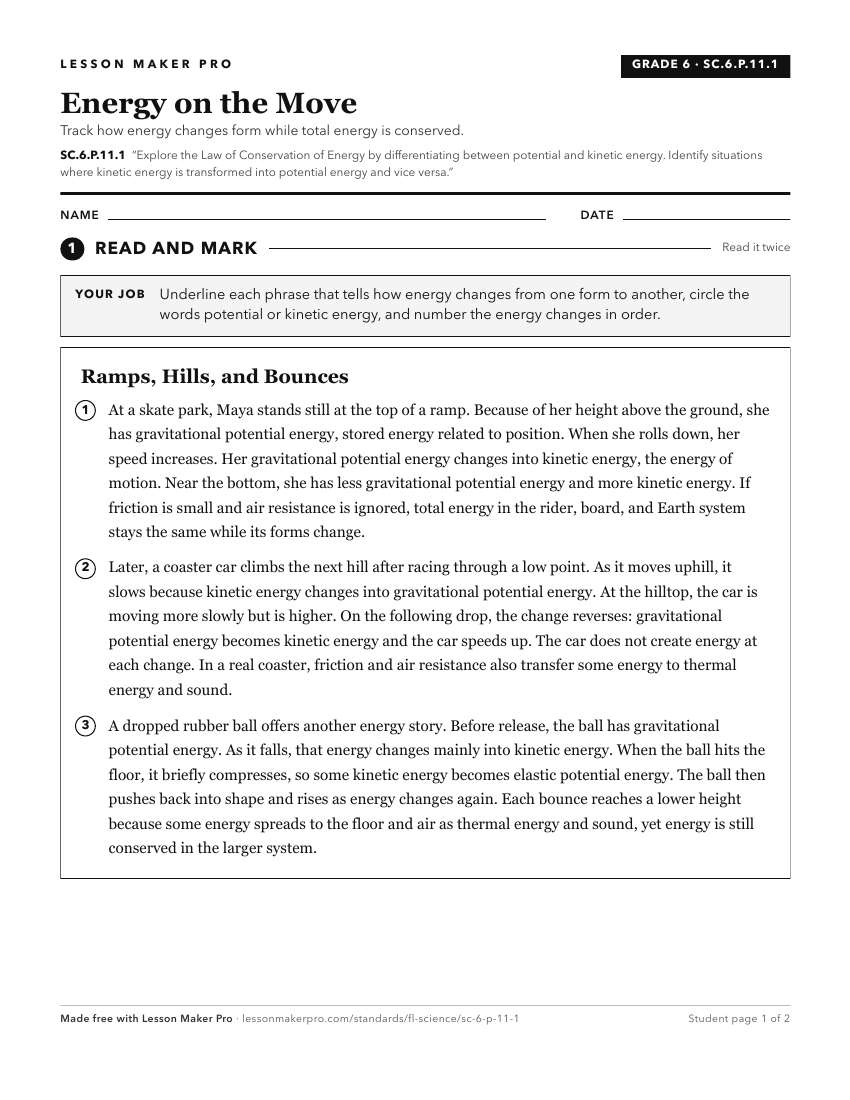
A ready-to-print activity worksheet aligned to SC.6.P.11.1, with an answer key for the teacher on its own page. No account needed.
PDF, US Letter, prints cleanly in black and white.
Download the worksheetKeep exploring
Related Standards
- SC.7.P.11.2
Investigate and describe the transformation of energy from one form to another.
- SC.4.P.10.1
Observe and describe some basic forms of energy, including light, heat, sound, electrical, and the energy of motion.
- SC.5.P.10.4
Investigate and explain that electrical energy can be transformed into heat, light, and sound energy, as well as the energy of motion.
- SC.3.P.10.1
Identify some basic forms of energy such as light, heat, sound, electrical, and mechanical.
Turn this exact standard into a lesson
Grade, subject, topic, and the complete standard are prefilled. Create one free, no account needed.
Also for this standard:Make a WorksheetMake a QuizMake a Sub Lesson