Florida SC.3.P.10.1
The Standard
Identify some basic forms of energy such as light, heat, sound, electrical, and mechanical.
Florida Next Generation Sunshine State Standards for Science
Teacher's field guide
What This Standard Means
What Students Need to Do
- Students sort familiar events and objects by the kind of energy they show. They use clues such as brightness, warmth, vibration, electricity, or movement to explain each choice.
What Mastery Looks Like
- Students can identify the energy shown by a flashlight, bell, toaster, circuit, or rolling ball. They can explain their answer using an observable clue.
Common Misconceptions
- Students may confuse an energy source, such as a battery, with the energy produced. They may think mechanical energy only involves machines or that sound only means music.
How to Assess It
- Show pictures of a lamp, ringing phone, hot pan, plugged-in fan, and moving bicycle. Students name each energy form and explain one answer with evidence.
Lesson moves
Ways to Teach It
Set up stations with a flashlight, warm water, bell, battery circuit, and rolling ball; students label the energy observed.
Ask, "How can one device show more than one kind of energy?" Students use a lamp or speaker as evidence.
Play Energy Charades: students act out or point to clues for an energy form while teammates identify and explain it.
Students inspect five classroom objects, record each energy form observed, and note what produces the light, warmth, sound, or movement.
Free download
Printable SC.3.P.10.1 Worksheet
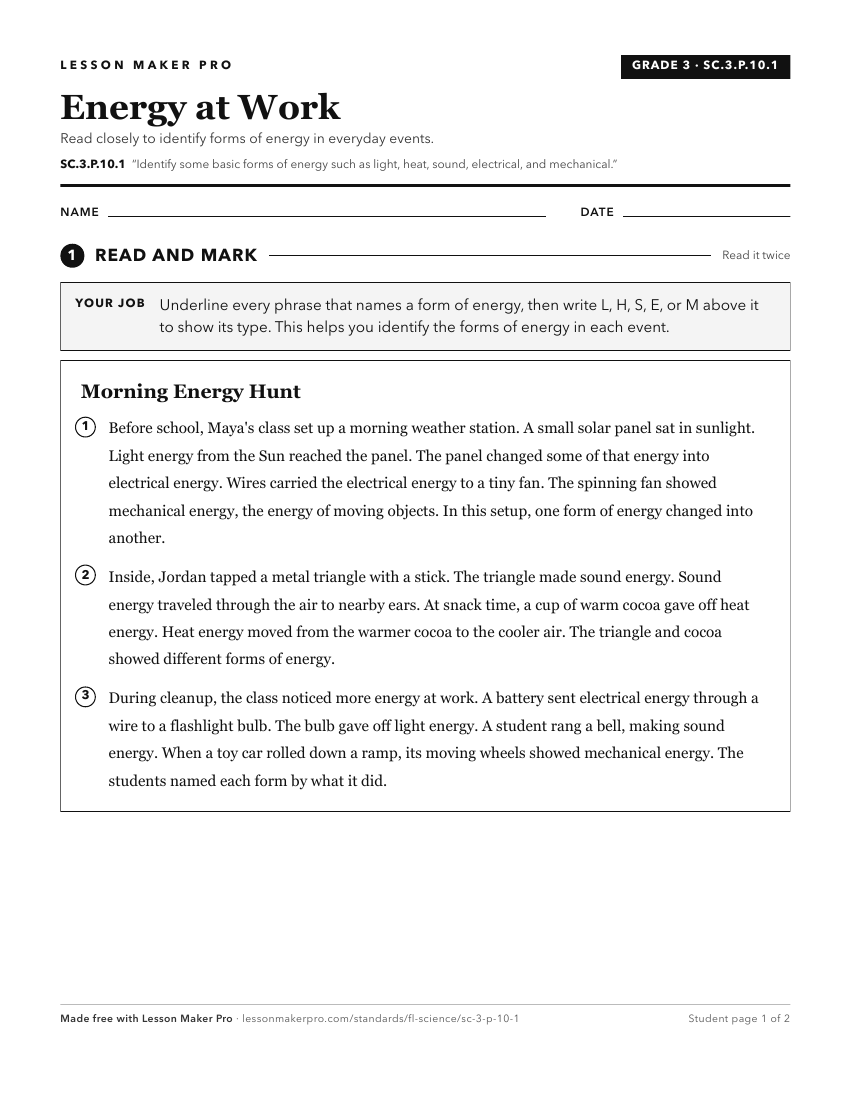
A ready-to-print activity worksheet aligned to SC.3.P.10.1, with an answer key for the teacher on its own page. No account needed.
PDF, US Letter, prints cleanly in black and white.
Download the worksheetKeep exploring
Related Standards
- SC.7.P.11.2
Investigate and describe the transformation of energy from one form to another.
- SC.4.P.10.1
Observe and describe some basic forms of energy, including light, heat, sound, electrical, and the energy of motion.
- SC.5.P.10.1
Investigate and describe some basic forms of energy, including light, heat, sound, electrical, chemical, and mechanical.
- SC.5.P.10.4
Investigate and explain that electrical energy can be transformed into heat, light, and sound energy, as well as the energy of motion.
Turn this exact standard into a lesson
Grade, subject, topic, and the complete standard are prefilled. Create one free, no account needed.
Also for this standard:Make a WorksheetMake a QuizMake a Sub Lesson