Florida SC.6.N.1.3
The Standard
Explain the difference between an experiment and other types of scientific investigation, and explain the relative benefits and limitations of each.
Florida Next Generation Sunshine State Standards for Science
Teacher's field guide
What This Standard Means
What Students Need to Do
- Students identify when scientists deliberately change one factor and when they gather evidence without controlling conditions. They choose a suitable method for a question and explain what its evidence can and cannot show.
What Mastery Looks Like
- Given a study description, a student correctly identifies a controlled experiment, observation, survey, or model. They name the changed variable and controls when present, then give a specific strength and weakness of the method.
Common Misconceptions
- Students may call any science activity an experiment, even when no variable is changed. They may think observations are less scientific, or that models always match real systems. They may also claim an experiment proves causation when several factors changed or the sample was too small.
How to Assess It
- Exit ticket: A biologist studies road noise and frog calls by recording existing ponds or playing traffic sounds to frogs in identical tanks. Identify each method, then give one benefit and one limitation of each.
Lesson moves
Ways to Teach It
Teams observe and describe three paper towels, then test absorbency by changing only the brand while keeping sheet size and water fixed.
Ask, "Should scientists test a new bridge design with a model or a full-size bridge, and what does each choice miss?"
Give pairs investigation cards to sort into controlled experiment, observation, survey, or model, then require one benefit and limitation for each.
Students read a hurricane forecast graphic and explain why meteorologists use observations and models instead of creating controlled hurricanes.
Free download
Printable SC.6.N.1.3 Worksheet
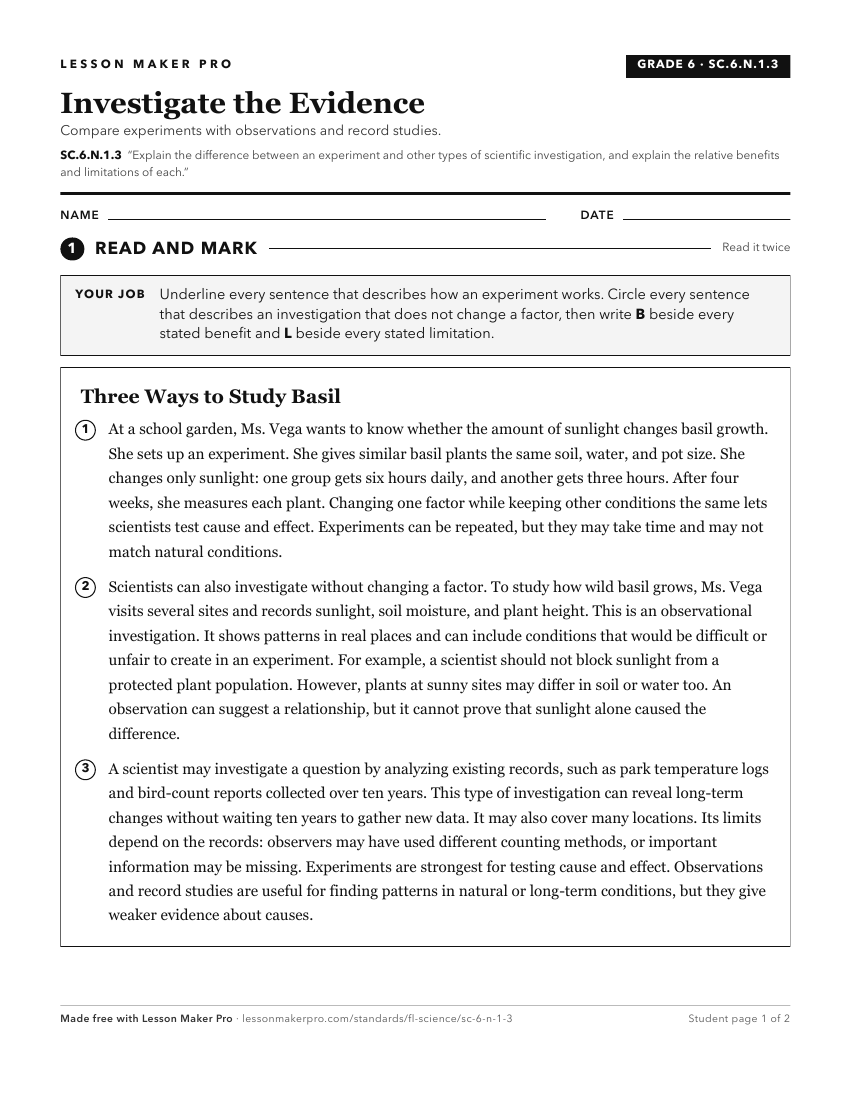
A ready-to-print activity worksheet aligned to SC.6.N.1.3, with an answer key for the teacher on its own page. No account needed.
PDF, US Letter, prints cleanly in black and white.
Download the worksheetKeep exploring
Related Standards
- SC.5.N.1.2
Explain the difference between an experiment and other types of scientific investigation.
- SC.5.N.1.5
Recognize and explain that authentic scientific investigation frequently does not parallel the steps of "the scientific method."
- SC.7.N.1.3
Distinguish between an experiment (which must involve the identification and control of variables) and other forms of scientific investigation and explain that ...
- SC.7.N.3.2
Identify the benefits and limitations of the use of scientific models.
Turn this exact standard into a lesson
Grade, subject, topic, and the complete standard are prefilled. Create one free, no account needed.
Also for this standard:Make a WorksheetMake a QuizMake a Sub Lesson