Florida SC.5.P.11.1
The Standard
Investigate and illustrate the fact that the flow of electricity requires a closed circuit (a complete loop).
Florida Next Generation Sunshine State Standards for Science
Teacher's field guide
What This Standard Means
What Students Need to Do
- Students build and test simple circuits with a battery, wires, and a bulb. They identify breaks in a circuit and draw a complete path for electric current.
What Mastery Looks Like
- A student can connect the materials so the bulb lights without help. The student can predict whether a circuit will work and explain how opening or closing a switch changes it.
Common Misconceptions
- Students may think one wire between the battery and bulb is enough. They may overlook the bulb’s two contact points or assume wires only need to be nearby. Some think electricity leaves the battery but does not need a return path.
How to Assess It
- Show one complete circuit diagram and one with a gap. Ask students to circle the circuit that lights the bulb, mark the gap, and explain their choice.
Lesson moves
Ways to Teach It
Give pairs a D-cell, small bulb, and two wires, then challenge them to light the bulb in three different arrangements.
Ask students to explain why a bulb goes out when one wire is removed, using the words path, gap, and current.
Play Circuit Detective with diagram cards, students sort them into working and nonworking circuits, then repair each nonworking diagram.
Have students open a flashlight, trace the electrical path from battery to bulb and back, then sketch and label the loop.
Free download
Printable SC.5.P.11.1 Worksheet
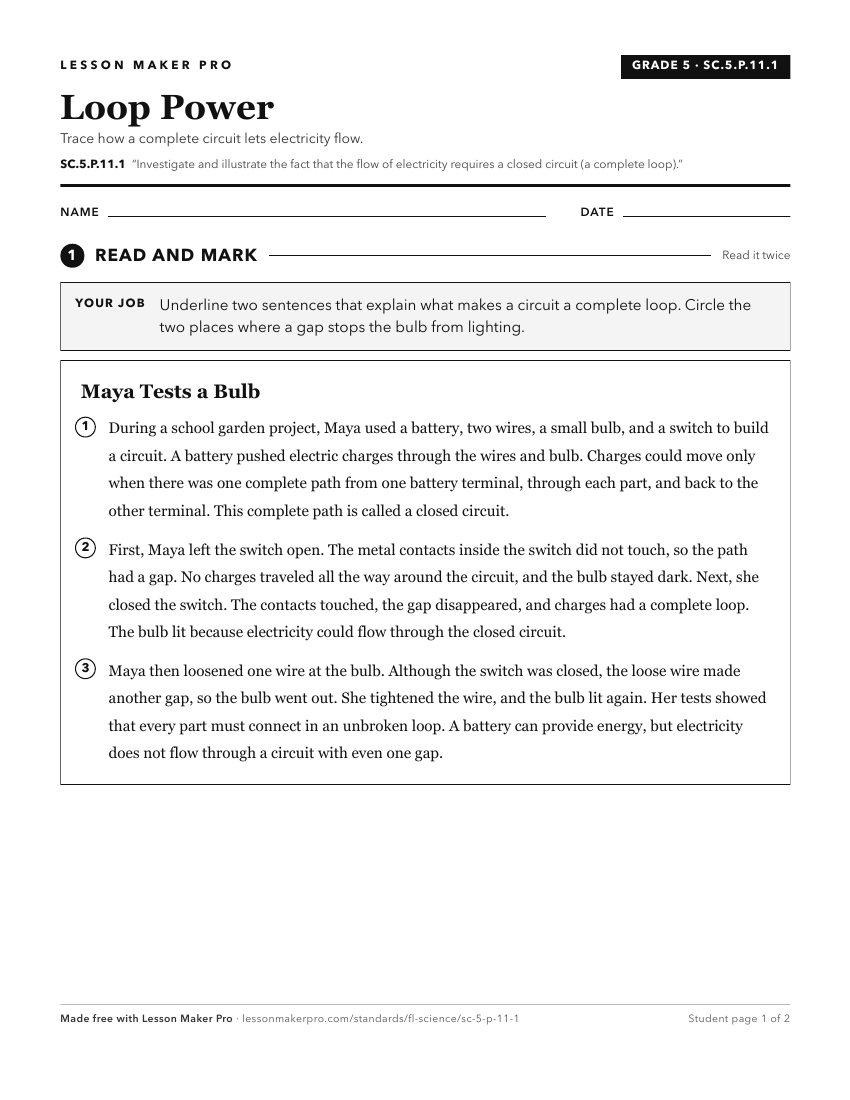
A ready-to-print activity worksheet aligned to SC.5.P.11.1, with an answer key for the teacher on its own page. No account needed.
PDF, US Letter, prints cleanly in black and white.
Download the worksheetKeep exploring
Related Standards
- SC.3.P.11.1
Investigate, observe, and explain that things that give off light often also give off heat.
- SC.5.P.10.4
Investigate and explain that electrical energy can be transformed into heat, light, and sound energy, as well as the energy of motion.
- SC.5.P.10.3
Investigate and explain that an electrically-charged object can attract an uncharged object and can either attract or repel another charged object without any c...
- SC.5.P.10.2
Investigate and explain that energy has the ability to cause motion or create change.
Turn this exact standard into a lesson
Grade, subject, topic, and the complete standard are prefilled. Create one free, no account needed.
Also for this standard:Make a WorksheetMake a QuizMake a Sub Lesson