Florida B.E.S.T. MA.912.LT.5.3
The Standard
Partition a set into disjoint subsets and determine an equivalence class given the equivalence relation on a set.
Florida B.E.S.T. Standards for Mathematics
Teacher's field guide
What This Standard Means
What Students Need to Do
- Students sort all elements of a set into nonoverlapping groups using a stated relation. They identify every element in the same group as a chosen element.
What Mastery Looks Like
- Students create groups that cover the full set without overlap. They test whether a relation is an equivalence relation and correctly list every element related to a given element.
Common Misconceptions
- Students may place one element in several subsets or leave an element out. They may group by a relation that is not reflexive, symmetric, and transitive, or list only one related element instead of the full class.
How to Assess It
- Give the set {1, 2, 3, 4, 5, 6, 7, 8} with numbers related when they have the same remainder after division by 3. Ask students to form all groups and list the class containing 5.
Lesson moves
Ways to Teach It
Give pairs cards numbered 1 through 18, then have them sort the cards by remainder after division by 4 and check for overlap.
Ask students to explain why grouping integers by odd and even creates valid classes, while grouping them by less than does not.
Play a matching game where students pair relation cards with the correct partitions, then identify the class containing a named element.
Group a sample class roster by shared birth month, then discuss why each student belongs to exactly one equivalence class.
Free download
Printable MA.912.LT.5.3 Worksheet
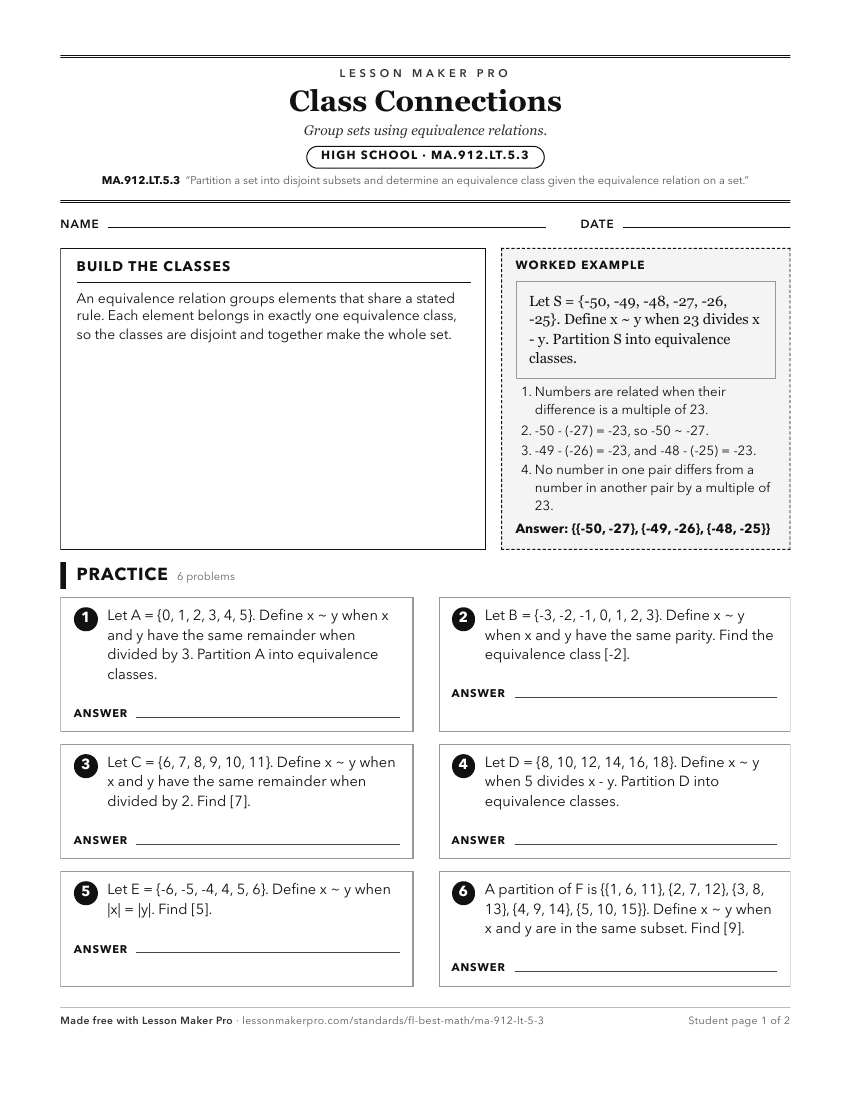
A ready-to-print activity worksheet aligned to MA.912.LT.5.3, with an answer key for the teacher on its own page. No account needed.
PDF, US Letter, prints cleanly in black and white.
Download the worksheetKeep exploring
Related Standards
- MA.2.FR.1.2
Partition rectangles into two, three or four equal-sized parts in two different ways showing that equal-sized parts of the same whole may have different shapes.
- MA.912.LT.5.1
Given two sets, determine whether the two sets are equivalent and whether one set is a subset of another. Given one set, determine its power set.
- MA.912.LT.5.2
Given a relation on two sets, determine whether the relation is a function, determine the inverse of the relation if it exists and identify if the relation is b...
- MA.912.LT.5.6
Prove set relations, including DeMorgan’s Laws and equivalence relations.
Turn this exact standard into a lesson
Grade, subject, topic, and the complete standard are prefilled. Create one free, no account needed.
Also for this standard:Make a WorksheetMake a QuizMake a Sub Lesson