Florida B.E.S.T. MA.912.LT.5.2
The Standard
Given a relation on two sets, determine whether the relation is a function, determine the inverse of the relation if it exists and identify if the relation is bijective.
Florida B.E.S.T. Standards for Mathematics
Teacher's field guide
What This Standard Means
What Students Need to Do
- Students decide whether a relation assigns exactly one output to every input. They reverse input-output pairs to form the inverse relation and check whether that inverse is a function. They decide whether the original function is both one-to-one and onto.
What Mastery Looks Like
- A student can inspect ordered pairs, a table, or a mapping diagram and justify whether each input has exactly one output. The student reverses every pair and checks whether the result is also a function. The student identifies a bijection by showing that every output is used exactly once.
Common Misconceptions
- Students often think repeated outputs mean a relation is not a function, even though only repeated inputs with different outputs cause failure. They may change signs instead of swapping coordinates when finding an inverse. They also confuse one-to-one with onto, especially when unused codomain values are shown.
How to Assess It
- Use this exit ticket: Let A = {1, 2, 3}, B = {a, b, c}, and R = {(1, b), (2, c), (3, a)}; classify R, write its inverse, and justify whether it is bijective.
Lesson moves
Ways to Teach It
Give students input and output cards to build mappings, reverse every arrow, and test whether each direction is a function.
Have students answer the prompt “Can a many-to-one function have an inverse function?” using a mapping diagram and counterexample.
Run a card sort where teams classify relations as not a function, function only, or bijection, then justify one choice.
Model employee ID assignments to explain why each employee needs one ID and why unique, fully used IDs make a bijection.
Free download
Printable MA.912.LT.5.2 Worksheet
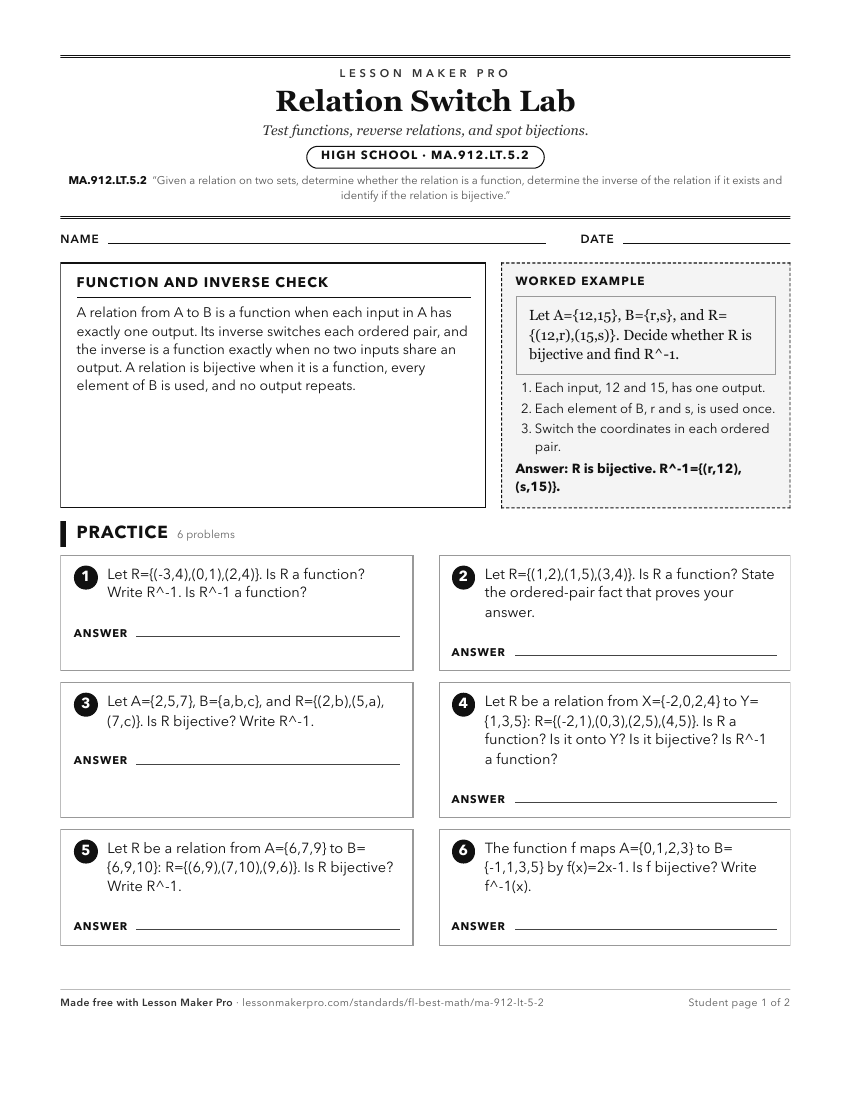
A ready-to-print activity worksheet aligned to MA.912.LT.5.2, with an answer key for the teacher on its own page. No account needed.
PDF, US Letter, prints cleanly in black and white.
Download the worksheetKeep exploring
Related Standards
- MA.912.F.3.7
Represent the inverse of a function algebraically, graphically or in a table. Use composition of functions to verify that one function is the inverse of the oth...
- MA.912.LT.5.1
Given two sets, determine whether the two sets are equivalent and whether one set is a subset of another. Given one set, determine its power set.
- MA.8.F.1.1
Given a set of ordered pairs, a table, a graph or mapping diagram, determine whether the relationship is a function. Identify the domain and range of the relati...
- MA.912.F.3.6
Determine whether an inverse function exists by analyzing tables, graphs and equations.
Turn this exact standard into a lesson
Grade, subject, topic, and the complete standard are prefilled. Create one free, no account needed.
Also for this standard:Make a WorksheetMake a QuizMake a Sub Lesson