Florida B.E.S.T. MA.912.DP.6.6
The Standard
Solve real-world problems involving Poisson distributions.
Florida B.E.S.T. Standards for Mathematics
Teacher's field guide
What This Standard Means
What Students Need to Do
- Students identify a fixed interval and the expected event count, λ. They calculate exact, at most, or at least probabilities with the Poisson model. They interpret the result and judge whether the model fits the situation.
What Mastery Looks Like
- A student can convert a stated rate to the interval in the question and use it as λ. They choose exact or cumulative probability correctly and report a sensible answer in context.
Common Misconceptions
- Students often use the rate for the wrong time interval or treat λ as a probability. They may calculate P(X = k) when the question asks for at most or at least k. They may also ignore changing rates or dependent events.
How to Assess It
- Exit ticket: A bakery averages 3 online orders every 10 minutes. Assuming a Poisson model, find the probability of exactly 8 orders in 20 minutes and interpret it. Look for λ = 6, a probability near 0.103, and a clear interpretation.
Lesson moves
Ways to Teach It
Roll a die 12 times per round, count sixes, and compare the class frequency table with a Poisson model using λ = 2.
Ask when customer arrivals would not follow a Poisson model, then have pairs defend one example using rate and independence.
Run a card sort matching phrases such as at least four with probability notation, calculator commands, and shaded count diagrams.
Use one week of cafeteria arrival counts to estimate an average per minute and predict the chance of a crowded five-minute interval.
Free download
Printable MA.912.DP.6.6 Worksheet
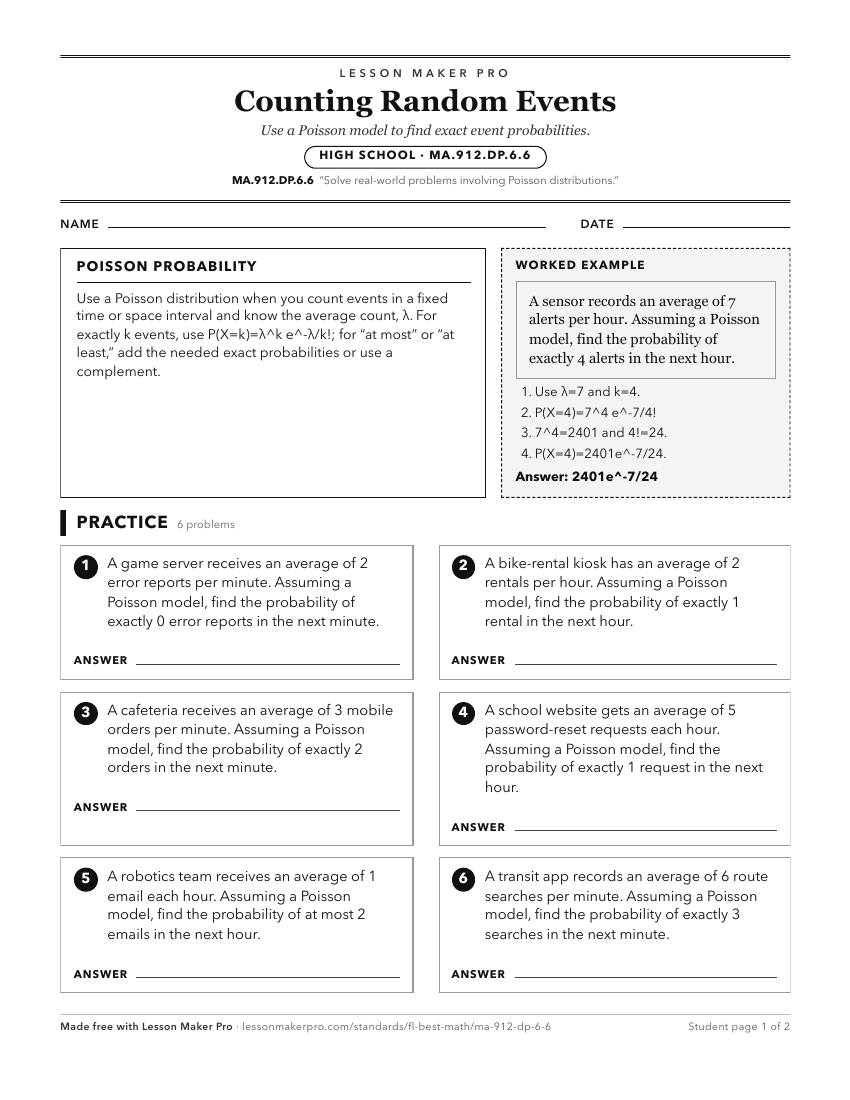
A ready-to-print activity worksheet aligned to MA.912.DP.6.6, with an answer key for the teacher on its own page. No account needed.
PDF, US Letter, prints cleanly in black and white.
Download the worksheetKeep exploring
Related Standards
- MA.4.DP.1.3
Solve real-world problems involving numerical data.
- MA.912.DP.6
Use probability distributions to solve problems.
- MA.912.DP.6.5
Solve real-world problems involving geometric distributions.
- MA.8.DP.2.3
Solve real-world problems involving probabilities related to single or repeated experiments, including making predictions based on theoretical probability.
Turn this exact standard into a lesson
Grade, subject, topic, and the complete standard are prefilled. Create one free, no account needed.
Also for this standard:Make a WorksheetMake a QuizMake a Sub Lesson