Florida B.E.S.T. MA.912.C.3.8
The Standard
Find average and instantaneous rates of change. Explain the instantaneous rate of change as the limit of the average rate of change. Interpret a derivative as a rate of change in applications, including velocity, speed and acceleration.
Florida B.E.S.T. Standards for Mathematics
Teacher's field guide
What This Standard Means
What Students Need to Do
- Students calculate average rate from two input-output pairs and instantaneous rate with a derivative. They connect the derivative to a limit of secant slopes and interpret its sign, size, and units in motion and other contexts.
What Mastery Looks Like
- Given a formula, graph, or table, students can find or estimate both rates and state what each means with units. For position functions, they identify velocity as the derivative, speed as its absolute value, and acceleration as the derivative of velocity.
Common Misconceptions
- Students often confuse average rate with the average of two function values, or use the wrong interval length. They may treat a tangent slope as unrelated to nearby secant slopes. In motion problems, they often call negative velocity negative speed or confuse velocity with acceleration.
How to Assess It
- Exit ticket: A particle’s position is s(t) = t³ meters. Find its average velocity from t = 1 to t = 3, velocity, speed, and acceleration at t = 2, then include units and the difference quotient limit.
Lesson moves
Ways to Teach It
Use a motion detector to record a walking student, then compare secant slopes over shrinking time intervals with the tangent slope.
Ask students to explain why a car’s speedometer gives an instantaneous rate while a trip summary gives an average rate.
Run a matching game with function cards, derivative cards, graphs, and context cards for position, velocity, speed, and acceleration.
Use a cyclist’s distance data at one-second intervals to estimate current speed, then compare the estimate with a fitted model’s derivative.
Free download
Printable MA.912.C.3.8 Worksheet
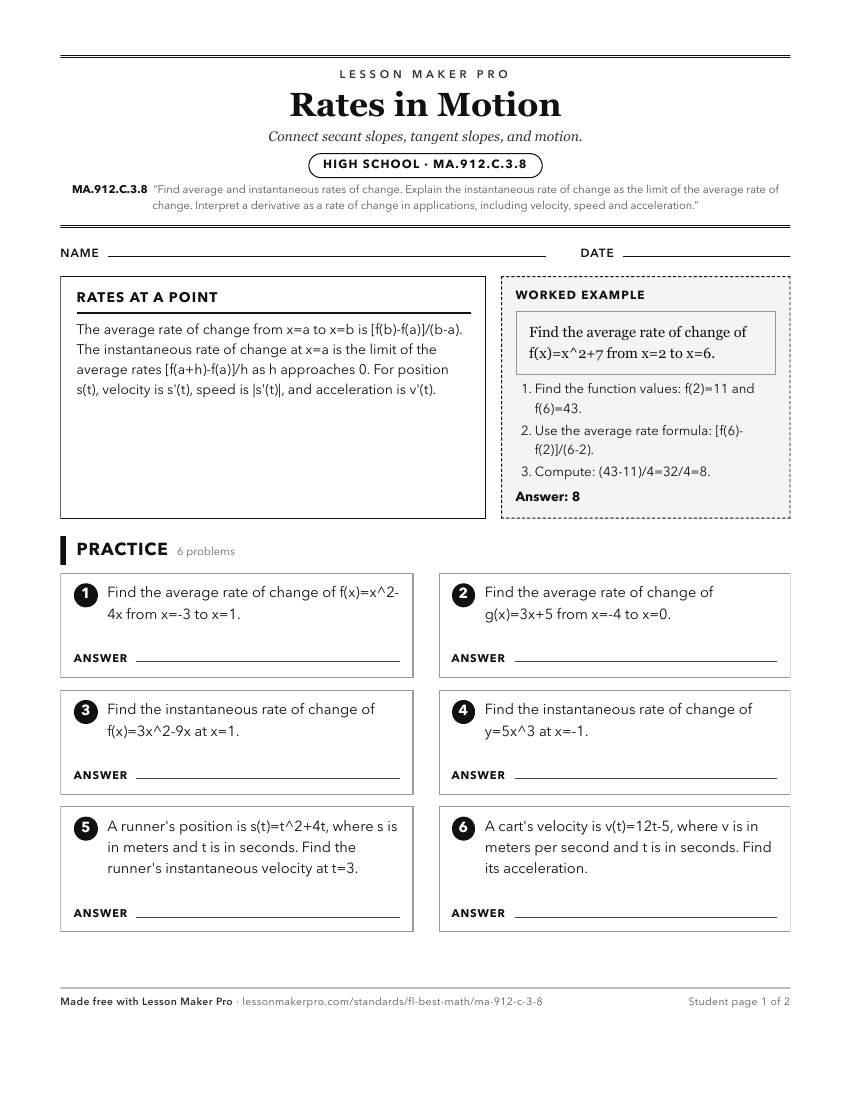
A ready-to-print activity worksheet aligned to MA.912.C.3.8, with an answer key for the teacher on its own page. No account needed.
PDF, US Letter, prints cleanly in black and white.
Download the worksheetKeep exploring
Related Standards
- MA.912.F.1.3
Calculate and interpret the average rate of change of a real-world situation represented graphically, algebraically or in a table over a specified interval.
- MA.912.C.2.2
Interpret the derivative as an instantaneous rate of change or as the slope of the tangent line.
- MA.912.C.4.3
Interpret a definite integral of the rate of change of a quantity over an interval as the change of the quantity over the interval.
- MA.912.C.3.10
Model and solve problems involving rates of change, including related rates.
Turn this exact standard into a lesson
Grade, subject, topic, and the complete standard are prefilled. Create one free, no account needed.
Also for this standard:Make a WorksheetMake a QuizMake a Sub Lesson