Florida B.E.S.T. MA.912.C.3.10
The Standard
Model and solve problems involving rates of change, including related rates.
Florida B.E.S.T. Standards for Mathematics
Teacher's field guide
What This Standard Means
What Students Need to Do
- Students identify which quantities are changing and write an equation that links them. They differentiate with respect to time, substitute known values, and solve for an unknown rate. They report the result with correct units and direction.
What Mastery Looks Like
- A student can draw and label a diagram, define variables, and write an equation connecting the changing quantities. The student differentiates correctly, solves for the requested rate, and explains the sign and units.
Common Misconceptions
- Students may substitute values before differentiating, which can make changing quantities look constant. They may forget the chain rule, confuse average rate with instantaneous rate, or drop negative signs and units.
How to Assess It
- Exit ticket: The radius of a circular puddle grows at 0.4 meters per minute. Find how fast its area grows when the radius is 3 meters, and show the differentiated equation.
Lesson moves
Ways to Teach It
Use a meter stick as a sliding ladder, move its base steadily, and measure how the top position changes each second.
Ask students to explain why substituting dimensions before differentiating can hide a changing quantity, then compare explanations with a partner.
Give pairs matching cards with diagrams, equations, known rates, and target rates; teams assemble and solve each complete set.
Model a spherical balloon being inflated, then calculate how fast its radius changes from a given air volume rate.
Free download
Printable MA.912.C.3.10 Worksheet
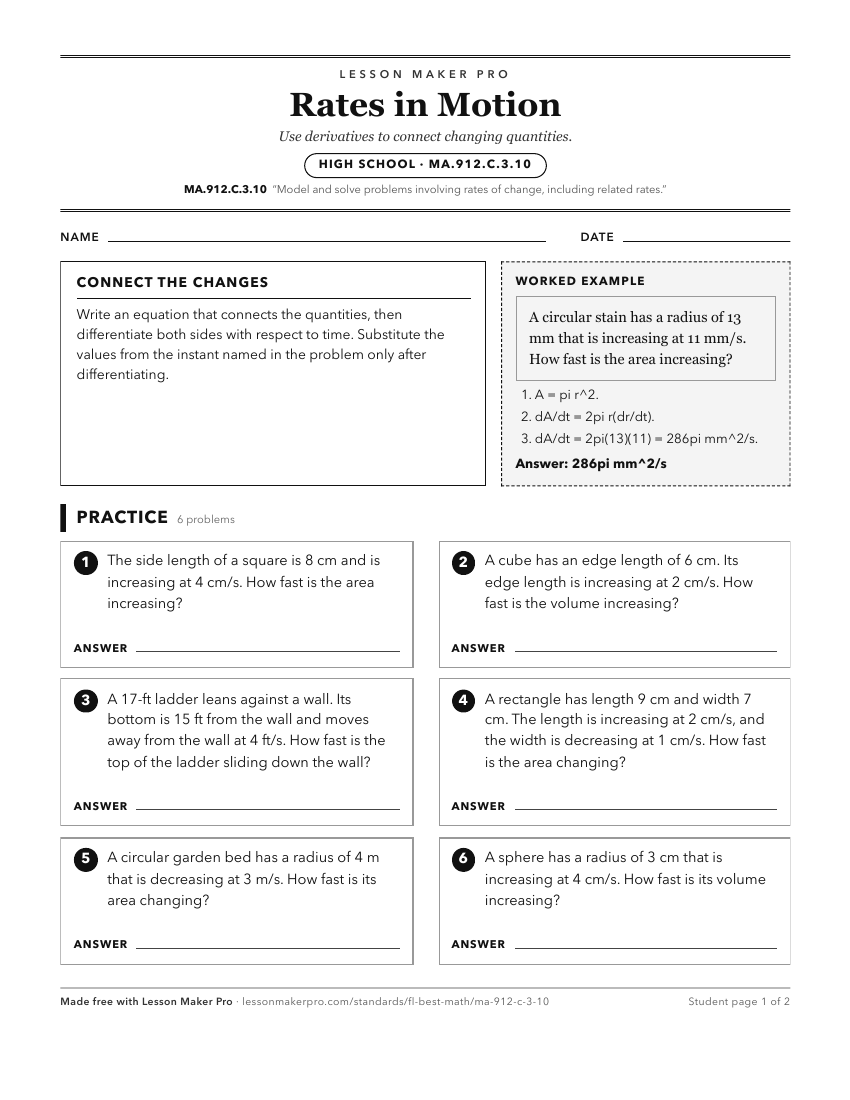
A ready-to-print activity worksheet aligned to MA.912.C.3.10, with an answer key for the teacher on its own page. No account needed.
PDF, US Letter, prints cleanly in black and white.
Download the worksheetKeep exploring
Related Standards
- MA.912.F.1.3
Calculate and interpret the average rate of change of a real-world situation represented graphically, algebraically or in a table over a specified interval.
- MA.6.AR.3.5
Solve mathematical and real-world problems involving ratios, rates and unit rates, including comparisons, mixtures, ratios of lengths and conversions within the...
- MA.7.AR.4.5
Solve real-world problems involving proportional relationships.
- MA.6.AR.3
Understand ratio and unit rate concepts and use them to solve problems.
Turn this exact standard into a lesson
Grade, subject, topic, and the complete standard are prefilled. Create one free, no account needed.
Also for this standard:Make a WorksheetMake a QuizMake a Sub Lesson