Florida B.E.S.T. MA.7.GR.1.1
The Standard
Apply formulas to find the areas of trapezoids, parallelograms and rhombi.
Florida B.E.S.T. Standards for Mathematics
Teacher's field guide
What This Standard Means
What Students Need to Do
- Students identify the measurements needed for each figure, including perpendicular height or rhombus diagonals. They choose a suitable formula, substitute values, calculate accurately, and use square units.
What Mastery Looks Like
- Students select the correct formula, substitute measurements accurately, and calculate the area. They identify perpendicular height, handle both trapezoid bases, and report answers in square units.
Common Misconceptions
- Students often use a slanted side as the height instead of a perpendicular segment. They may omit one trapezoid base or forget the one-half factor. When using rhombus diagonals, they may multiply them without dividing by two.
How to Assess It
- Exit ticket: Find the area of a parallelogram with base 9 and height 4, a trapezoid with bases 6 and 10 and height 5, and a rhombus with diagonals 8 and 12.
Lesson moves
Ways to Teach It
Cut paper parallelograms, rhombi, and trapezoids into pieces, rearrange them as rectangles, and label the measurements used in each area formula.
Ask: Why is a slanted side not always the height, and how can you verify that a marked segment is perpendicular?
Use matching cards with figures, dimensions, formulas, and areas; students race to build correct four-card sets and explain each match.
Give a garden plan with trapezoid, parallelogram, and rhombus beds, then have students calculate soil coverage and label square units.
Free download
Printable MA.7.GR.1.1 Worksheet
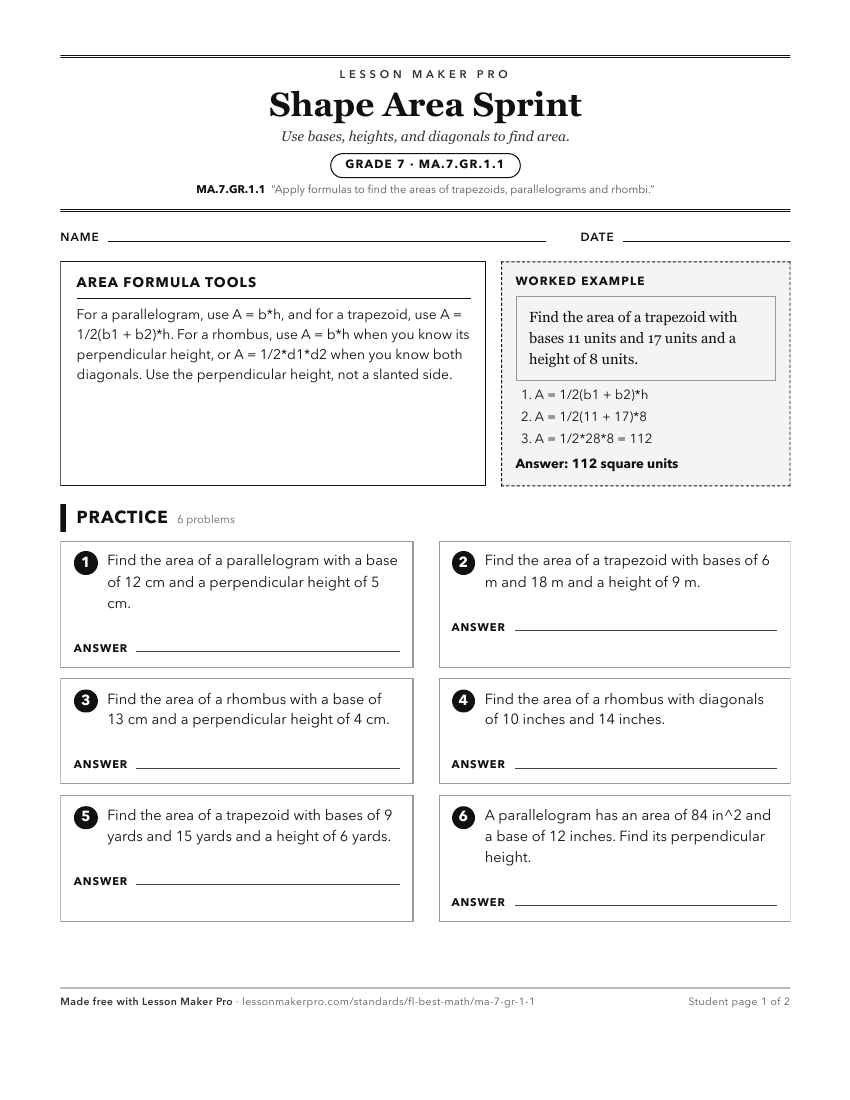
A ready-to-print activity worksheet aligned to MA.7.GR.1.1, with an answer key for the teacher on its own page. No account needed.
PDF, US Letter, prints cleanly in black and white.
Download the worksheetKeep exploring
Related Standards
- MA.912.GR.1.5
Prove relationships and theorems about trapezoids. Solve mathematical and real-world problems involving postulates, relationships and theorems of trapezoids.
- MA.6.GR.2.2
Solve mathematical and real-world problems involving the area of quadrilaterals and composite figures by decomposing them into triangles or rectangles.
- MA.3.GR.1.2
Identify and draw quadrilaterals based on their defining attributes. Quadrilaterals include parallelograms, rhombi, rectangles, squares and trapezoids.
- MA.6.GR.2.1
Derive a formula for the area of a right triangle using a rectangle. Apply a formula to find the area of a triangle.
Turn this exact standard into a lesson
Grade, subject, topic, and the complete standard are prefilled. Create one free, no account needed.
Also for this standard:Make a WorksheetMake a QuizMake a Sub Lesson