Florida B.E.S.T. MA.6.NSO.3.1
The Standard
Given a mathematical or real-world context, find the greatest common factor and least common multiple of two whole numbers.
Florida B.E.S.T. Standards for Mathematics
Teacher's field guide
What This Standard Means
What Students Need to Do
- Students find shared factors for equal-group problems and shared multiples for repeating-event problems. They choose an efficient method and connect the result to the situation.
What Mastery Looks Like
- A student can determine GCF(24, 36) = 12 and LCM(8, 12) = 24 using factor lists or prime factorization. They choose the right result for a context and explain what the number means, including units.
Common Misconceptions
- Students often use GCF for repeating events and LCM for making equal groups. They may omit the numbers themselves from factor lists or stop listing multiples before finding a match. Some give a correct calculation but do not explain what the answer means in the situation.
How to Assess It
- Give this exit ticket: “Make the greatest number of identical supply bags from 24 pencils and 36 erasers. Two bells ring every 8 and 12 minutes. When will they ring together again?” Students must show a factor or multiple strategy and label both answers.
Lesson moves
Ways to Teach It
Use 24 red counters and 36 blue counters to build the greatest number of identical groups, then record each group’s contents.
Ask, “How can you tell whether a problem needs GCF or LCM?” Students cite clues from two sample situations.
Play a card sort where number pairs are matched to GCF and LCM cards, then partners verify each match with factor lists.
Compare bus schedules that repeat every 12 and 18 minutes, then determine when both buses will next arrive together.
Free download
Printable MA.6.NSO.3.1 Worksheet
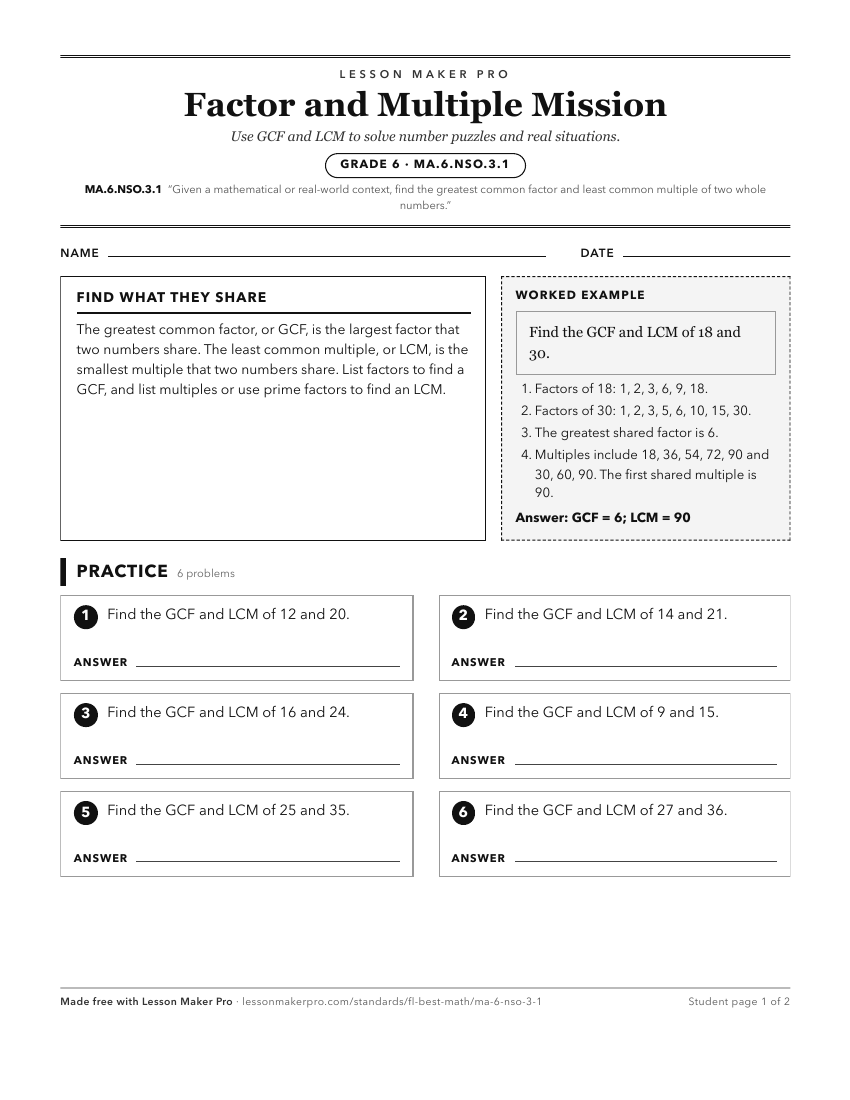
A ready-to-print activity worksheet aligned to MA.6.NSO.3.1, with an answer key for the teacher on its own page. No account needed.
PDF, US Letter, prints cleanly in black and white.
Download the worksheetKeep exploring
Related Standards
- MA.5.FR.1.1
Given a mathematical or real-world problem, represent the division of two whole numbers as a fraction.
- MA.4.AR.2.2
Given a mathematical or real-world context, write an equation involving multiplication or division to determine the unknown whole number with the unknown in any...
- MA.4.AR.1.1
Solve real-world problems involving multiplication and division of whole numbers including problems in which remainders must be interpreted within the context.
- MA.4.AR.1.3
Solve real-world problems involving multiplication of a fraction by a whole number or a whole number by a fraction.
Turn this exact standard into a lesson
Grade, subject, topic, and the complete standard are prefilled. Create one free, no account needed.
Also for this standard:Make a WorksheetMake a QuizMake a Sub Lesson