Florida B.E.S.T. MA.4.GR.1.2
The Standard
Estimate angle measures. Using a protractor, measure angles in whole-number degrees and draw angles of specified measure in whole-number degrees. Demonstrate that angle measure is additive.
Florida B.E.S.T. Standards for Mathematics
Teacher's field guide
What This Standard Means
What Students Need to Do
- Students estimate angle size, then use a protractor to measure and draw angles in whole degrees. They split an angle into adjacent parts and add the parts to find the whole measure.
What Mastery Looks Like
- Students align a protractor correctly, choose the correct scale, and measure or draw angles to the nearest whole degree. They find a whole angle by adding adjacent angle measures and explain why the sum works.
Common Misconceptions
- Students may think longer rays make a larger angle. They may use the wrong protractor scale or place the center away from the vertex. Some add angle measures that overlap instead of adjacent parts.
How to Assess It
- Give students a 68° angle to estimate and measure, then ask them to draw 125°. Show adjacent angles of 47° and 36°, and ask for the total angle.
Lesson moves
Ways to Teach It
Make angles with two craft sticks and a brad, estimate each measure, check with a protractor, then split one angle into two parts.
Ask, “How can two smaller angles combine to make a larger angle?” Students draw an example and label all measures.
Play Angle Match: students pair angle cards with estimate cards, then use protractors to check and score one point per correct match.
Photograph corners in classroom objects, estimate and measure their angles, then identify two adjacent angles whose measures combine into a larger angle.
Free download
Printable MA.4.GR.1.2 Worksheet
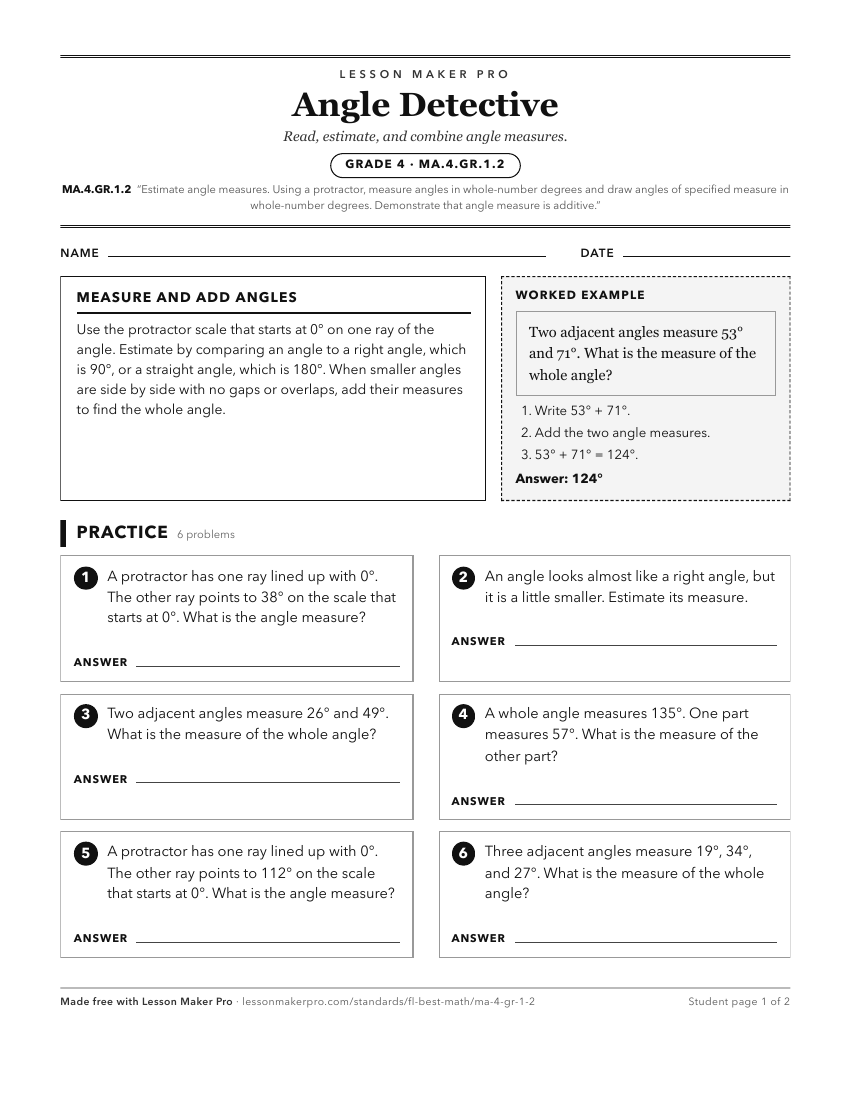
A ready-to-print activity worksheet aligned to MA.4.GR.1.2, with an answer key for the teacher on its own page. No account needed.
PDF, US Letter, prints cleanly in black and white.
Download the worksheetKeep exploring
Related Standards
- MA.8.GR.1.4
Solve mathematical problems involving the relationships between supplementary, complementary, vertical or adjacent angles.
- MA.4.GR.1
Draw, classify and measure angles.
- MA.4.GR.1.3
Solve real-world and mathematical problems involving unknown whole-number angle measures. Write an equation to represent the unknown.
- MA.912.GR.6.2
Solve mathematical and real-world problems involving the measures of arcs and related angles.
Turn this exact standard into a lesson
Grade, subject, topic, and the complete standard are prefilled. Create one free, no account needed.
Also for this standard:Make a WorksheetMake a QuizMake a Sub Lesson