Florida B.E.S.T. MA.4.AR.3.2
The Standard
Generate, describe and extend a numerical pattern that follows a given rule.
Florida B.E.S.T. Standards for Mathematics
Teacher's field guide
What This Standard Means
What Students Need to Do
- Students use an operation rule, such as add 6 or multiply by 3, to build a sequence from a starting number. They explain how the numbers change and find later terms.
What Mastery Looks Like
- A student can build an accurate sequence from any given starting number and operation rule. The student can state the rule, continue the sequence, and explain how each term was found.
Common Misconceptions
- Students may add the rule number instead of multiplying, or change the amount used at each step. They may treat the starting number as term zero instead of term one.
How to Assess It
- Exit ticket: Start at 6 and multiply by 2. Write the first five terms, circle the fourth term, and explain the rule in one sentence.
Lesson moves
Ways to Teach It
Give pairs number cards, counters, and an add 4 card; students model and record six terms starting at 3.
Ask, “How do you know 37 belongs in the pattern 7, 12, 17, 22?” Students justify with words and equations.
Play Pattern Relay: teams draw a start card and rule card, then take turns writing the next correct term.
Track savings starting at $5 and increasing by $3 weekly; students make a table and predict the amount after eight weeks.
Free download
Printable MA.4.AR.3.2 Worksheet
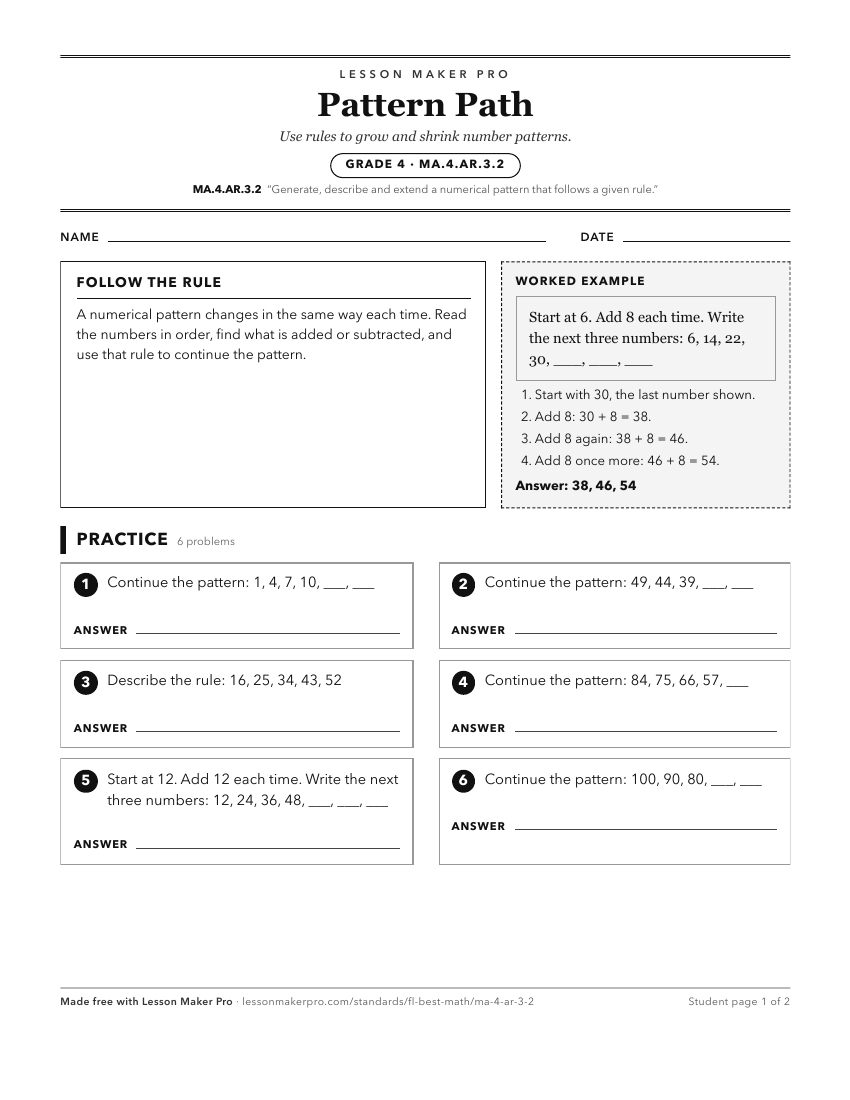
A ready-to-print activity worksheet aligned to MA.4.AR.3.2, with an answer key for the teacher on its own page. No account needed.
PDF, US Letter, prints cleanly in black and white.
Download the worksheetKeep exploring
Related Standards
- MA.4.AR.3
Recognize numerical patterns, including patterns that follow a given rule.
- MA.5.AR.3.2
Given a rule for a numerical pattern, use a two-column table to record the inputs and outputs.
- MA.3.AR.3.3
Identify, create and extend numerical patterns.
- MA.5.AR.3.1
Given a numerical pattern, identify and write a rule that can describe the pattern as an expression.
Turn this exact standard into a lesson
Grade, subject, topic, and the complete standard are prefilled. Create one free, no account needed.
Also for this standard:Make a WorksheetMake a QuizMake a Sub Lesson