Florida B.E.S.T. MA.3.FR.1.1
The Standard
Represent and interpret unit fractions in the form 1/n as the quantity formed by one part when a whole is partitioned into n equal parts.
Florida B.E.S.T. Standards for Mathematics
Teacher's field guide
What This Standard Means
What Students Need to Do
- Students divide one whole into equal-sized parts and name one part with a fraction. They connect the denominator to the total number of equal parts in the whole.
What Mastery Looks Like
- Students can draw, shade, and label unit fractions using circles, rectangles, or number lines. They explain that the denominator tells how many equal parts make the whole and that one part is selected.
Common Misconceptions
- Students may accept unequal pieces as fractions of one whole. They may think 1/8 is greater than 1/4 because 8 is greater than 4. They may count shaded parts instead of all equal parts when naming the denominator.
How to Assess It
- Give students a rectangle and ask them to show 1/6, label the fraction, and explain what the 6 means.
Lesson moves
Ways to Teach It
Fold paper strips into two, three, four, and six equal sections, then shade and label one section on each strip.
Show same-sized models of 1/4 and 1/8, then ask students to explain which piece is larger and why.
Match fraction cards such as 1/3 and 1/6 to picture cards, rejecting models with unequal parts.
Cut a paper sandwich into equal shares for different group sizes, then name one person’s share each time.
Free download
Printable MA.3.FR.1.1 Worksheet
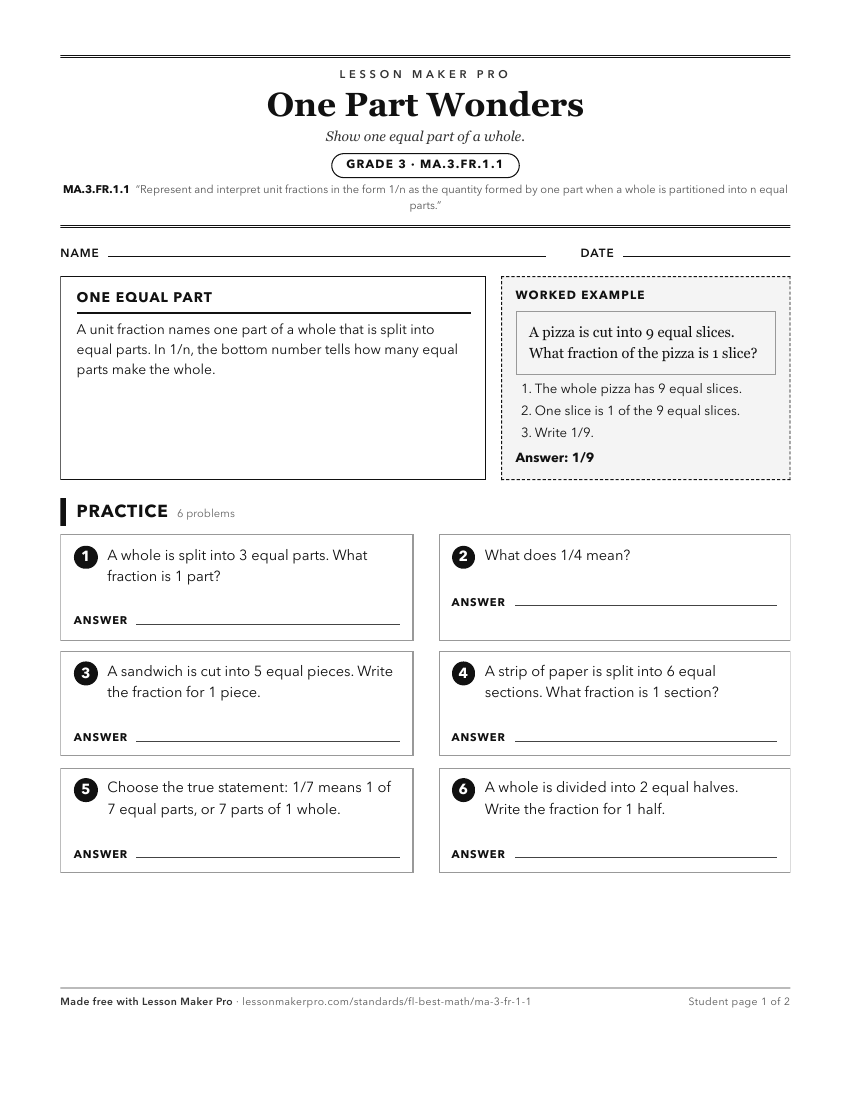
A ready-to-print activity worksheet aligned to MA.3.FR.1.1, with an answer key for the teacher on its own page. No account needed.
PDF, US Letter, prints cleanly in black and white.
Download the worksheetKeep exploring
Related Standards
- MA.3.FR.1
Understand fractions as numbers and represent fractions.
- MA.5.FR.1.1
Given a mathematical or real-world problem, represent the division of two whole numbers as a fraction.
- MA.5.FR.2.4
Extend previous understanding of division to explore the division of a unit fraction by a whole number and a whole number by a unit fraction.
- MA.3.FR.1.2
Represent and interpret fractions, including fractions greater than one, in the form of m n as the result of adding the unit fraction 1 n to itself m times.
Turn this exact standard into a lesson
Grade, subject, topic, and the complete standard are prefilled. Create one free, no account needed.
Also for this standard:Make a WorksheetMake a QuizMake a Sub Lesson