Florida B.E.S.T. ELA.2.R.2.3
The Standard
Explain an author’s purpose in an informational text.
Florida B.E.S.T. Standards for English Language Arts
Teacher's field guide
What This Standard Means
What Students Need to Do
- Students decide what a writer wants readers to learn, understand, or do. They use the title, facts, word choices, and text features to explain their thinking.
What Mastery Looks Like
- Given a short nonfiction passage, students state a specific reason the writer created it, such as teaching how bees pollinate flowers. They point to a relevant detail and explain how it supports their answer.
Common Misconceptions
- Students may name the topic instead of the writer's reason for writing. They may say every nonfiction text is "to inform" without explaining what readers should learn. Some rely only on a picture or title and ignore details in the text.
How to Assess It
- Give students this passage: "A camel's hump stores fat. The fat gives the camel energy when food is scarce." Ask them to write the writer's purpose and underline one supporting clue.
Lesson moves
Ways to Teach It
Give pairs short nonfiction cards to sort by whether the writer wants readers to learn facts, follow steps, or take action.
Ask, "What does the writer want you to know or do, and which sentence makes you think that?"
Play Purpose Detective by reading short passages aloud while teams hold up a purpose card and cite one clue for a point.
Have students examine a cafeteria menu, weather alert, and library notice, then state what each writer wants readers to know or do.
Free download
Printable ELA.2.R.2.3 Worksheet
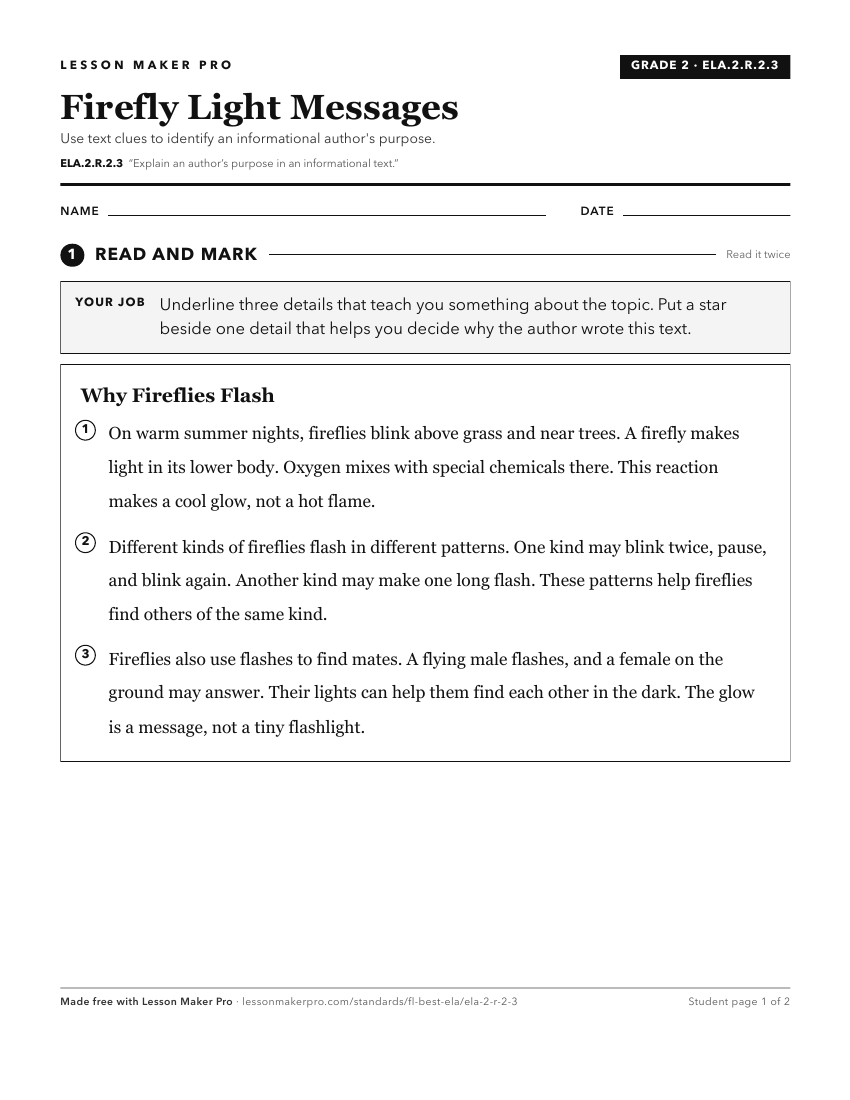
A ready-to-print activity worksheet aligned to ELA.2.R.2.3, with an answer key for the teacher on its own page. No account needed.
PDF, US Letter, prints cleanly in black and white.
Download the worksheetKeep exploring
Related Standards
Turn this exact standard into a lesson
Grade, subject, topic, and the complete standard are prefilled. Create one free, no account needed.
Also for this standard:Make a WorksheetMake a QuizMake a Sub Lesson