Florida B.E.S.T. ELA.1.R.1.3
The Standard
Explain who is telling the story using context clues.
Florida B.E.S.T. Standards for English Language Arts
Teacher's field guide
What This Standard Means
What Students Need to Do
- Students figure out whose voice tells a story. They use clues such as I, my, character names, actions, and details the narrator knows.
What Mastery Looks Like
- Students can say whether a character or an outside voice tells a short story. They can point to pronouns, actions, or details that support their answer.
Common Misconceptions
- Students may name the author, main character, or person in the picture as the narrator without checking the words. They may also mistake dialogue spoken by a character for the voice telling the whole story.
How to Assess It
- Give this exit ticket: “I pulled on my boots and followed Dad into the rain.” Ask, “Who tells the story? Circle two clue words.”
Lesson moves
Ways to Teach It
Give pairs short passages to sort into character narrator and outside narrator piles, then highlight the clue words.
Read a story opening and ask, “Whose voice do we hear, and which words helped you decide?”
Play Narrator Detective by showing one passage at a time and awarding points for naming the narrator and citing a clue.
Compare a child retelling a playground event with a teacher describing it, then identify who tells each version and how readers know.
Free download
Printable ELA.1.R.1.3 Worksheet
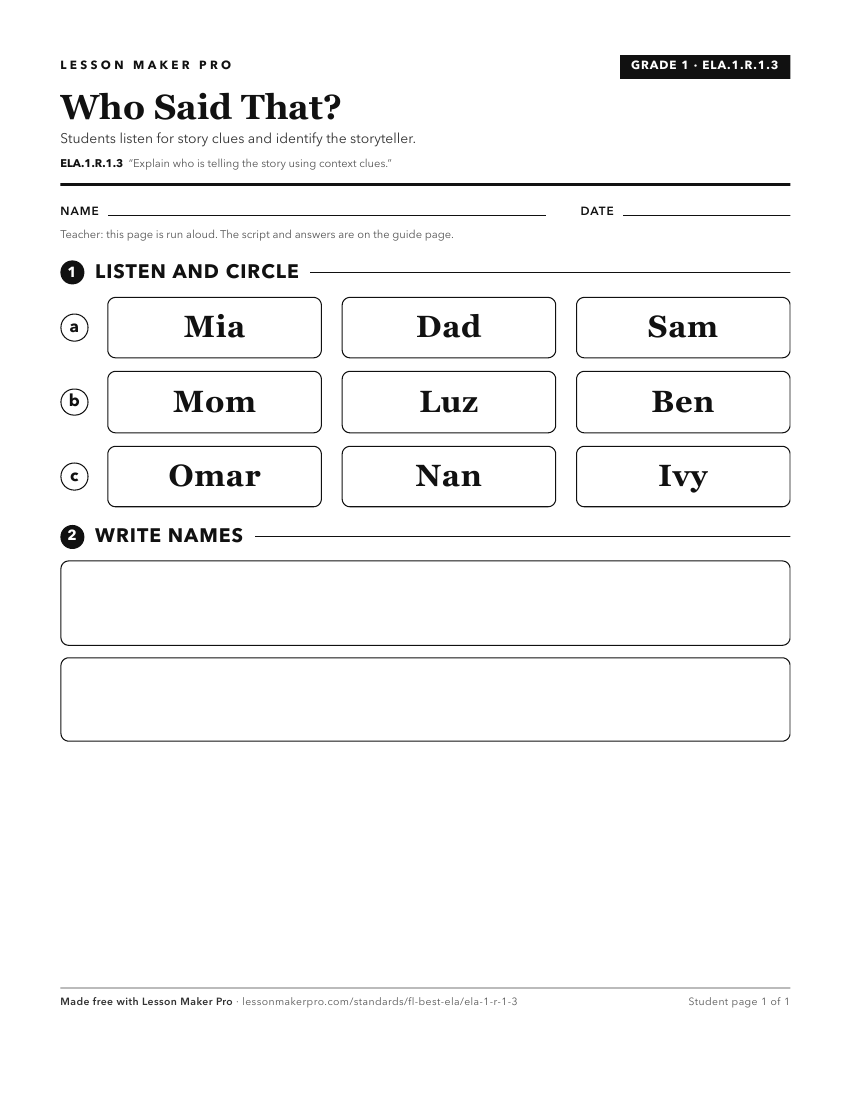
A ready-to-print activity worksheet aligned to ELA.1.R.1.3, with an answer key for the teacher on its own page. No account needed.
PDF, US Letter, prints cleanly in black and white.
Download the worksheetKeep exploring
Related Standards
- ELA.3.R.1.3
Explain different characters' perspectives in a literary text
- ELA.4.V.1.3
Use context clues, figurative language, word relationships, reference materials, and/or background knowledge to determine the meaning of multiple-meaning and un...
- ELA.5.V.1.3
Use context clues, figurative language, word relationships, reference materials, and/or background knowledge to determine the meaning of multiple-meaning and un...
- ELA.3.V.1.3
Use context clues, figurative language, word relationships, reference materials, and/or background knowledge to determine the meaning of multiple-meaning and un...
Turn this exact standard into a lesson
Grade, subject, topic, and the complete standard are prefilled. Create one free, no account needed.
Also for this standard:Make a WorksheetMake a QuizMake a Sub Lesson