CCSS.
The Standard
Make sense of problems and persevere in solving them. Mathematically proficient students start by explaining to themselves the meaning of a problem and looking for entry points to its solution. They analyze givens, constraints, relationships, and goals. They make conjectures about the form and meaning of the solution and plan a solution pathway rather than simply jumping into a solution attempt. They consider analogous problems, and try special cases and simpler forms of the original problem in order to gain insight into its solution. They monitor and evaluate their progress and change course if necessary. Older students might, depending on the context of the problem, transform algebraic expressions or change the viewing window on their graphing calculator to get the information they need. Mathematically proficient students can explain correspondences between equations, verbal descriptions, tables, and graphs or draw diagrams of important features and relationships, graph data, and search for regularity or trends. Younger students might rely on using concrete objects or pictures to help conceptualize and solve a problem. Mathematically proficient students check their answers to problems using a different method, and they continually ask themselves, "Does this make sense?" They can understand the approaches of others to solving complex problems and identify correspondences between different approaches.
Common Core State Standards for Mathematics
Teacher's field guide
What This Standard Means
What Students Need to Do
- Students interpret an unfamiliar problem before calculating. They identify known information, the goal, and any limits, then choose a strategy, track their progress, revise, and check.
What Mastery Looks Like
- A student can represent a problem with objects, a diagram, a table, a graph, words, or equations. When a first plan stalls, the student tries another approach and explains why the final answer is reasonable.
Common Misconceptions
- Students may grab every number and calculate without deciding what the quantities mean. They may think a failed attempt means they cannot solve the problem. Some check only their arithmetic, not whether the answer fits the situation.
How to Assess It
- Put one unfamiliar, grade-level problem on an exit ticket. Ask students to solve it, show their plan, mark where they checked or changed course, and verify the answer.
Lesson moves
Ways to Teach It
Give pairs counters, tiles, or algebra tiles and a multistep puzzle, then require a model, a plan, and one recorded revision.
Post two student solutions and ask, "Where does each plan work, where does it stall, and what should happen next?"
Run a strategy-switch relay where teams solve task cards, then use a new representation or method before submitting each answer.
Have students plan a class event with a fixed budget, stated constraints, and a written check that their choices fit.
Free download
Printable CCSS.Math.Practice.MP1 Worksheet
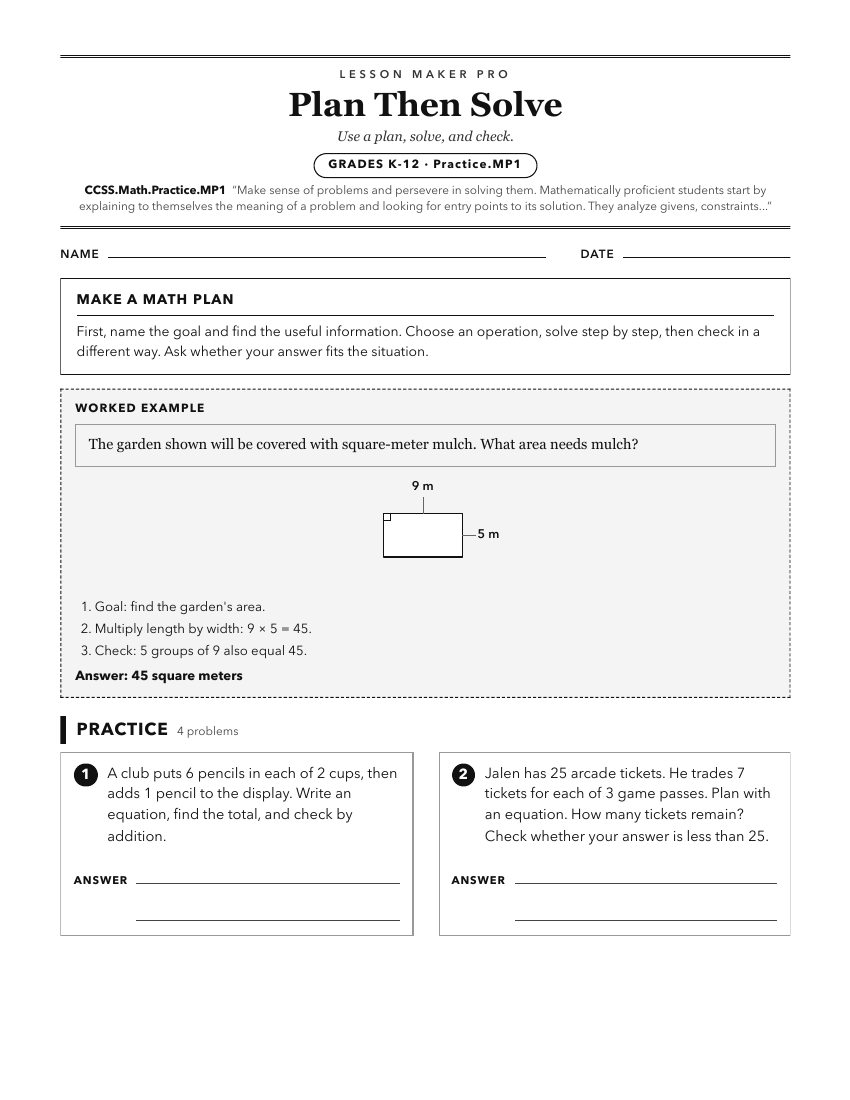
A ready-to-print activity worksheet aligned to CCSS.Math.Practice.MP1, with an answer key for the teacher on its own page. No account needed.
PDF, US Letter, prints cleanly in black and white.
Download the worksheetKeep exploring
Related Standards
- CCSS.Math.Content.7.EE.B
Solve real-life and mathematical problems using numerical and algebraic expressions and equations.
- CCSS.Math.Content.HSN-Q.A.1
Use units as a way to understand problems and to guide the solution of multi-step problems; choose and interpret units consistently in formulas; choose and inte...
- CCSS.Math.Content.6.RP.A
Understand ratio concepts and use ratio reasoning to solve problems.
- CCSS.Math.Content.3.OA.D
Solve problems involving the four operations, and identify and explain patterns in arithmetic.
Turn this exact standard into a lesson
Grade, subject, topic, and the complete standard are prefilled. Create one free, no account needed.
Also for this standard:Make a WorksheetMake a QuizMake a Sub Lesson