CCSS.
The Standard
(+) Use matrices to represent and manipulate data, e.g., to represent payoffs or incidence relationships in a network.
Common Core State Standards for Mathematics · Vector and Matrix Quantities
Teacher's field guide
What This Standard Means
What Students Need to Do
- Students organize data or network connections in rows and columns of a matrix. They change, combine, or compare matrices to answer questions. They explain what specific entries and results mean in the situation.
What Mastery Looks Like
- Students can organize contextual data into a matrix with clear row and column labels. They can perform appropriate matrix operations and explain each result in context. They can also create an incidence or adjacency matrix from a network diagram.
Common Misconceptions
- Students may switch row and column meanings or omit labels, making entries hard to interpret. They may assume every network matrix is symmetric, even when connections are directed. They may perform operations correctly but cannot explain what the results mean.
How to Assess It
- Give students a three-store sales table and ask them to create a labeled matrix, double all values, and explain one resulting entry.
Lesson moves
Ways to Teach It
Give groups index cards and yarn to build a five-node network, then create its adjacency matrix and compare matrices across groups.
Ask students to explain in writing what the entry in row 2, column 4 means in a labeled payoff matrix.
Play Matrix Match by having students pair network diagrams, labeled matrices, and interpretation cards, then justify each match.
Use weekly store sales data to create matrices, combine two weeks, and calculate projected values after a percentage increase.
Free download
Printable HSN-VM.C.6 Worksheet
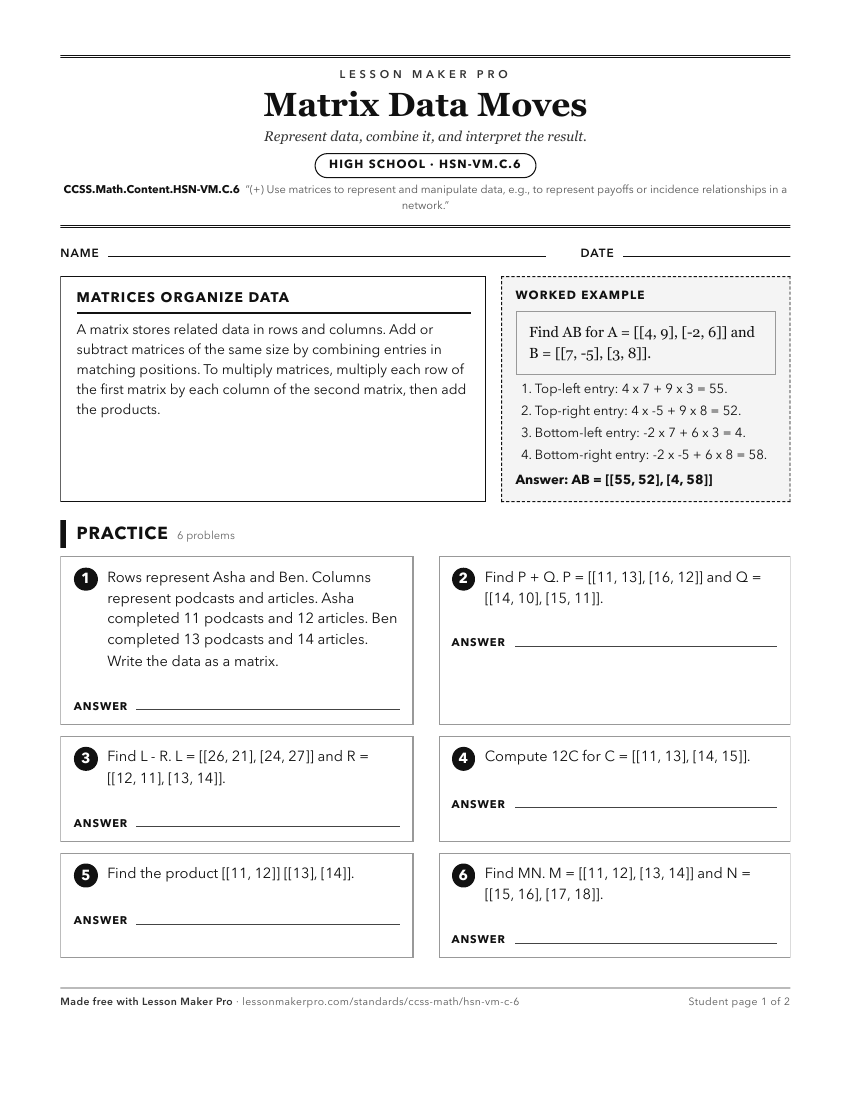
A ready-to-print activity worksheet aligned to CCSS.Math.Content.HSN-VM.C.6, with an answer key for the teacher on its own page. No account needed.
PDF, US Letter, prints cleanly in black and white.
Download the worksheetLearning progression
Where This Standard Sits
Before This Standard
If students are struggling here, check these first.
- CCSS.Math.Content.7.NS.A.3
Matrix data work often requires accurate arithmetic with entries, so rational-number operation gaps can interfere with manipulating matrix values.
- CCSS.Math.Content.HSN-Q.A.2
Choosing relevant quantities and relationships supports deciding what matrix entries represent in payoff, incidence, or other data models.
What This Unlocks
Mastery here sets students up for these next.
- CCSS.Math.Content.HSN-VM.C.8
Representing data in matrix rows and columns supports understanding entries and dimensions before performing matrix operations.
- CCSS.Math.Content.HSN-VM.C.7
Understanding matrices as arrays of quantities supports interpreting scalar multiplication as scaling every represented data value.
- CCSS.Math.Content.HSN-VM.C.11
Representing data in matrices gives students familiarity with entries and dimensions needed before matrix vector multiplication.
Keep exploring
Related Standards
Turn this exact standard into a lesson
Grade, subject, topic, and the complete standard are prefilled. Create one free, no account needed.
Also for this standard:Make a WorksheetMake a QuizMake a Sub Lesson