CCSS.
Standard Cluster
Perform operations on matrices and use matrices in applications.
Common Core State Standards for Mathematics
Cluster contents
Standards in This Cluster
CCSS.Math.Content.HSN-VM.C is a cluster heading. These are the individual standards under it.
- CCSS.Math.Content.HSN-VM.C.10
(+) Understand that the zero and identity matrices play a role in matrix addition and multiplication similar to the role of 0 and 1 in the real numbers. The det...
- CCSS.Math.Content.HSN-VM.C.11
(+) Multiply a vector (regarded as a matrix with one column) by a matrix of suitable dimensions to produce another vector. Work with matrices as transformations...
- CCSS.Math.Content.HSN-VM.C.12
(+) Work with 2 × 2 matrices as transformations of the plane, and interpret the absolute value of the determinant in terms of area.
- CCSS.Math.Content.HSN-VM.C.6
(+) Use matrices to represent and manipulate data, e.g., to represent payoffs or incidence relationships in a network.
- CCSS.Math.Content.HSN-VM.C.7
(+) Multiply matrices by scalars to produce new matrices, e.g., as when all of the payoffs in a game are doubled.
- CCSS.Math.Content.HSN-VM.C.8
(+) Add, subtract, and multiply matrices of appropriate dimensions.
- CCSS.Math.Content.HSN-VM.C.9
(+) Understand that, unlike multiplication of numbers, matrix multiplication for square matrices is not a commutative operation, but still satisfies the associa...
Teacher's field guide
What This Cluster Means
What Students Need to Do
- Students represent data with matrices and perform valid operations on them. They use matrix products, identity matrices, and other results to model and solve problems.
What Mastery Looks Like
- Students choose and carry out addition, subtraction, scalar multiplication, or matrix multiplication with correct dimensions. They use zero and identity matrices and interpret matrix results within a given situation.
Common Misconceptions
- Students often multiply corresponding entries when matrix multiplication is required. They may reverse factor order, ignore incompatible dimensions, or treat the identity matrix like a matrix of all ones.
How to Assess It
- Give students A = [[1, 2], [3, 4]] and B = [[2], [5]]. Ask them to find AB, state its dimensions, and explain what one entry represents.
Lesson moves
Ways to Teach It
Give pairs colored grid cards, then have students build matrix sums and row-by-column products with counters placed on matching entries.
Ask students to explain why AB may exist while BA does not, using one pair of matrices as evidence.
Run a dimension-match card game where students pair matrices that can be added or multiplied, then compute one valid result.
Use a transition matrix to model customers switching between two phone plans, then calculate and interpret the next month's totals.
Free download
Printable HSN-VM.C Worksheet
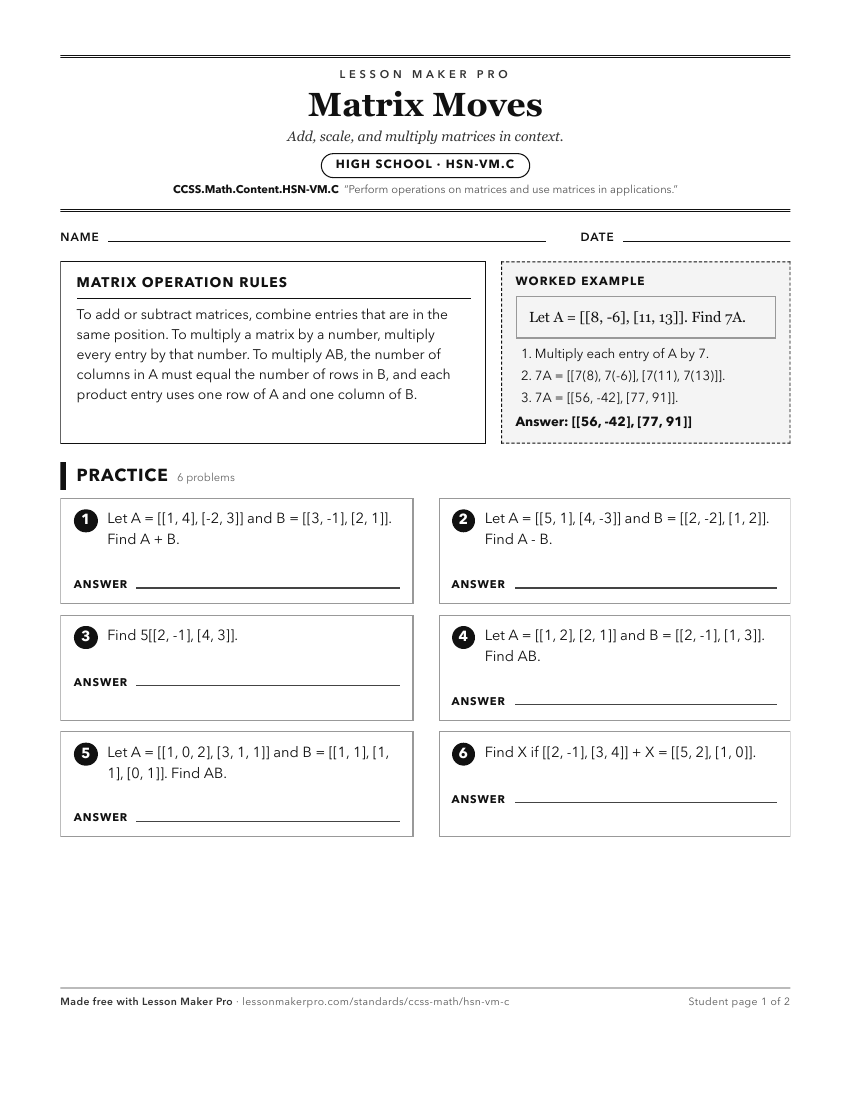
A ready-to-print activity worksheet aligned to CCSS.Math.Content.HSN-VM.C, with an answer key for the teacher on its own page. No account needed.
PDF, US Letter, prints cleanly in black and white.
Download the worksheetKeep exploring
Related Standards
Turn this cluster into a lesson
Grade, subject, topic, and the complete cluster are prefilled. Create one free, no account needed.
Also for this cluster:Make a WorksheetMake a QuizMake a Sub Lesson