CCSS.
Standard Cluster
Represent and model with vector quantities.
Common Core State Standards for Mathematics
Cluster contents
Standards in This Cluster
CCSS.Math.Content.HSN-VM.A is a cluster heading. These are the individual standards under it.
- CCSS.Math.Content.HSN-VM.A.1
(+) Recognize vector quantities as having both magnitude and direction. Represent vector quantities by directed line segments, and use appropriate symbols for v...
- CCSS.Math.Content.HSN-VM.A.2
(+) Find the components of a vector by subtracting the coordinates of an initial point from the coordinates of a terminal point.
- CCSS.Math.Content.HSN-VM.A.3
(+) Solve problems involving velocity and other quantities that can be represented by vectors.
Teacher's field guide
What This Cluster Means
What Students Need to Do
- Students represent quantities that have both size and direction using arrows and component form. They find components from endpoints and interpret vectors in situations such as velocity or force.
What Mastery Looks Like
- Students draw and label a directed segment from a given starting point to an endpoint. They write its component form, calculate its magnitude, and explain what both mean in context.
Common Misconceptions
- Students often reverse the subtraction order when finding components. They may ignore direction, confuse a vector with an endpoint, or treat component values as coordinates of a point.
How to Assess It
- Give this exit ticket: A drone flies from (-2, 1) to (4, 9). Draw the vector, write its components, and find its magnitude.
Lesson moves
Ways to Teach It
Tape a coordinate grid on the floor, have students walk between points, place a rope arrow, then record components and magnitude.
Ask students to explain why two runners moving at the same speed can have different velocity vectors.
Give teams cards showing endpoint pairs, vector diagrams, and component forms, then have them race to build matching sets.
Use a weather map with wind arrows, and have students compare wind speed and direction at four locations.
Free download
Printable HSN-VM.A Worksheet
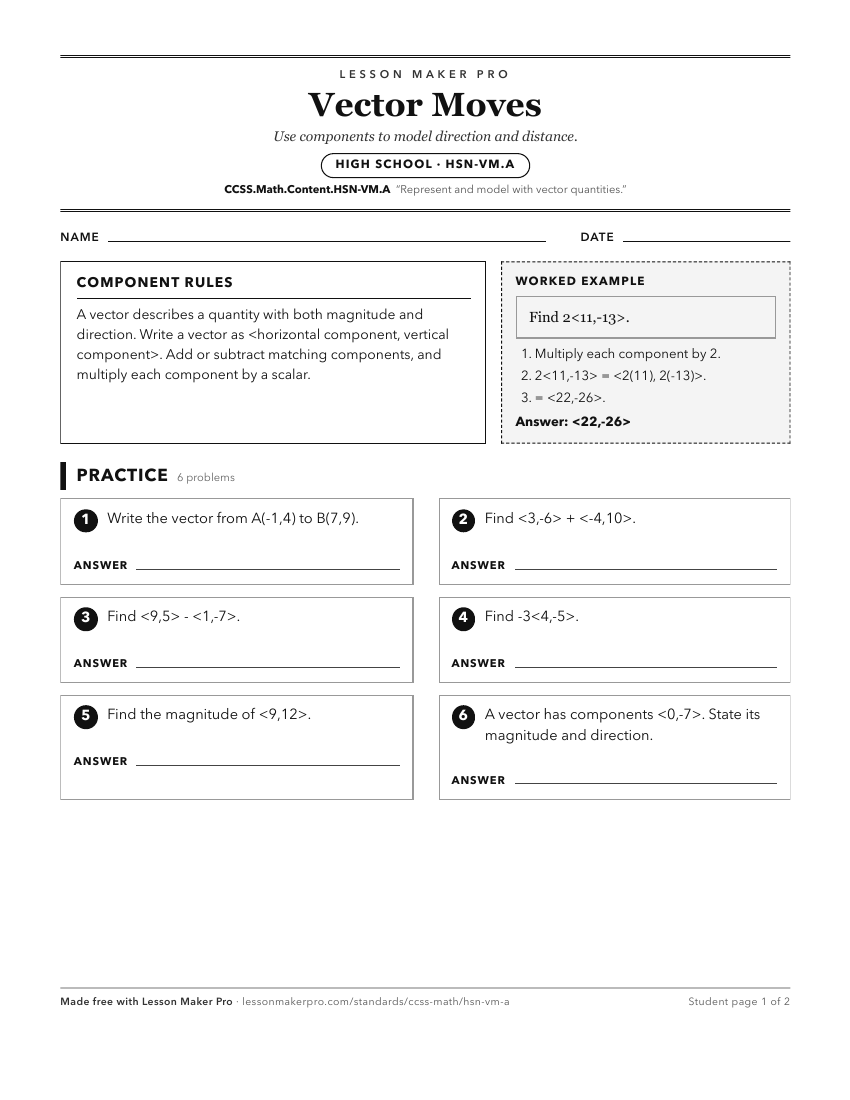
A ready-to-print activity worksheet aligned to CCSS.Math.Content.HSN-VM.A, with an answer key for the teacher on its own page. No account needed.
PDF, US Letter, prints cleanly in black and white.
Download the worksheetKeep exploring
Related Standards
Turn this cluster into a lesson
Grade, subject, topic, and the complete cluster are prefilled. Create one free, no account needed.
Also for this cluster:Make a WorksheetMake a QuizMake a Sub Lesson