CCSS.
The Standard
Represent constraints by equations or inequalities, and by systems of equations and/or inequalities, and interpret solutions as viable or nonviable options in a modeling context.
Common Core State Standards for Mathematics
Teacher's field guide
What This Standard Means
What Students Need to Do
- Students name the quantities in a situation and assign variables. They turn limits, requirements, and totals into equations or inequalities. They check whether given values satisfy both the mathematics and the real situation.
What Mastery Looks Like
- Students define variables and write equations or inequalities that match every stated limit. They test possible solutions and explain why each is viable or nonviable. They also reject values that are negative, fractional, or otherwise unreasonable in context.
Common Misconceptions
- Students often use an equation when a limit allows a range of values. They may reverse inequality symbols or misread phrases such as at least. They may accept negative, fractional, or over-budget answers that do not fit the situation.
How to Assess It
- Give this exit ticket: Shirts cost $12 and hats cost $8. With $120 and a requirement of at least four hats, write a system and decide whether six shirts and five hats is viable.
Lesson moves
Ways to Teach It
Use play money and price cards to build snack combinations under $20 with at least six items, then record each inequality.
Ask why a point can satisfy the algebra but fail the situation, then have students defend an example using negative or fractional quantities.
Run a card sort matching event-budget scenarios, systems of inequalities, graphs, and labeled viable or nonviable points.
Have teams plan a cafeteria order that meets cost, calorie, and item-count limits, then compare feasible choices.
Free download
Printable HSA-CED.A.3 Worksheet
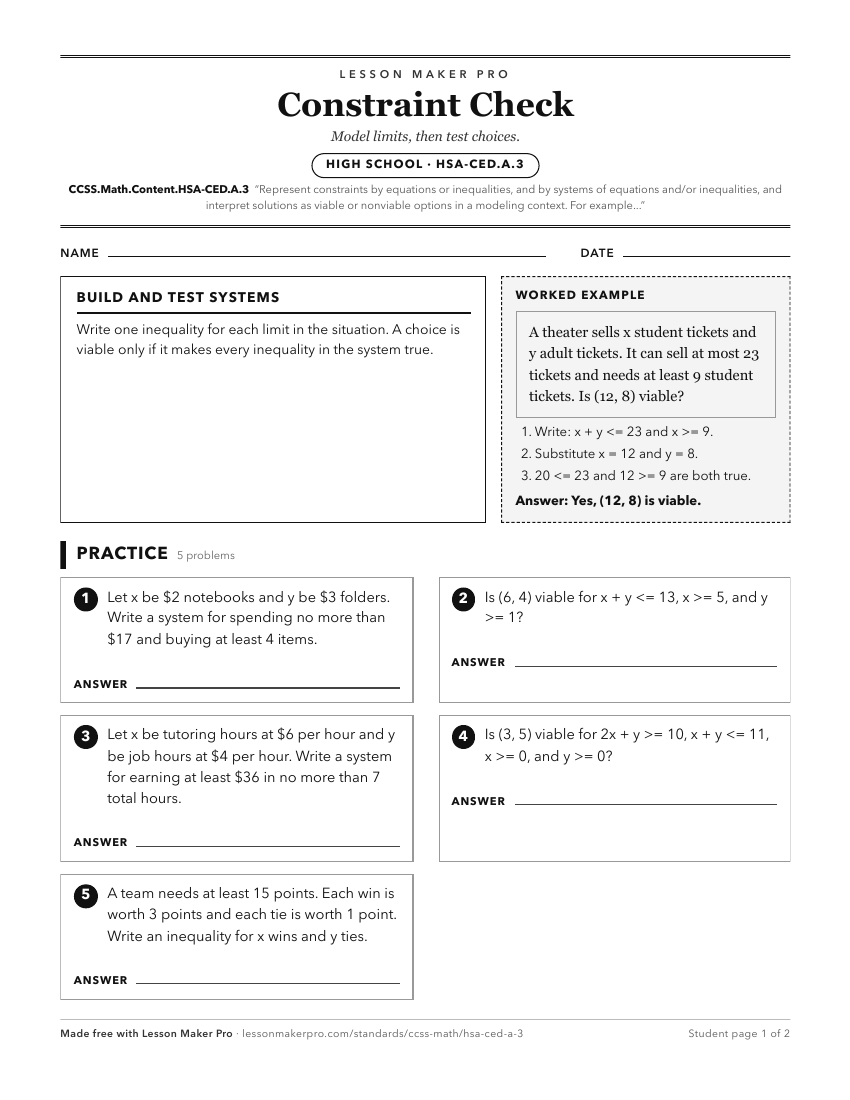
A ready-to-print activity worksheet aligned to CCSS.Math.Content.HSA-CED.A.3, with an answer key for the teacher on its own page. No account needed.
PDF, US Letter, prints cleanly in black and white.
Download the worksheetLearning progression
Where This Standard Sits
Before This Standard
If students are struggling here, check these first.
- CCSS.Math.Content.HSA-CED.A.2
Writing and graphing equations for relationships supports forming constraint systems and judging which solutions make sense in context.
- CCSS.Math.Content.HSA-CED.A.1
Writing and solving one-variable equations and inequalities supports turning context conditions into constraints and judging whether solutions make sense.
- CCSS.Math.Content.HSA-REI.D.12
Graphing half-plane intersections supports seeing which modeled constraint combinations are feasible and interpreting solutions as viable options.
What This Unlocks
Mastery here sets students up for these next.
Keep exploring
Related Standards
- CCSS.Math.Content.7.EE.B.4
Use variables to represent quantities in a real-world or mathematical problem, and construct simple equations and inequalities to solve problems by reasoning ab...
- CCSS.Math.Content.HSA-REI.D
Represent and solve equations and inequalities graphically
- CCSS.Math.Content.8.EE.C.8c
Solve real-world and mathematical problems leading to two linear equations in two variables.
- CCSS.Math.Content.6.EE.B
Reason about and solve one-variable equations and inequalities.
Turn this exact standard into a lesson
Grade, subject, topic, and the complete standard are prefilled. Create one free, no account needed.
Also for this standard:Make a WorksheetMake a QuizMake a Sub Lesson