CCSS.
Standard Cluster
Understand and apply the Pythagorean Theorem.
Common Core State Standards for Mathematics
Cluster contents
Standards in This Cluster
CCSS.Math.Content.8.G.B is a cluster heading. These are the individual standards under it.
- CCSS.Math.Content.8.G.B.6
Explain a proof of the Pythagorean Theorem and its converse.
- CCSS.Math.Content.8.G.B.7
Apply the Pythagorean Theorem to determine unknown side lengths in right triangles in real-world and mathematical problems in two and three dimensions.
- CCSS.Math.Content.8.G.B.8
Apply the Pythagorean Theorem to find the distance between two points in a coordinate system.
Teacher's field guide
What This Cluster Means
What Students Need to Do
- Students explain with an area model why the side lengths of a right triangle follow a squared relationship. They find missing sides, test whether triangles are right, and calculate distances on a coordinate plane.
What Mastery Looks Like
- Students correctly identify the hypotenuse, set up an equation, and solve for a missing side. They can test three side lengths, find coordinate distances, and support the relationship with an area model.
Common Misconceptions
- Students may add side lengths instead of their squares. They may choose a leg as c, forget the square root, or use the relationship on triangles that are not right triangles.
How to Assess It
- Exit ticket: A triangle has side lengths 7, 24, and 25. Decide whether it is right, then find the distance between (1, 2) and (8, 26), showing your equations.
Lesson moves
Ways to Teach It
Cut and rearrange squares from the sides of a 3-4-5 triangle, then record how the three areas are related.
Ask students to write why the squares of two side lengths add, rather than the side lengths themselves.
Play a card sort matching right triangles, missing-side equations, solutions, and coordinate-plane distance problems.
Use a classroom floor plan to calculate the shortest straight-line distance between two corners or fixed objects.
Free download
Printable 8.G.B Worksheet
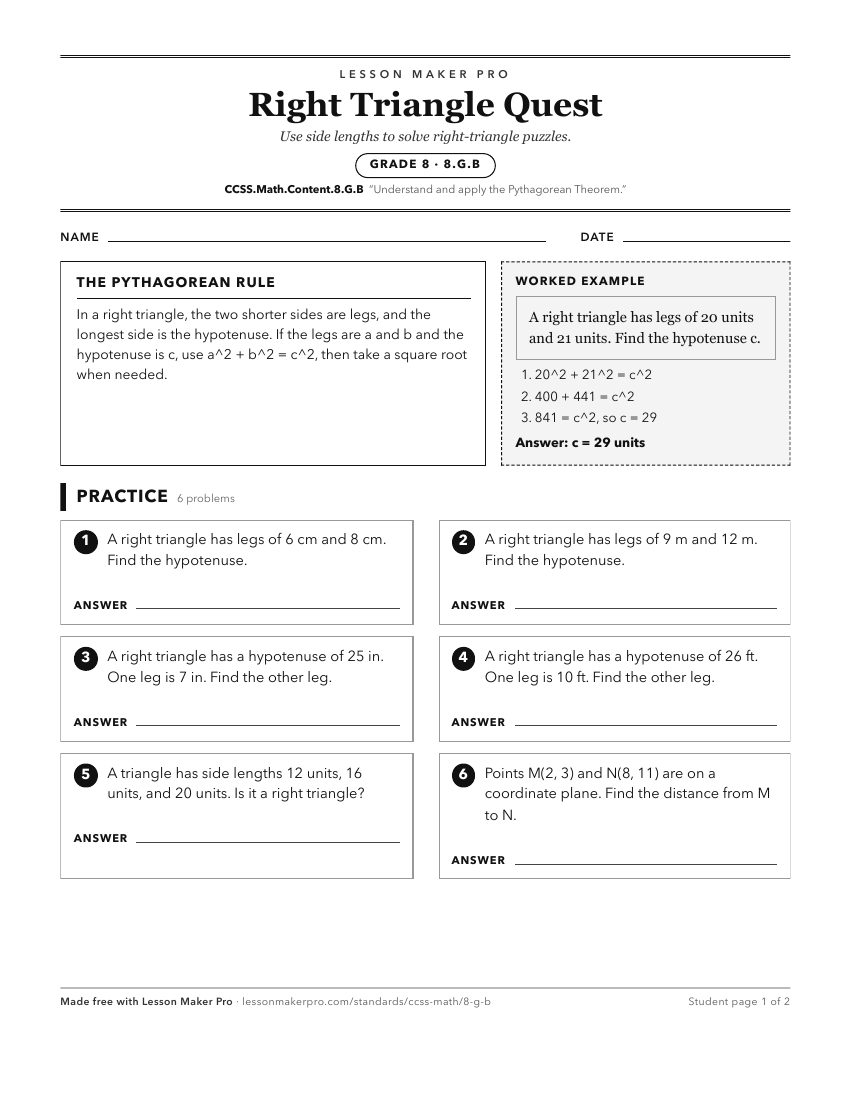
A ready-to-print activity worksheet aligned to CCSS.Math.Content.8.G.B, with an answer key for the teacher on its own page. No account needed.
PDF, US Letter, prints cleanly in black and white.
Download the worksheetKeep exploring
Related Standards
Turn this cluster into a lesson
Grade, subject, topic, and the complete cluster are prefilled. Create one free, no account needed.
Also for this cluster:Make a WorksheetMake a QuizMake a Sub Lesson