CCSS.
The Standard
Apply the Pythagorean Theorem to find the distance between two points in a coordinate system.
Common Core State Standards for Mathematics · Geometry
Teacher's field guide
What This Standard Means
What Students Need to Do
- Students find the horizontal and vertical changes between two plotted points. They treat those changes as legs of a right triangle and calculate the diagonal length.
What Mastery Looks Like
- Students correctly find the horizontal and vertical changes between two points. They use those values as right triangle legs and give the diagonal distance in exact or decimal form.
Common Misconceptions
- Students may add coordinates instead of finding their differences. They may forget to square both leg lengths or take the square root at the end. Negative coordinate differences can also cause sign errors.
How to Assess It
- Give the points (-2, 3) and (4, -5). Ask students to draw the right triangle, label both legs, and calculate the distance.
Lesson moves
Ways to Teach It
Plot two points on a floor grid, tape the horizontal and vertical legs, then measure and calculate the diagonal length.
Ask, “Why do coordinate differences become triangle legs?” and have students explain with a labeled sketch.
Play coordinate-pair bingo: call two points, and students cover the matching distance after showing their work.
Map two landmarks on a coordinate grid, then calculate the straight-line distance using the map scale.
Free download
Printable 8.G.B.8 Worksheet
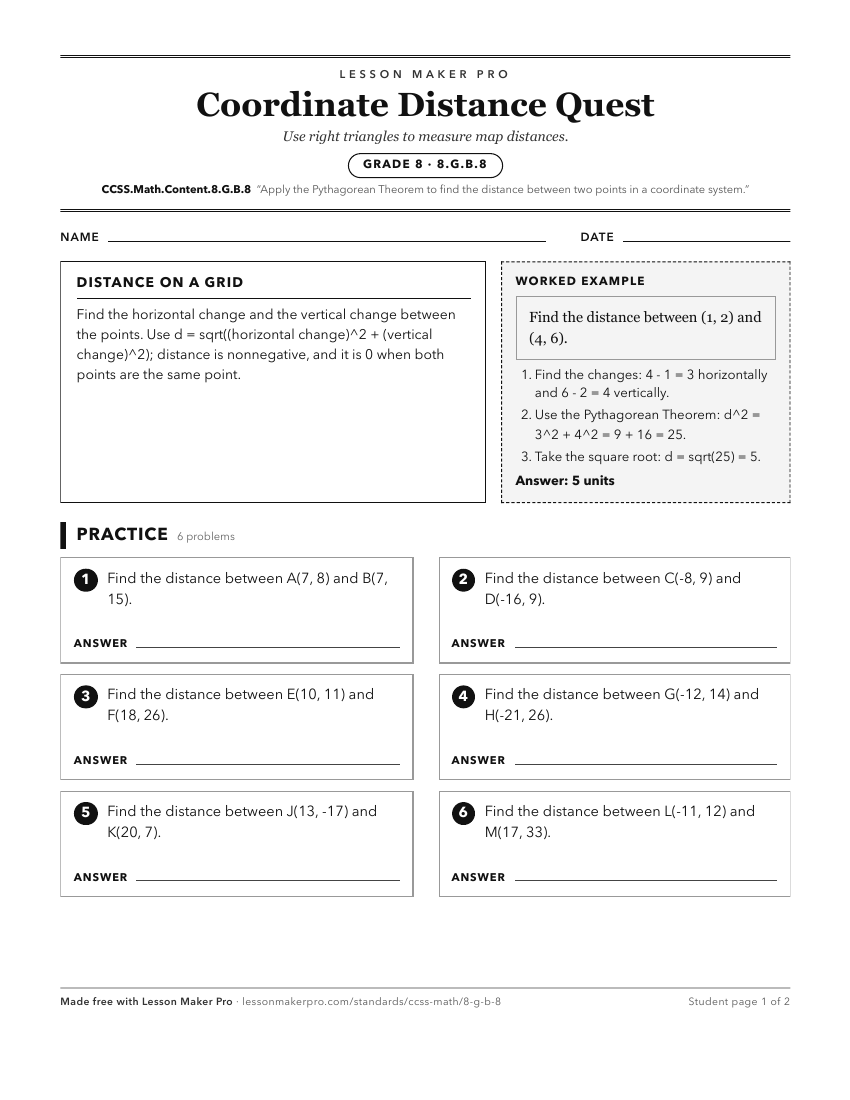
A ready-to-print activity worksheet aligned to CCSS.Math.Content.8.G.B.8, with an answer key for the teacher on its own page. No account needed.
PDF, US Letter, prints cleanly in black and white.
Download the worksheetBefore This Standard
If students are struggling here, check these first.
- CCSS.Math.Content.8.G.B.7
Finding coordinate distance requires forming a right triangle and using the Pythagorean Theorem to solve for its hypotenuse.
- CCSS.Math.Content.6.NS.C.8
Students use coordinate differences and horizontal or vertical distances as the legs before finding diagonal distances with the Pythagorean Theorem.
- CCSS.Math.Content.8.EE.A.2
Finding coordinate distance requires turning d² into d with square roots, including exact roots and irrational lengths.
What This Unlocks
Mastery here sets students up for these next.
- CCSS.Math.Content.HSG-GPE.A.3
Deriving conic equations requires writing distances from a variable point to each focus using the coordinate distance formula.
- CCSS.Math.Content.HSG-GPE.B.4
Coordinate proofs often use distances from the Pythagorean Theorem to show congruent lengths and classify figures.
- CCSS.Math.Content.HSG-GPE.A.2
Deriving a parabola requires setting the variable point’s distance to the focus equal to its distance from the directrix.
- CCSS.Math.Content.HSG-GPE.A.1
Circle equations come from setting the coordinate distance from center to point equal to the radius.
- CCSS.Math.Content.HSG-GPE.B.7
Finding side lengths between coordinate points is needed to compute polygon perimeters and many triangle or rectangle areas.
- CCSS.Math.Content.HSN-CN.B.6
Coordinate-plane distance using horizontal and vertical changes carries over directly to modulus of a complex difference.
Keep exploring
Related Standards
Turn this exact standard into a lesson
Grade, subject, topic, and the complete standard are prefilled. Create one free, no account needed.
Also for this standard:Make a WorksheetMake a QuizMake a Sub Lesson