CCSS.
The Standard
Explain a proof of the Pythagorean Theorem and its converse.
Common Core State Standards for Mathematics · Geometry
Teacher's field guide
What This Standard Means
What Students Need to Do
- Students connect the side lengths of a right triangle to the areas of squares built on its sides. They explain an area-based argument and reverse the relationship to identify right triangles.
What Mastery Looks Like
- Students can use a labeled area diagram to explain why the two leg squares equal the hypotenuse square. They can also test three side lengths and explain whether the triangle must be right.
Common Misconceptions
- Students may use a + b = c instead of squaring each side. They may apply the relationship to every triangle or use the converse without checking that c is the longest side.
How to Assess It
- Exit ticket: A triangle has side lengths 6, 8, and 10. Explain why it is right, then sketch an area rearrangement that justifies a² + b² = c².
Lesson moves
Ways to Teach It
Cut four congruent paper right triangles and rearrange them inside two equal squares to compare the uncovered areas.
Write why the area equation from the rearrangement becomes a² + b² = c², then explain what each term represents.
Sort triangle side-card sets into right or not right, then defend each choice using squared side lengths.
Measure a rectangular tabletop and its diagonal, then compare the measurements with the diagonal predicted from its side lengths.
Free download
Printable 8.G.B.6 Worksheet
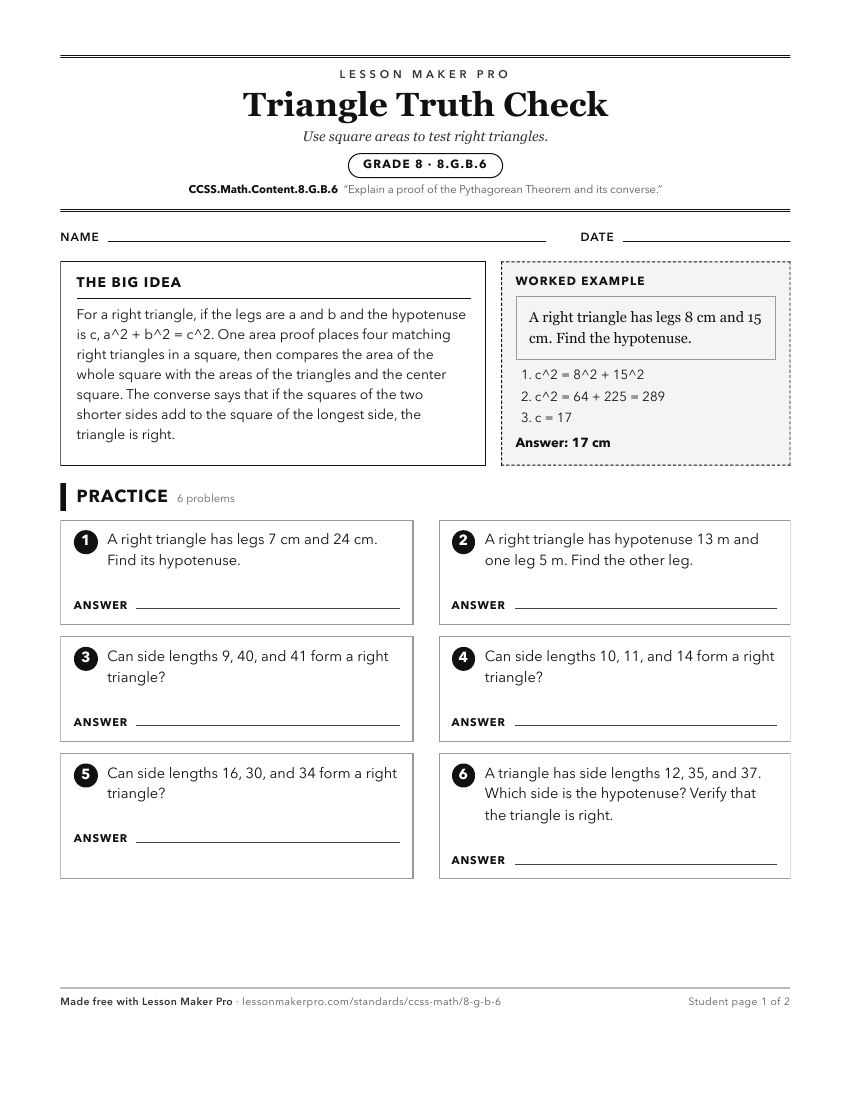
A ready-to-print activity worksheet aligned to CCSS.Math.Content.8.G.B.6, with an answer key for the teacher on its own page. No account needed.
PDF, US Letter, prints cleanly in black and white.
Download the worksheetBefore This Standard
If students are struggling here, check these first.
- CCSS.Math.Content.6.G.A.1
Composing and decomposing shapes by area supports understanding area-based explanations of why the side-square areas in Pythagorean proofs match.
- CCSS.Math.Content.6.EE.A.1
Understanding square notation and evaluating squared lengths helps students follow algebraic statements in Pythagorean Theorem proofs.
- CCSS.Math.Content.6.EE.A.4
Recognizing equivalent expressions helps students follow area equations and algebraic rearrangements used in many Pythagorean Theorem proofs.
What This Unlocks
Mastery here sets students up for these next.
Keep exploring
Related Standards
Turn this exact standard into a lesson
Grade, subject, topic, and the complete standard are prefilled. Create one free, no account needed.
Also for this standard:Make a WorksheetMake a QuizMake a Sub Lesson