CCSS.
The Standard
Analyze multiple interpretations of a story, drama, or poem (e.g., recorded or live production of a play or recorded novel or poetry), evaluating how each version interprets the source text. (Include at least one play by Shakespeare and one play by an American dramatist.)
Common Core State Standards for English Language Arts · Reading Standards for Literature
Teacher's field guide
What This Standard Means
What Students Need to Do
- Students compare two or more performances or recordings of the same literary work. They track choices in delivery, staging, cuts, setting, sound, and visuals, then judge how those choices shape meaning using source evidence.
What Mastery Looks Like
- Students identify specific differences between versions and connect them to exact lines or stage directions. They explain how each choice shapes tone, character, conflict, or theme, then support an evaluation. They can do this with a Shakespeare play and a play by an American dramatist.
Common Misconceptions
- Students often summarize each version instead of comparing interpretive choices. They may call one version better because it is more faithful, without explaining how specific choices affect tone, character, or theme.
How to Assess It
- Show two recordings of the same short Hamlet excerpt. Ask students to name one choice in each, cite the line being interpreted, and explain which version better builds tension.
Lesson moves
Ways to Teach It
In groups, stage the same 12-line Macbeth scene twice, changing one choice such as pace, blocking, lighting, or character intention.
Write: Which performance best captures Willy Loman's self-deception, and which line and acting choice most strongly support your claim?
Play Interpretation Match: teams pair source lines with clip notes, then earn points by explaining how each performance choice changes meaning.
Compare a local theater trailer with its script excerpt, then identify how casting, costume, and music target a particular audience.
Free download
Printable RL.11-12.7 Worksheet
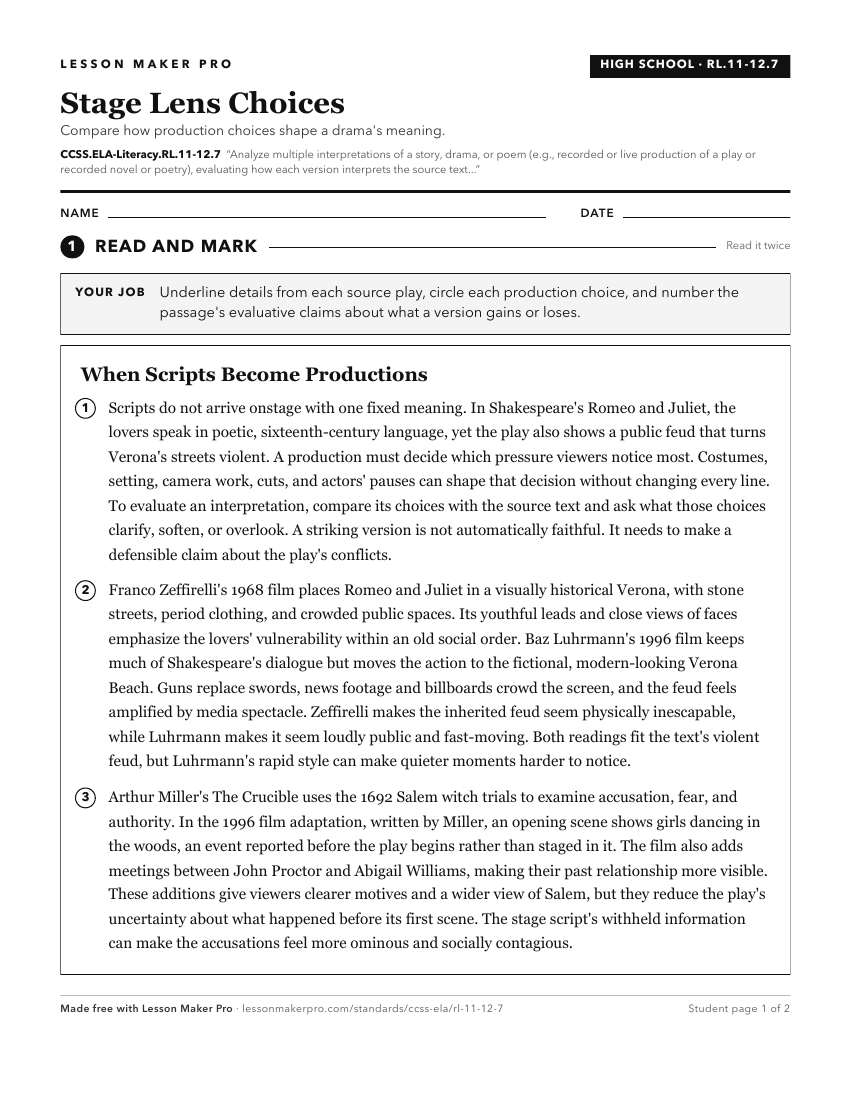
A ready-to-print activity worksheet aligned to CCSS.ELA-Literacy.RL.11-12.7, with an answer key for the teacher on its own page. No account needed.
PDF, US Letter, prints cleanly in black and white.
Download the worksheetLearning progression
Where This Standard Sits
See the whole path on the Reading: Literature progression map.
Before This Standard
If students are struggling here, check these first.
Keep exploring
Related Standards
- CCSS.ELA-Literacy.RL.9-10.9
Analyze how an author draws on and transforms source material in a specific work (e.g., how Shakespeare treats a theme or topic from Ovid or the Bible or how a ...
- CCSS.ELA-Literacy.RL.7.3
Analyze how particular elements of a story or drama interact (e.g., how setting shapes the characters or plot).
- CCSS.ELA-Literacy.RL.11-12.3
Analyze the impact of the author's choices regarding how to develop and relate elements of a story or drama (e.g., where a story is set, how the action is order...
- CCSS.ELA-Literacy.RL.7.7
Compare and contrast a written story, drama, or poem to its audio, filmed, staged, or multimedia version, analyzing the effects of techniques unique to each med...
Turn this exact standard into a lesson
Grade, subject, topic, and the complete standard are prefilled. Create one free, no account needed.
Also for this standard:Make a WorksheetMake a QuizMake a Sub Lesson