CCSS.
The Standard
Analyze how an author draws on and transforms source material in a specific work (e.g., how Shakespeare treats a theme or topic from Ovid or the Bible or how a later author draws on a play by Shakespeare).
Common Core State Standards for English Language Arts · Reading Standards for Literature
Teacher's field guide
What This Standard Means
What Students Need to Do
- Students compare a literary work with an earlier source it uses. They identify what the later author keeps, changes, or leaves out, then explain how those choices shape meaning.
What Mastery Looks Like
- Students can trace a specific theme, character, image, or plot event across both works. They support a clear claim about how and why the later author reshaped it.
Common Misconceptions
- Students may treat shared characters or plot events as proof that two works are identical. They may list changes without explaining how those changes affect theme, tone, character, or meaning.
How to Assess It
- Give students paired source and adaptation excerpts. Ask them to name one retained element, one change, and explain the change’s effect using evidence from both texts.
Lesson moves
Ways to Teach It
Sort event cards from “Pyramus and Thisbe” and Romeo and Juliet into kept, changed, and omitted groups, then label each change’s effect.
Write one paragraph answering: Why might an author change a familiar character, conflict, or ending for a new audience?
Teams match source passages with transformed passages, earning a point only when they explain one meaningful change.
Compare a familiar fairy tale with a film adaptation trailer, then identify how the new setting or audience changes its message.
Free download
Printable RL.9-10.9 Worksheet
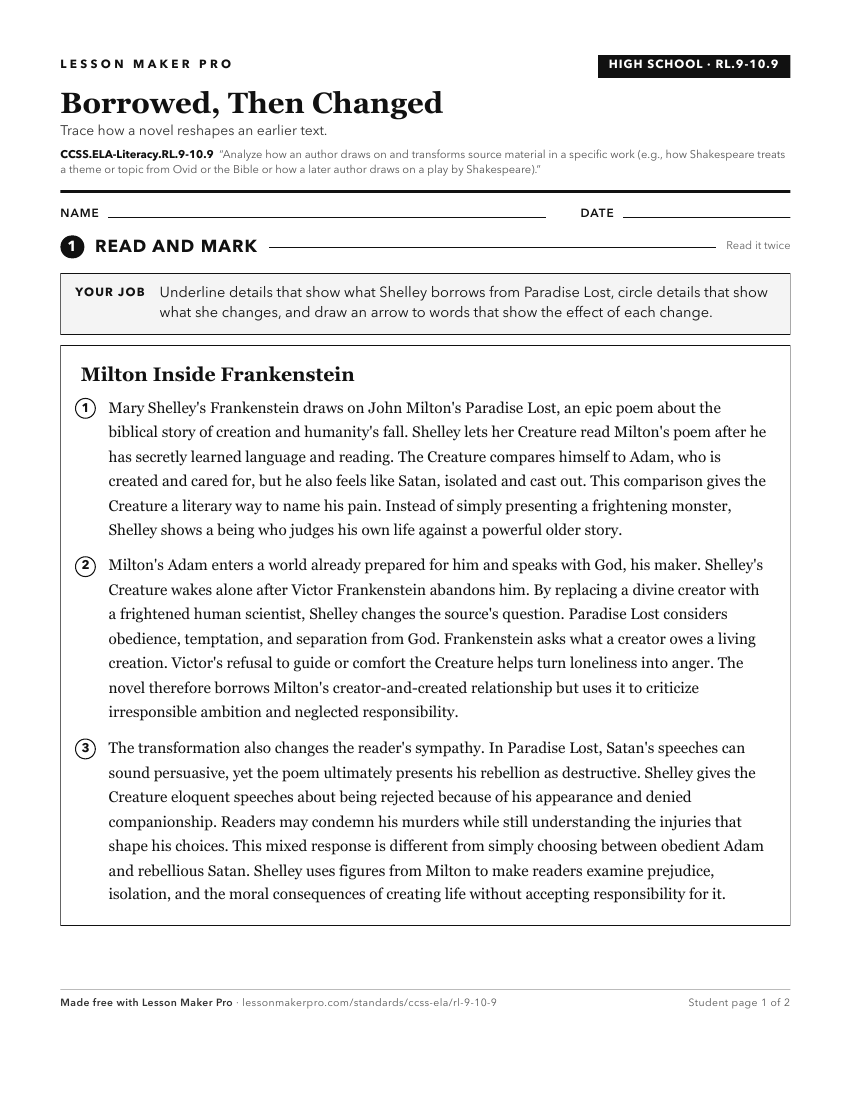
A ready-to-print activity worksheet aligned to CCSS.ELA-Literacy.RL.9-10.9, with an answer key for the teacher on its own page. No account needed.
PDF, US Letter, prints cleanly in black and white.
Download the worksheetLearning progression
Where This Standard Sits
See the whole path on the Reading: Literature progression map.
Before This Standard
If students are struggling here, check these first.
What This Unlocks
Mastery here sets students up for these next.
Keep exploring
Related Standards
- CCSS.ELA-Literacy.RL.11-12.7
Analyze multiple interpretations of a story, drama, or poem (e.g., recorded or live production of a play or recorded novel or poetry), evaluating how each versi...
- CCSS.ELA-Literacy.RL.11-12.3
Analyze the impact of the author's choices regarding how to develop and relate elements of a story or drama (e.g., where a story is set, how the action is order...
- CCSS.ELA-Literacy.W.9-10.9a
Apply grades 9—10 Reading standards to literature (e.g., "Analyze how an author draws on and transforms source material in a specific work [e.g., how Shakespear...
Turn this exact standard into a lesson
Grade, subject, topic, and the complete standard are prefilled. Create one free, no account needed.
Also for this standard:Make a WorksheetMake a QuizMake a Sub Lesson