Alabama Social Studies SS24.US1.17
Standard Cluster
Analyze the push and pull factors contributing to the rapid growth of cities in the United States during the late nineteenth and early twentieth centuries. 17a Summarize social, economic, and cultural consequences of urbanization for American society, including changes in living and working conditions, the emergence of new social classes, and the growth of leisure opportunities. 17b Explain how various reform and reactionary movements emerged in response to the challenges of urbanization and immigration. 17c Investigate and recount the experiences of immigrant communities in urban America, including patterns of settlement, cultural assimilation, and origins of migration.
2024 Alabama Course of Study: Social Studies
Cluster contents
Standards in This Cluster
SS24.US1.17 is a cluster heading. These are the individual standards under it.
- SS24.US1.17a
Summarize social, economic, and cultural consequences of urbanization for American society, including changes in living and working conditions, the emergence of...
- SS24.US1.17b
Explain how various reform and reactionary movements emerged in response to the challenges of urbanization and immigration.
- SS24.US1.17c
Investigate and recount the experiences of immigrant communities in urban America, including patterns of settlement, cultural assimilation, and origins of migra...
Teacher's field guide
What This Cluster Means
What Students Need to Do
- Students explain why poverty, farm debt, and violence pushed people toward cities, while factory jobs drew them in. They trace where immigrants came from, where they settled, and how they kept or changed their customs. They connect crowded housing, unsafe work, class divisions, and new leisure to reform efforts and anti-immigrant campaigns.
What Mastery Looks Like
- A student can explain why a family left Italy, settled near jobs and relatives, and kept speaking Italian while learning English. They can compare the lives of factory owners, clerks, and wage workers and describe how streetcars made parks easier to visit. They can link tenement crowding to settlement houses, unsafe work to unions, and nativist fears to calls for immigration limits.
Common Misconceptions
- Students may label farm debt a city attraction rather than a reason to leave home. They may assume all immigrants came from the same place or quickly gave up their home languages. They may mistake efforts to restrict immigration for reforms meant to improve tenement life.
How to Assess It
- Give students this exit ticket: “In 1905, Lena left a low-paying farm in Poland for a factory job in Chicago. She lived in a crowded tenement and visited a settlement house.” Ask them to name one push factor, one pull factor, one city problem, and one response.
Lesson moves
Ways to Teach It
Give pairs a city map and farm debt, factory pay, and tenement cards; have them sort push factors, pull factors, and consequences.
Read a short immigrant letter from 1900; ask, “What did the writer keep from home, and what changed in the city?”
Run a matching game: pair tenement crowding with settlement houses, unsafe factories with unions, and nativist fears with immigration restrictions.
Compare a current bus map with a 1900 streetcar map; have students mark routes to parks and discuss who could afford the ride.
Free download
Printable SS24.US1.17 Worksheet
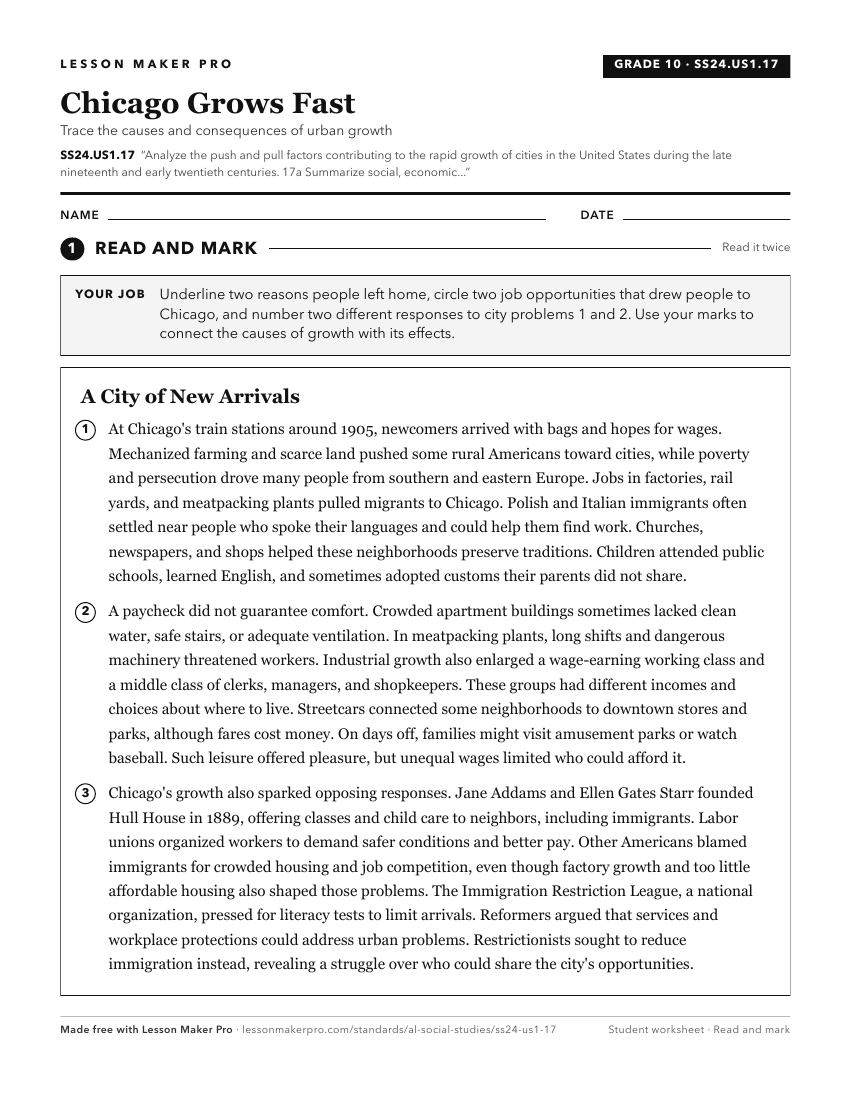
A ready-to-print activity worksheet aligned to SS24.US1.17, with an answer key for the teacher on its own page. No account needed.
PDF, US Letter, prints cleanly in black and white.
Download the worksheetKeep exploring
Related Standards
- SS24.5.4
Analyze the reasons for increased immigration to, and migration within, the United States and Alabama in the early twentieth century.
- SS24.5.1c
Outline reasons for the growth of urban areas at the turn of the twentieth century, including Birmingham.
- SS24.2.14
Explain how and why people have moved into and within the United States.
Turn this cluster into a lesson
Grade, subject, topic, and the complete cluster are prefilled. Create one free, no account needed.
Also for this cluster:Make a WorksheetMake a QuizMake a Sub Lesson