Alabama Social Studies SS24.P.10a
The Standard
- SS24.P.10
- Explain the importance and processes of memory, including how information is encoded and stored, the use of mnemonic devices, and how schemas influence memory construction and retrieval.
Compare ways memories are stored in the brain, including episodic and procedural, and explain how information is retrieved, reconstructed, or misremembered.
2024 Alabama Course of Study: Social Studies · Cognitive Psychology
Teacher's field guide
What This Standard Means
What Students Need to Do
- Students compare memories of events with memories of learned skills. They identify brain systems involved in each and explain how cues and later information can affect recall.
What Mastery Looks Like
- A student links a first bike ride to episodic memory and pedaling to procedural memory. They name the hippocampus as important for forming event memories and the basal ganglia as important for learned skills. They explain how a photo might prompt recall or a misleading question might change a detail.
Common Misconceptions
- Students may think all memories are stored in one spot, or that a vivid memory is an exact recording. They may also confuse forgetting a detail with never learning it.
How to Assess It
- Exit ticket: Maya recalls her first bike ride and can still pedal without thinking. Name each memory type and one brain system involved, then explain how a photo or a friend's false detail could affect her account.
Lesson moves
Ways to Teach It
Show eight objects on a tray for 20 seconds, cover them, mention an absent coin, then have students list what they saw.
Ask: Why can you tie your shoes without recalling the day you learned, but remember what happened at yesterday's lunch?
Give pairs cards labeled first concert, shoelace tying, and touch typing; have them sort by memory type and match each to a brain system.
Read a mock cafeteria spill report, ask 'Was the student running?', then list which details a school investigator should verify.
Free download
Printable SS24.P.10a Worksheet
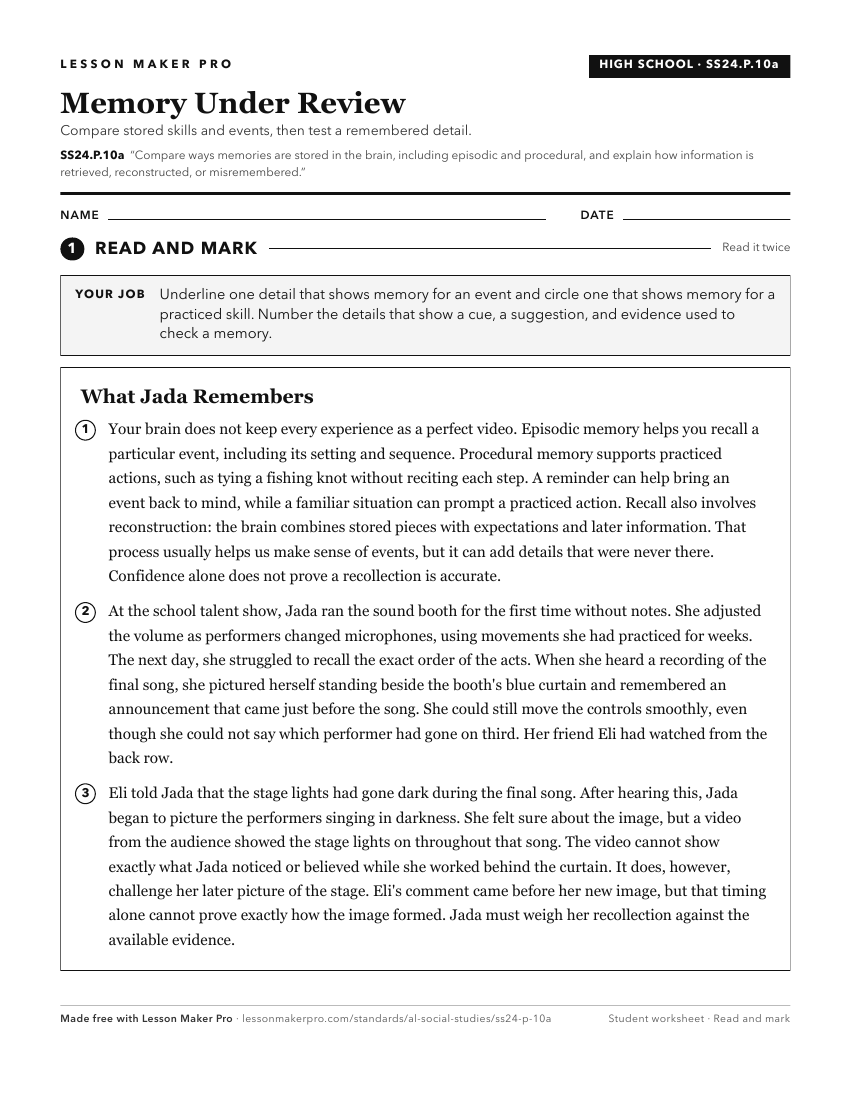
A ready-to-print activity worksheet aligned to SS24.P.10a, with an answer key for the teacher on its own page. No account needed.
PDF, US Letter, prints cleanly in black and white.
Download the worksheetKeep exploring
Related Standards
- SS24.HS.3
Explain how historic preservation has been or can be used to impact historical memory of the subject.
- SS24.HS.1
Describe how a selected historical subject is currently remembered or regarded, explaining how historical memory contributes to current thinking about the event...
- SS24.P.11
Describe ways in which organisms learn, including the processes of classical conditioning, operant conditioning, and observational learning.*
- SS24.P.10
Explain the importance and processes of memory, including how information is encoded and stored, the use of mnemonic devices, and how schemas influence memory c...
Turn this exact standard into a lesson
Grade, subject, topic, and the complete standard are prefilled. Create one free, no account needed.
Also for this standard:Make a WorksheetMake a QuizMake a Sub Lesson