Alabama Social Studies SS24.HOS.9
Standard Cluster
Describe how Jewish immigration was perceived and restricted by various nations from 1933 to 1939.* 9a Describe the difficulties European Jewish refugees faced when attempting to emigrate to the United States, Canada, and Latin America during the 1930s and 1940s.* 9b Evaluate the extent to which Americans were aware of Nazi antisemitic and racial policies and the Holocaust through the information and news available to them during the 1930s and 1940s. 9c Describe how Alabamians responded to Nazi persecution of the Jews in Europe.*
2024 Alabama Course of Study: Social Studies
Cluster contents
Standards in This Cluster
SS24.HOS.9 is a cluster heading. These are the individual standards under it.
- SS24.HOS.9a
Describe the difficulties European Jewish refugees faced when attempting to emigrate to the United States, Canada, and Latin America during the 1930s and 1940s....
- SS24.HOS.9b
Evaluate the extent to which Americans were aware of Nazi antisemitic and racial policies and the Holocaust through the information and news available to them d...
- SS24.HOS.9c
Describe how Alabamians responded to Nazi persecution of the Jews in Europe.*
Teacher's field guide
What This Cluster Means
What Students Need to Do
- Students explain why Jewish refugees faced different entry rules in the United States, Canada, and Latin American countries. They use dated news reports to judge what Americans could know about Nazi persecution and mass murder. They examine how people in Alabama responded.
What Mastery Looks Like
- A student can use a quota chart and a refugee account to explain why a family struggled to leave Europe. They can distinguish what a 1938 reader could learn from what reports revealed in 1942. They can describe an Alabama response and cite its source.
Common Misconceptions
- Students may think refugees could simply buy a ticket, or that every Latin American country had the same rules. They may assume Americans knew the full scale of Nazi mass murder in 1933, or heard nothing about it until 1945. One Alabama editorial does not represent the whole state.
How to Assess It
- Give students a Canadian immigration rule, a 1942 news excerpt, and an Alabama newspaper clipping. Ask them to name one entry barrier, one fact readers could learn, and one local response, citing a detail for each.
Lesson moves
Ways to Teach It
Hand out a refugee visa application, a U.S. quota chart, and an affidavit form; students mark three places the application could stall.
Compare a 1938 Kristallnacht headline with a 1942 mass-murder report; ask, "What could readers know at each date?"
Play a country-card sort using 1939 rules for the United States, Canada, Cuba, and the Dominican Republic; students defend each match.
Search digitized Alabama newspapers for "Jewish refugees"; students quote one local response and compare it with a recent local refugee report.
Free download
Printable SS24.HOS.9 Worksheet
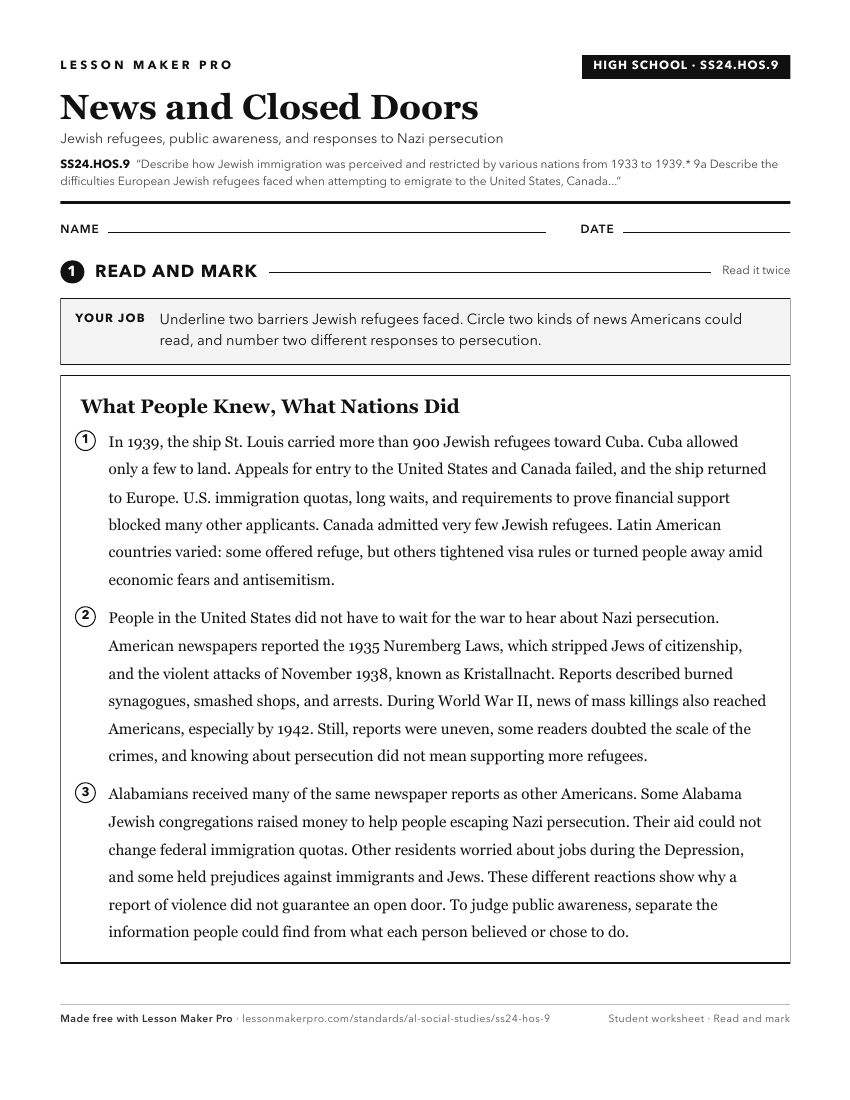
A ready-to-print activity worksheet aligned to SS24.HOS.9, with an answer key for the teacher on its own page. No account needed.
PDF, US Letter, prints cleanly in black and white.
Download the worksheetKeep exploring
Related Standards
- SS24.HOS.7b
Evaluate the effects of the Nuremberg Laws on Jewish life in Germany.*
- SS24.HOS.7d
Assess how German Jews reacted to increasing exclusion and isolation in German society between 1933 and 1939 and describe the strategies they employed both to l...
- SS24.HOS.7
Describe how Jewish life deteriorated under the Third Reich in Germany and its annexed territories from 1933 to 1938.*
Turn this cluster into a lesson
Grade, subject, topic, and the complete cluster are prefilled. Create one free, no account needed.
Also for this cluster:Make a WorksheetMake a QuizMake a Sub Lesson