Alabama Social Studies SS24.HOS.17
Standard Cluster
Assess the effectiveness of different armed and unarmed resistance efforts in Europe from 1933 to 1945, including individuals who opposed the Nazis and their policies.* 17a Explain how and why Jewish partisans undertook armed resistance against the Germans and their Axis partners.
2024 Alabama Course of Study: Social Studies
Cluster contents
Standards in This Cluster
SS24.HOS.17 is a cluster heading. These are the individual standards under it.
Teacher's field guide
What This Cluster Means
What Students Need to Do
- Students compare armed attacks with unarmed efforts such as leaflets and rescue. They explain why Jewish partisans escaped into forests, sheltered others, and fought German forces and their allies.
What Mastery Looks Like
- A student can use evidence from a Bielski partisans account, a White Rose leaflet, and the Danish boat rescue to judge what each effort achieved. They can explain why saving lives or spreading dissent mattered, even when an effort could not defeat the Nazis.
Common Misconceptions
- Students may think resistance only meant fighting with guns, or that it failed unless it brought down the Nazi government. Some assume Jewish people could easily get weapons or escape, or that partisans fought only to damage military targets.
How to Assess It
- Give students a brief Bielski partisans account and a White Rose leaflet excerpt. Ask them to explain why each group resisted, how it acted, and one result or limit of each effort.
Lesson moves
Ways to Teach It
Give pairs a Belarus forest map and a short Bielski partisans account; have them mark hiding areas and obstacles to armed resistance.
Ask: Was the White Rose leaflet campaign effective if its members were arrested? Have students defend an answer using a stated measure of success.
Hand out cards on the Warsaw Ghetto uprising, Bielski partisans, and Danish boat rescue; students sort each by goal, method, and outcome.
Compare a 1943 Denmark-Sweden crossing map with today's Øresund Bridge map; identify what boats and local guides made possible before the bridge.
Free download
Printable SS24.HOS.17 Worksheet
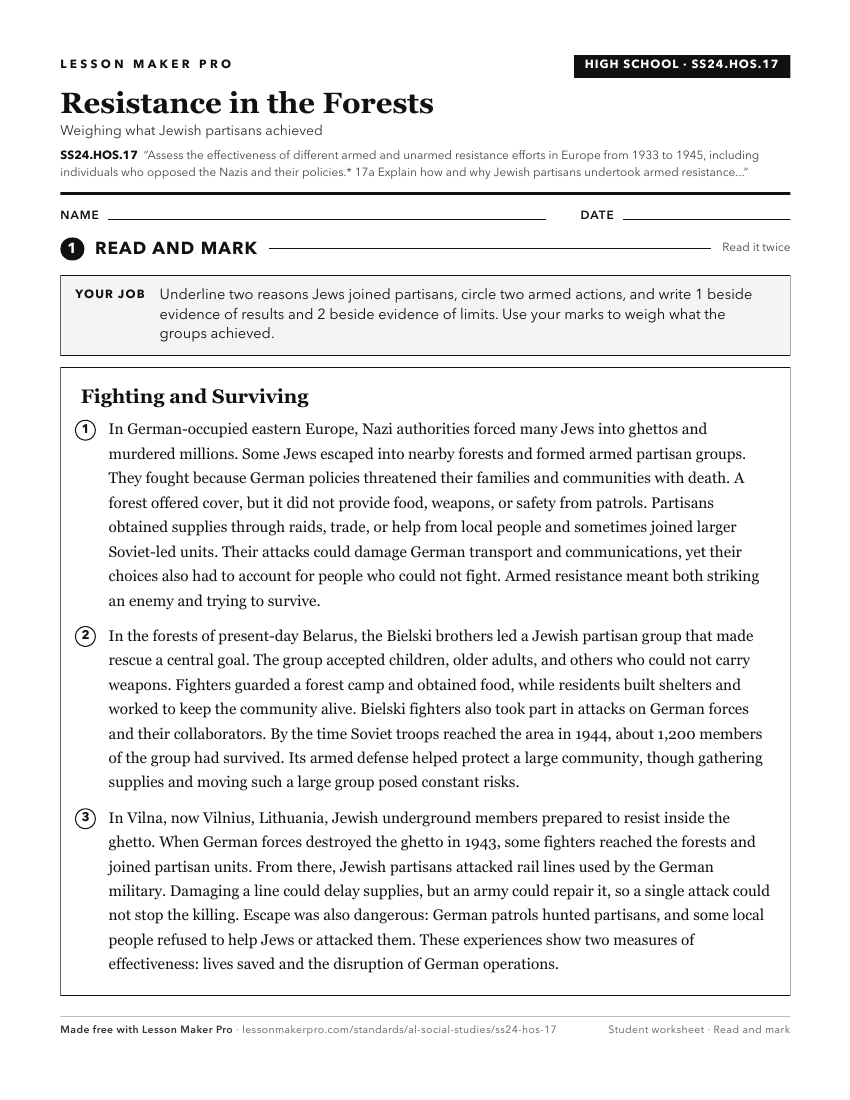
A ready-to-print activity worksheet aligned to SS24.HOS.17, with an answer key for the teacher on its own page. No account needed.
PDF, US Letter, prints cleanly in black and white.
Download the worksheetKeep exploring
Related Standards
- SS24.HOS.5c
Analyze how the Schutzstaffel (SS) and the Gestapo broke resistance and instilled fear within Germany and in Nazi-occupied territories.*
- SS24.WH.10c
Compare the experiences of civilians in different countries involved in conflict during World War II.
- SS24.HOS.19a
Evaluate the effect of Nazi policies on other groups targeted by the government of Nazi Germany, including the Roma, Sinti, and people with disabilities.*
- SS24.HOS.16
Critique the role that bystanders, collaborators, and perpetrators played in the implementation of Nazi policies against Jewish people and other targeted groups...
Turn this cluster into a lesson
Grade, subject, topic, and the complete cluster are prefilled. Create one free, no account needed.
Also for this cluster:Make a WorksheetMake a QuizMake a Sub Lesson