Alabama Social Studies SS24.HOS.15
Standard Cluster
Differentiate among the types of camps utilized by the Nazis, including their origins, purposes, and the conditions associated with them.* 15a Outline the arrival, selection, and process components of a prisoner’s entry into a camp.* 15b Describe daily life in the camps, including means of resistance. 15c Locate major camps and explain their significance.*
2024 Alabama Course of Study: Social Studies
Cluster contents
Standards in This Cluster
SS24.HOS.15 is a cluster heading. These are the individual standards under it.
Teacher's field guide
What This Cluster Means
What Students Need to Do
- Students distinguish concentration, transit, forced-labor, and killing camps by their origins, purposes, and conditions. They explain what happened when prisoners arrived, including selection where it occurred. They use survivor accounts to describe daily life and resistance, then locate major camps on a map.
What Mastery Looks Like
- Students identify Dachau as an early concentration camp, Westerbork as a transit camp, and Treblinka as a killing center on a map. They explain that Auschwitz-Birkenau used selection for forced labor and mass murder. They use testimony to describe hunger or overcrowding and an act of resistance, such as sharing food.
Common Misconceptions
- Students may call every camp a killing center or assume every arrival followed the same process. They may place all killing centers in Germany rather than Nazi-occupied Poland. They may think resistance only meant armed revolt, overlooking mutual aid and secret records.
How to Assess It
- Give students a map marked with Dachau, Westerbork, Auschwitz-Birkenau, and Treblinka. Ask them to name each site's role, explain selection at Auschwitz-Birkenau, and give one example of resistance.
Lesson moves
Ways to Teach It
Have pairs place site cards and purpose cards for Dachau, Westerbork, Auschwitz-Birkenau, and Treblinka on a map of wartime Europe.
Read a survivor account about prisoners sharing food; ask, "What risks did they take, and how was this resistance?"
Give students six Auschwitz-Birkenau arrival cards; have them draw a branching flowchart showing selection, registration for labor, and immediate murder.
Compare a current map of Poland with a 1942 occupation map; write a museum caption naming who operated Treblinka and Auschwitz-Birkenau.
Free download
Printable SS24.HOS.15 Worksheet
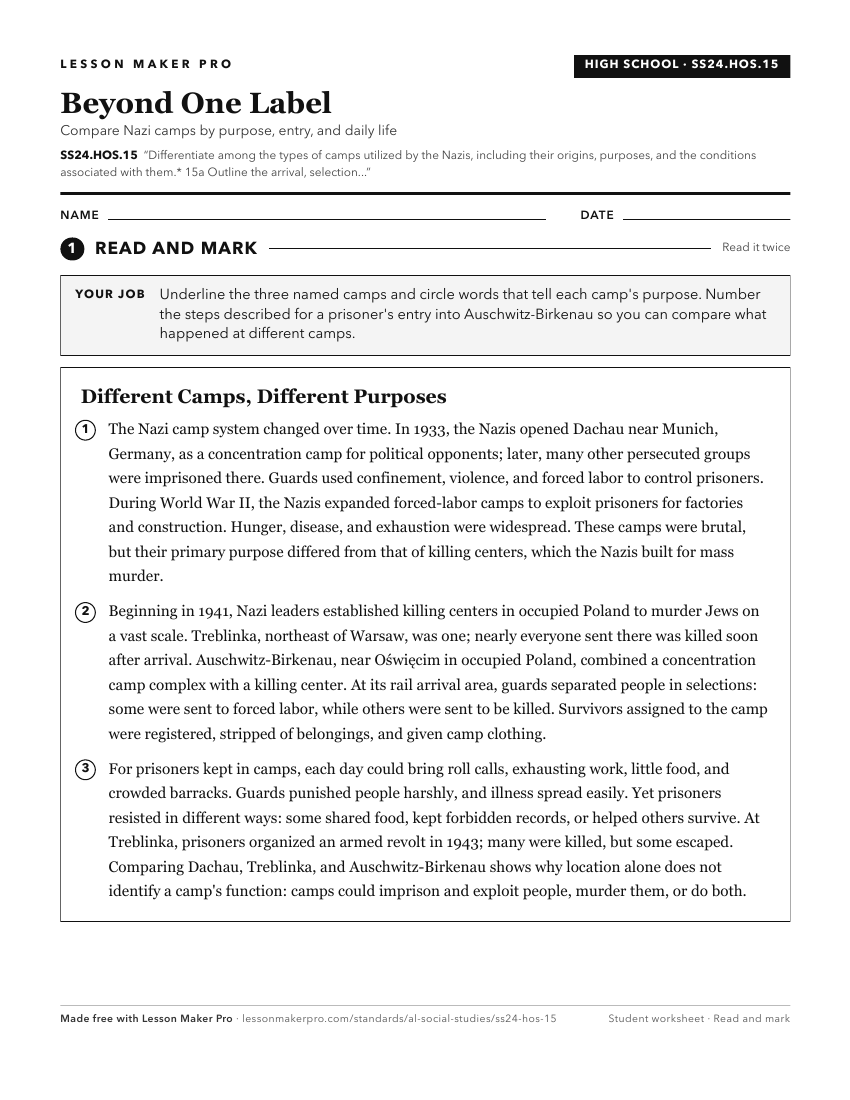
A ready-to-print activity worksheet aligned to SS24.HOS.15, with an answer key for the teacher on its own page. No account needed.
PDF, US Letter, prints cleanly in black and white.
Download the worksheetKeep exploring
Related Standards
- SS24.HOS.5a
Describe how the Nazis utilized various forms of propaganda, including education and youth programs, to indoctrinate the German population and exploit antisemit...
- SS24.WH.11c
Explain the roles of different types of camps in the Holocaust, including slave labor, transit, concentration camps, and killing centers.
- SS24.HOS.2b
Analyze how the Nazi regime utilized and built on historical antisemitism to cast the Jewish people as a common enemy.*
Turn this cluster into a lesson
Grade, subject, topic, and the complete cluster are prefilled. Create one free, no account needed.
Also for this cluster:Make a WorksheetMake a QuizMake a Sub Lesson