Alabama Social Studies SS24.E.9
Standard Cluster
Explain how fiscal and monetary policy influence price stability, employment, and economic growth, citing examples from the past hundred years. 9a Explain how the United States Federal Reserve System regulates the banking system and uses its tools of monetary policy through an ample reserve system to achieve its economic goals. 9b Describe how Congress and state legislatures use fiscal policy to achieve their economic, social, and political goals, including taxing, spending, grants, and mandates. 9c Correlate fluctuations in government deficits over time to the extent of national debt during those periods.
2024 Alabama Course of Study: Social Studies
Cluster contents
Standards in This Cluster
SS24.E.9 is a cluster heading. These are the individual standards under it.
- SS24.E.9a
Explain how the United States Federal Reserve System regulates the banking system and uses its tools of monetary policy through an ample reserve system to achie...
- SS24.E.9b
Describe how Congress and state legislatures use fiscal policy to achieve their economic, social, and political goals, including taxing, spending, grants, and m...
- SS24.E.9c
Correlate fluctuations in government deficits over time to the extent of national debt during those periods.
Teacher's field guide
What This Cluster Means
What Students Need to Do
- Students tell apart Federal Reserve actions and tax or spending choices by Congress and state lawmakers. They explain how bank oversight, interest paid on reserves, grants, and mandates affect jobs, prices, or growth. They use past events to connect annual deficits with the national debt.
What Mastery Looks Like
- A student explains how the Fed uses interest paid on reserves to steer short-term rates and checks banks for safety. They link a tax, grant, or mandate to a government goal and predict an effect on the economy. They can track how repeated deficits add to debt and use 2020 relief payments or 2022 rate hikes as examples.
Common Misconceptions
- Students may call a Fed rate change a tax decision or think the Fed sets every loan rate directly. Some assume every government mandate comes with grant money. Others confuse one year's deficit with the total debt, or think lower inflation means prices have fallen.
How to Assess It
- Exit ticket: Compare 2020 federal relief payments with the Fed's 2022 rate hikes. Name which was fiscal and which was monetary, give one likely effect on jobs or prices, and explain what repeated deficits do to debt.
Lesson moves
Ways to Teach It
Give pairs cards labeled tax cut, state road grant, bank inspection, and higher interest on reserves; have them sort by decision maker and likely effect.
Ask: How could a federal highway grant create jobs while a Fed rate hike cools prices, and why might both happen together?
Run a simple debt tracker: start at $20 trillion, draw deficit and surplus cards for five years, and update the running total.
Use a receipt for a taxable item to calculate sales tax paid, then find one service your state funds with tax revenue.
Free download
Printable SS24.E.9 Worksheet
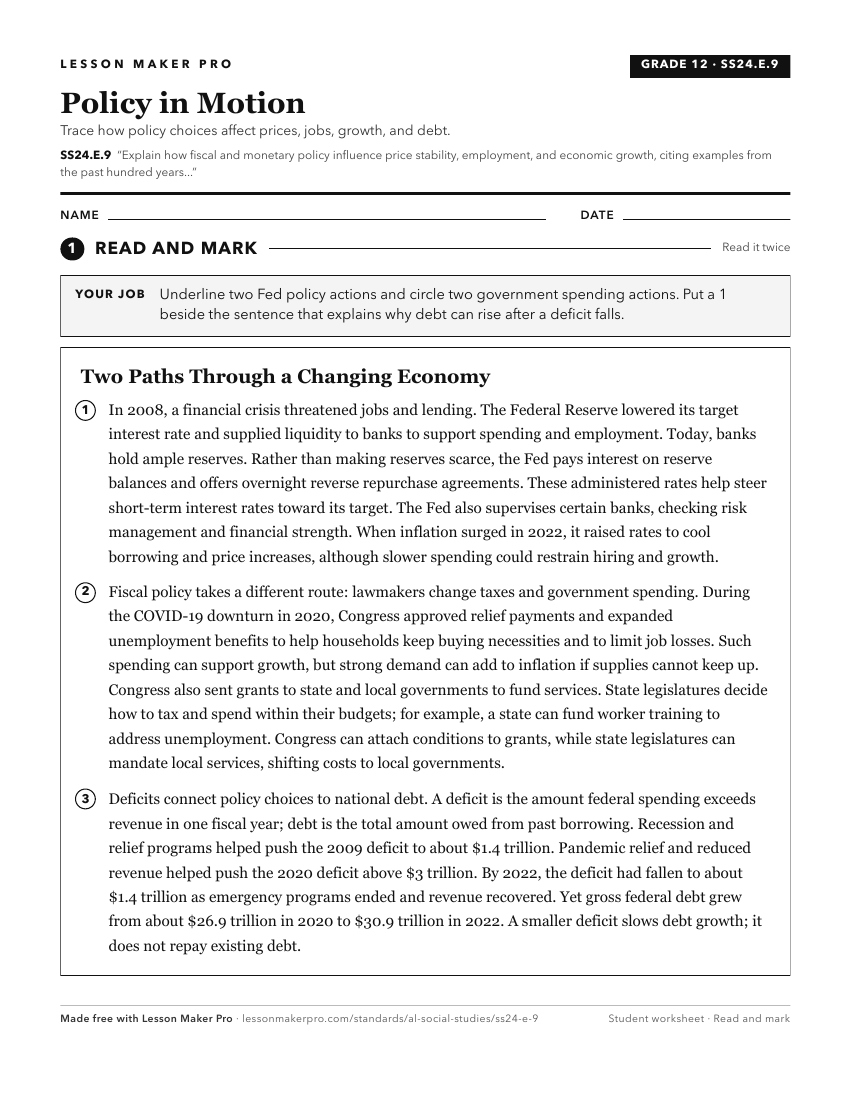
A ready-to-print activity worksheet aligned to SS24.E.9, with an answer key for the teacher on its own page. No account needed.
PDF, US Letter, prints cleanly in black and white.
Download the worksheetKeep exploring
Related Standards
- SS24.US2.15c
Identify the reasons for the economic fluctuations of the 1970s and evaluate the effectiveness of government action on the problem of stagflation.
- SS24.E.8d
Explain how unemployment and inflation affect individuals and nations, citing specific examples.
- SS24.E.7a
Research and explain ways the government influences the economy, including promoting and securing competition, protecting private property rights, distributing ...
Turn this cluster into a lesson
Grade, subject, topic, and the complete cluster are prefilled. Create one free, no account needed.
Also for this cluster:Make a WorksheetMake a QuizMake a Sub Lesson