Alabama Social Studies SS24.E.5a
The Standard
- SS24.E.5
- Compare and contrast types of business firms, including sole proprietorships, partnerships, and corporations.
Evaluate the role of profit as an incentive for short- and long-term decisions by corporations, partnerships, and sole proprietorships.
2024 Alabama Course of Study: Social Studies
Teacher's field guide
What This Standard Means
What Students Need to Do
- Students compare taking profit now with spending money to earn more later. They explain how costs, risks, and shared ownership shape choices for sole owners, partners, and corporations.
What Mastery Looks Like
- Given a choice between a payout now and an equipment purchase, a student identifies who pays and who gains in each business type. They explain why the higher expected profit may not be worth the risk.
Common Misconceptions
- Students may count sales as profit without subtracting costs. They may assume the choice with the highest profit this month is always best, or that all owners share gains the same way.
How to Assess It
- Exit ticket: A $500 machine could bring in $900 next year with no added costs. Give one reason a sole owner, two partners, or a corporation might buy it, and one reason they might wait.
Lesson moves
Ways to Teach It
Give groups 20 paper tokens and ownership cards; have them choose between a payout now and a machine with a stated payoff next year.
Ask students to write: Who might object to spending this year's profit on training, and who might benefit next year?
Play three rounds where teams draw ownership cards, choose a $100 payout or a $160 delayed return, and explain who receives the gain.
Show a grocery store coupon and ask how its price cut might affect profit this week and repeat sales next month.
Free download
Printable SS24.E.5a Worksheet
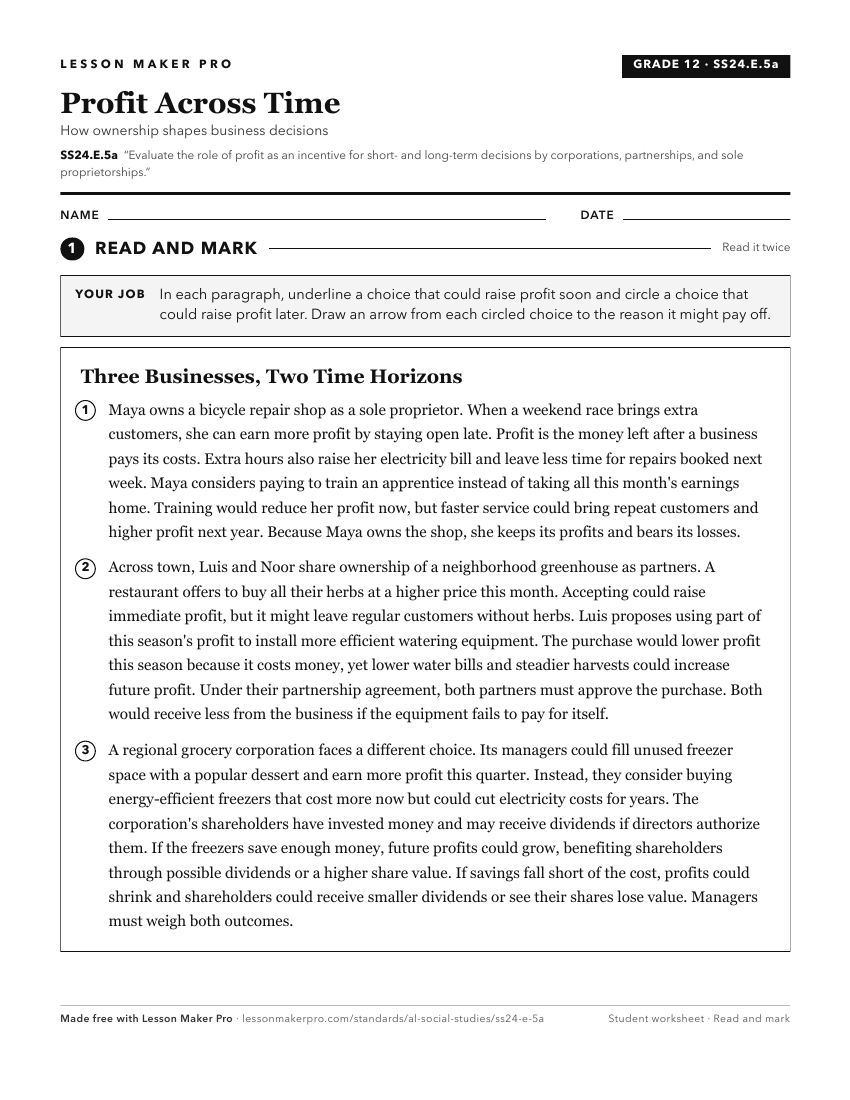
A ready-to-print activity worksheet aligned to SS24.E.5a, with an answer key for the teacher on its own page. No account needed.
PDF, US Letter, prints cleanly in black and white.
Download the worksheetKeep exploring
Related Standards
- SS24.E.3c
Compare the ways that different economic systems address competition, consumer sovereignty, government regulation, private ownership, and profit motive.
- SS24.E.2b
Illustrate and explain how rational decision-making involves the consideration of trade-offs and opportunity costs.
- SS24.E.2a
Analyze how changes in opportunity costs impact the rational decision-making of individuals, businesses, and governments.
- SS24.E.5
Compare and contrast types of business firms, including sole proprietorships, partnerships, and corporations.
Turn this exact standard into a lesson
Grade, subject, topic, and the complete standard are prefilled. Create one free, no account needed.
Also for this standard:Make a WorksheetMake a QuizMake a Sub Lesson