Alabama Social Studies SS24.E.1
Standard Cluster
Investigate and share information on how scarcity can impact factors of production and the decision-making of individuals, businesses, and governments. 1a Explain the relationship between scarcity as a basic condition of economics and the decision-making needed to allocate limited resources. 1b Explain how land (natural resource), labor (human resource), capital (physical or human resource), and entrepreneurship function as factors of production.
2024 Alabama Course of Study: Social Studies
Cluster contents
Standards in This Cluster
SS24.E.1 is a cluster heading. These are the individual standards under it.
- SS24.E.1a
Explain the relationship between scarcity as a basic condition of economics and the decision-making needed to allocate limited resources.
- SS24.E.1b
Explain how land (natural resource), labor (human resource), capital (physical or human resource), and entrepreneurship function as factors of production.
Teacher's field guide
What This Cluster Means
What Students Need to Do
- Students identify natural resources, workers, equipment, skills, and entrepreneurs in a production example. They use a short source to show how a scarce resource changes choices for households, businesses, and governments, then share the trade-offs.
What Mastery Looks Like
- Given a bakery facing water limits, students identify water as a natural resource, staff as labor, ovens as physical capital, workers' skills as human capital, and the owner's risk-taking as entrepreneurship. They explain how the bakery, customers, and city respond and name what each gives up.
Common Misconceptions
- Students may call money physical capital instead of identifying equipment. They may treat a worker's time and skills as the same thing, or think scarcity means only a temporary empty shelf. Some assume governments can avoid trade-offs by raising taxes.
How to Assess It
- Exit ticket: A drought cuts a town's water supply. Name the affected factor of production, then describe one choice each a bakery, a customer, and the town must make.
Lesson moves
Ways to Teach It
Give groups water, worker, oven, and founder cards to plan a bakery; remove worker cards and ask for a revised plan.
Ask students to write how a drought changes a family's shopping, a farm's hiring, and a town's water rules.
Play a card sort with farmland, a cook, an oven, worker training, and a restaurant founder; have students defend each label.
Use a grocery flyer and a $25 budget; students plan dinner for four, then name what they gave up.
Free download
Printable SS24.E.1 Worksheet
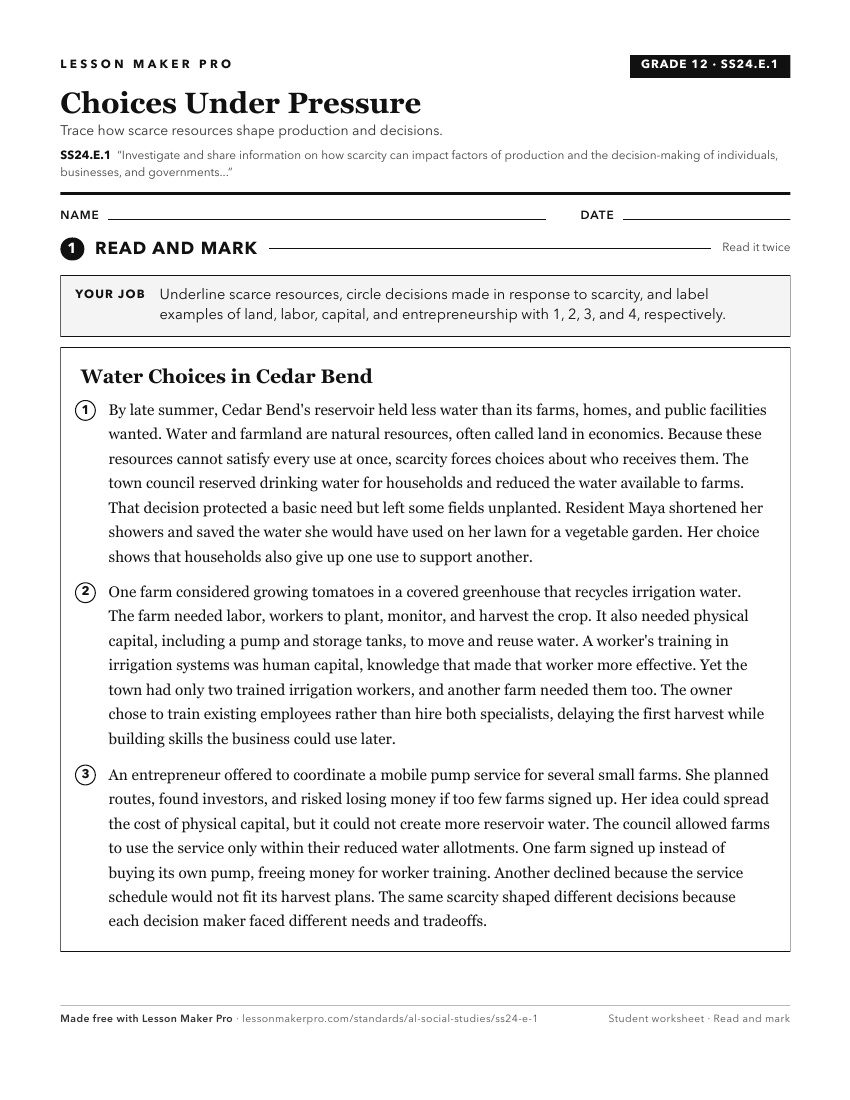
A ready-to-print activity worksheet aligned to SS24.E.1, with an answer key for the teacher on its own page. No account needed.
PDF, US Letter, prints cleanly in black and white.
Download the worksheetKeep exploring
Related Standards
- SS24.E.3b
Research and share information illustrating how different economic systems answer the basic economic questions of what to produce, how to produce, and for whom ...
- SS24.E.8a
Analyze how spending and production decisions made by households, businesses, and government determine overall levels of income, employment, and prices.
- SS24.2.5
Explain how scarcity influences supply and demand.
Turn this cluster into a lesson
Grade, subject, topic, and the complete cluster are prefilled. Create one free, no account needed.
Also for this cluster:Make a WorksheetMake a QuizMake a Sub Lesson