Alabama Social Studies SS24.8.7
Standard Cluster
Outline the social, cultural, economic, and religious developments of early medieval Europe. 7a Compare and contrast the growth of medieval societies in different geographic regions of Europe. 7b Analyze the relationship of the Catholic Church to economic, political, and social systems and rulers in medieval Europe. 7c Explain the significant economic, political, and social aspects of European feudalism. 7d Analyze the effects of political events in Europe during the Middle Ages, including the coronation of Charlemagne, the Norman Conquest, and the Hundred Years’ War. 7e Summarize the significance of the issuing of the Magna Carta in limiting royal power and establishing the rule of law.
2024 Alabama Course of Study: Social Studies
Cluster contents
Standards in This Cluster
SS24.8.7 is a cluster heading. These are the individual standards under it.
- SS24.8.7a
Compare and contrast the growth of medieval societies in different geographic regions of Europe.
- SS24.8.7b
Analyze the relationship of the Catholic Church to economic, political, and social systems and rulers in medieval Europe.
- SS24.8.7c
Explain the significant economic, political, and social aspects of European feudalism.
- SS24.8.7d
Analyze the effects of political events in Europe during the Middle Ages, including the coronation of Charlemagne, the Norman Conquest, and the Hundred Years’ W...
- SS24.8.7e
Summarize the significance of the issuing of the Magna Carta in limiting royal power and establishing the rule of law.
Teacher's field guide
What This Cluster Means
What Students Need to Do
- Students compare farming, trade, customs, and religious life across European regions. They explain how Church land and tithes affected rulers and families, and how feudal ties organized land, labor, and military service. They connect major events to changes in royal power and law.
What Mastery Looks Like
- A student can use a map to explain why trade helped northern Italian towns grow while farming shaped many English villages. They can explain how bishops gained influence and how a vassal's service differed from a peasant's labor. They can link Charlemagne's coronation, the Norman Conquest, the Hundred Years' War, and Magna Carta to specific changes in power.
Common Misconceptions
- Students may assume peasants received land in exchange for military service, confusing them with vassals. Some think the Church handled worship but held no land or political power. Others think Magna Carta gave everyone equal rights and ended monarchy.
How to Assess It
- Exit ticket: Draw a lord, vassal, peasant, and bishop. Use labeled arrows to show who gives land, labor, military service, and tithes.
Lesson moves
Ways to Teach It
On printed maps of England and northern Italy, have students place paper town markers near rivers and trade routes, then compare patterns.
Show an image of Charlemagne's coronation and a diagram of tithes; ask, "How did Church leaders gain political and economic influence?"
Give groups cards for Charlemagne's coronation, the Norman Conquest, the Hundred Years' War, and Magna Carta; have them match each to a political effect.
Compare Magna Carta's lawful judgment clause with a school policy requiring a hearing before suspension; identify whose power each rule limits.
Free download
Printable SS24.8.7 Worksheet
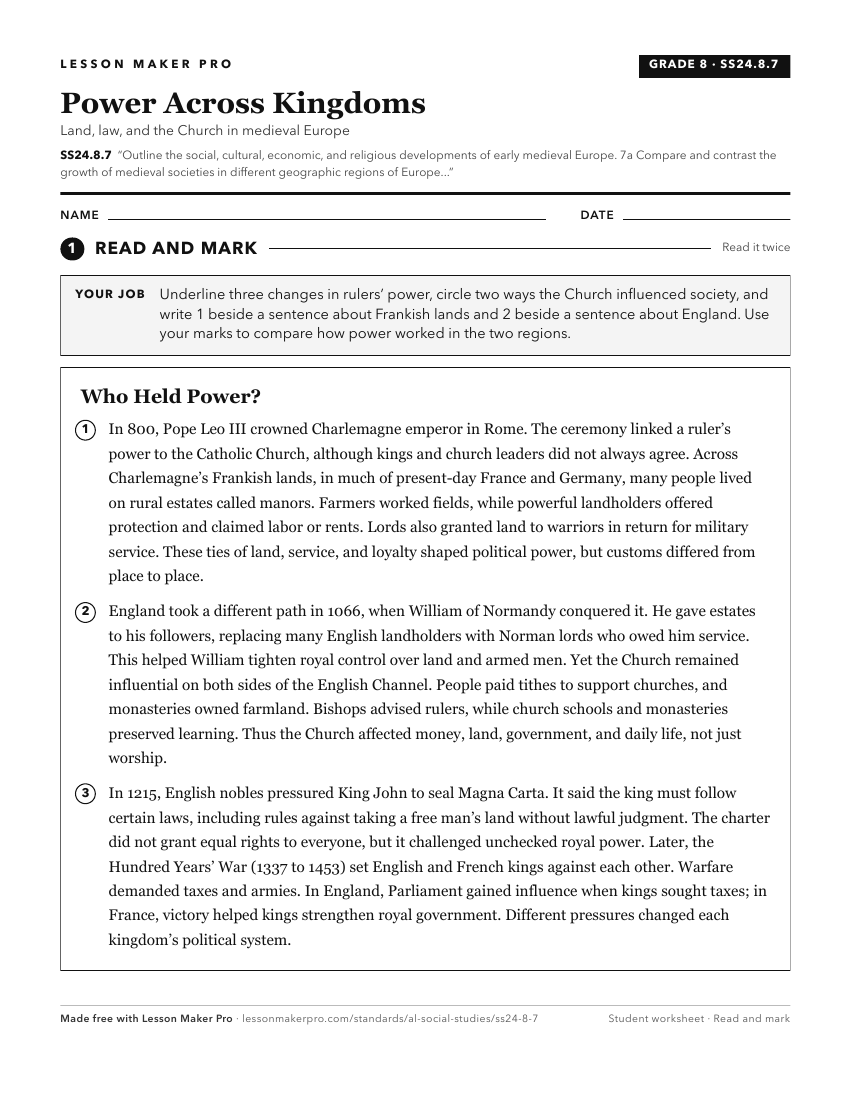
A ready-to-print activity worksheet aligned to SS24.8.7, with an answer key for the teacher on its own page. No account needed.
PDF, US Letter, prints cleanly in black and white.
Download the worksheetKeep exploring
Related Standards
Turn this cluster into a lesson
Grade, subject, topic, and the complete cluster are prefilled. Create one free, no account needed.
Also for this cluster:Make a WorksheetMake a QuizMake a Sub Lesson